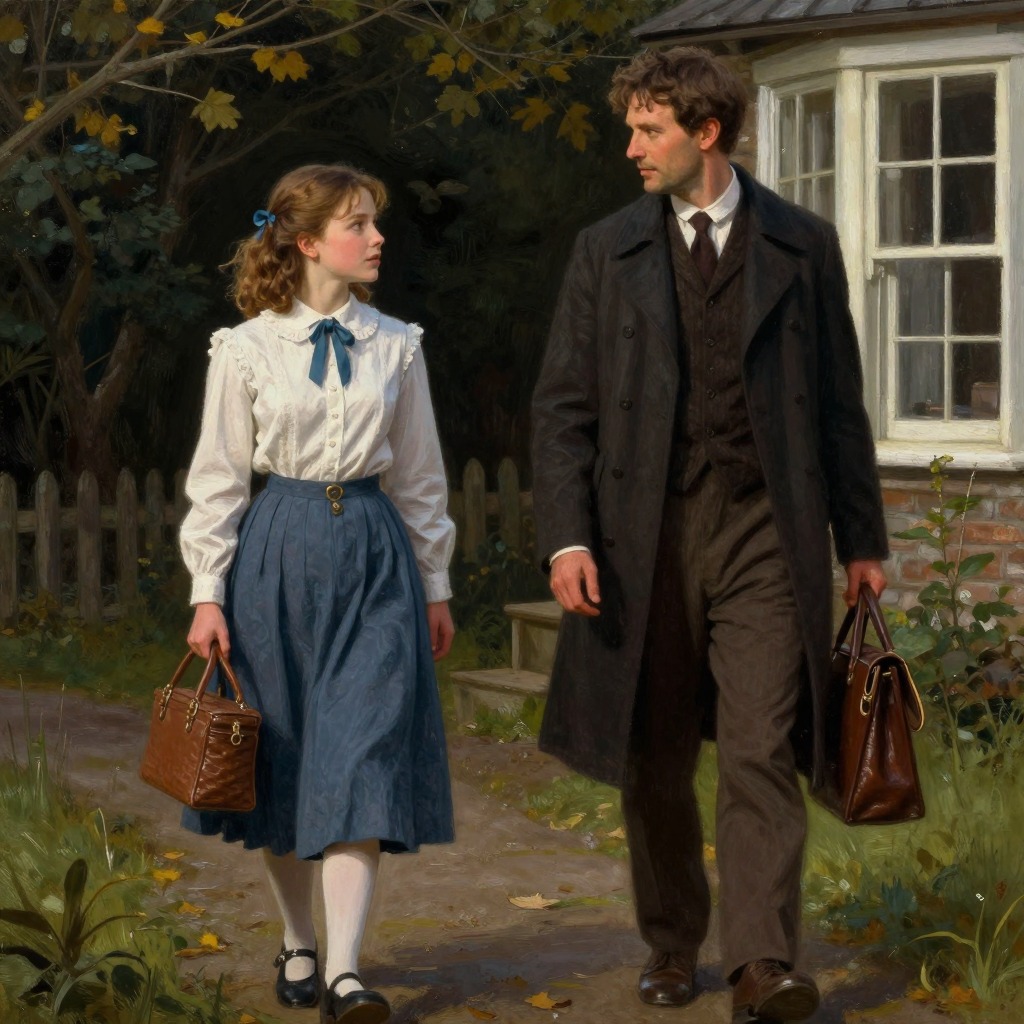
Mrs. Alexander Spencer
Mrs. Alexander Spencer is the neighbor whose errand to the Hopeton orphan asylum inadvertently delivers Anne Shirley to Green Gables, transforming the Cuthberts' plan to adopt a boy into the central event of the novel. A resident of White Sands Cove, she is a benevolent, bustling woman who takes on the task of selecting a child for the Cuthberts and for herself, but her reliance on a secondhand message—passed through her brother Robert and then his flighty daughter Nancy—results in a girl being sent when a boy was requested. This mistake, which Mrs. Spencer learns of only when Marilla Cuthbert arrives at her door to investigate, is the hinge on which the entire story turns; without it, Anne would never have come to Avonlea.
Role in Anne's Arrival
Mrs. Spencer's involvement begins the previous winter, when she visits Green Gables and mentions her plan to get a little girl from the asylum in Hopeton. This conversation plants the idea in Matthew and Marilla's minds, and after months of discussion they decide to ask her to bring them a boy of about ten or eleven. They send word through Richard Spencer's folks at Carmody, and Mrs. Spencer, acting on what she believes are clear instructions, selects Anne and brings her on the train from Nova Scotia. She drops Anne off at Bright River station, intending to continue on to White Sands herself, and gives the child into the stationmaster's charge with the explanation that Mr. and Miss Cuthbert are adopting her. When Matthew arrives expecting a boy, the stationmaster can only report that Mrs. Spencer left a girl and that he has "no more orphans concealed hereabouts."
The Mistake and Its Aftermath
The day after Anne's arrival, Marilla drives to White Sands to confront Mrs. Spencer. Mrs. Spencer meets her at the door of her big yellow house with surprise and welcome, but quickly realizes something is wrong. Marilla explains that they sent word for a boy, and Mrs. Spencer, distressed, traces the error: her brother Robert sent word down by his daughter Nancy, and Nancy said the Cuthberts wanted a girl. Mrs. Spencer's own daughter, Flora Jane, corroborates this, and Mrs. Spencer calls Nancy "a terrible flighty thing" whom she has often had to scold for heedlessness. She apologizes but insists it was not her fault, and Marilla, resigned, admits they should have come themselves rather than leave an important message to be passed along by word of mouth.
Attempt to Place Anne with Mrs. Blewett
Mrs. Spencer, eager to set things right, immediately proposes a solution: Mrs. Peter Blewett was at her house the previous day, wishing she had sent for a little girl to help with her large family. Mrs. Spencer calls this "positively providential" and, when Mrs. Blewett herself appears up the lane, ushers everyone into her parlor—a room so chilled by drawn blinds that it feels deadly cold—and introduces the two women. Mrs. Blewett, a small, shrewish-faced woman, questions Anne sharply and agrees to take her, but Marilla, seeing Anne's pale face and mute misery, cannot bring herself to hand the child over. She tells Mrs. Blewett she will take Anne home and consult Matthew, and if they decide not to keep her, they will bring or send her the next night. This hesitation, born of Marilla's sudden protective instinct, saves Anne from a life of drudgery with a woman who looks "exactly like a—like a gimlet."
Significance
Mrs. Spencer is a minor character who appears only briefly, but her role is structurally decisive. She is the agent of the mistake that brings Anne to Green Gables, and her well-intentioned but careless handling of the message—relying on a chain of oral communication rather than written instructions—reflects the casual, community-based methods of rural life in late-nineteenth-century Prince Edward Island. Her attempt to place Anne with Mrs. Blewett also serves as a crucial test of Marilla's character, forcing Marilla to recognize that she cannot abandon the child to a harsh fate. In the end, Mrs. Spencer's error is not corrected but embraced; as Matthew later reflects, it was not luck but Providence, because the Almighty saw they needed Anne.