Dink Meeker
Dink Meeker is one of the most influential older soldiers Ender Wiggin encounters at Battle School, a toon leader in Rat Army who becomes Ender's mentor and, briefly, his closest confidant. He is distinguished by his exceptional skill in null-gravity combat and his profound skepticism toward the school's authorities, whom he openly calls "the enemy." Dink's role in the novel is to challenge Ender's naive acceptance of the training system, teaching him not only tactical prowess but also the dangerous truth that the adults running Battle School are manipulating the children for their own ends. His arc—from a brilliant but disillusioned soldier who refuses promotion, to a commander who reluctantly accepts it, to a key squadron leader in the real war—mirrors the novel's central tension between individual integrity and the collective demands of survival.
Identity and Background
Dink Meeker is introduced as a member of Rat Army, one of the top-ranked armies at Battle School, where he serves as a toon leader under the flamboyant commander Rose the Nose. He is older than Ender, already in his early teens, and is widely regarded as one of the best soldiers in the school. When Ender is transferred to Rat Army, Dink reveals that he specifically requested Ender for his toon, having watched Ender's practice sessions with the Launchies and recognizing his potential. "I've watched your practice sessions with the Launchies," Dink tells him. "I think you show some promise. Bonzo is stupid and I wanted you to get better training than Petra could give you. All she can do is shoot." This early encounter establishes Dink as a discerning judge of talent and a mentor figure who sees beyond Ender's youth and inexperience.
Dink's background is hinted at through his conversations with Ender. He mentions a brother back home, "a normal guy" who loved girls and flying, and who was teaching him to dribble a ball when Dink was taken to Battle School. This memory underscores the normal childhood Dink was denied, and it fuels his resentment toward the school. He tells Ender, "I was six years old when they brought me here. What the hell did I know? They decided I was right for the program, but nobody ever asked me if the program was right for me." This sense of having been robbed of his youth is central to Dink's character and his later disillusionment.
Role as Mentor and Teacher
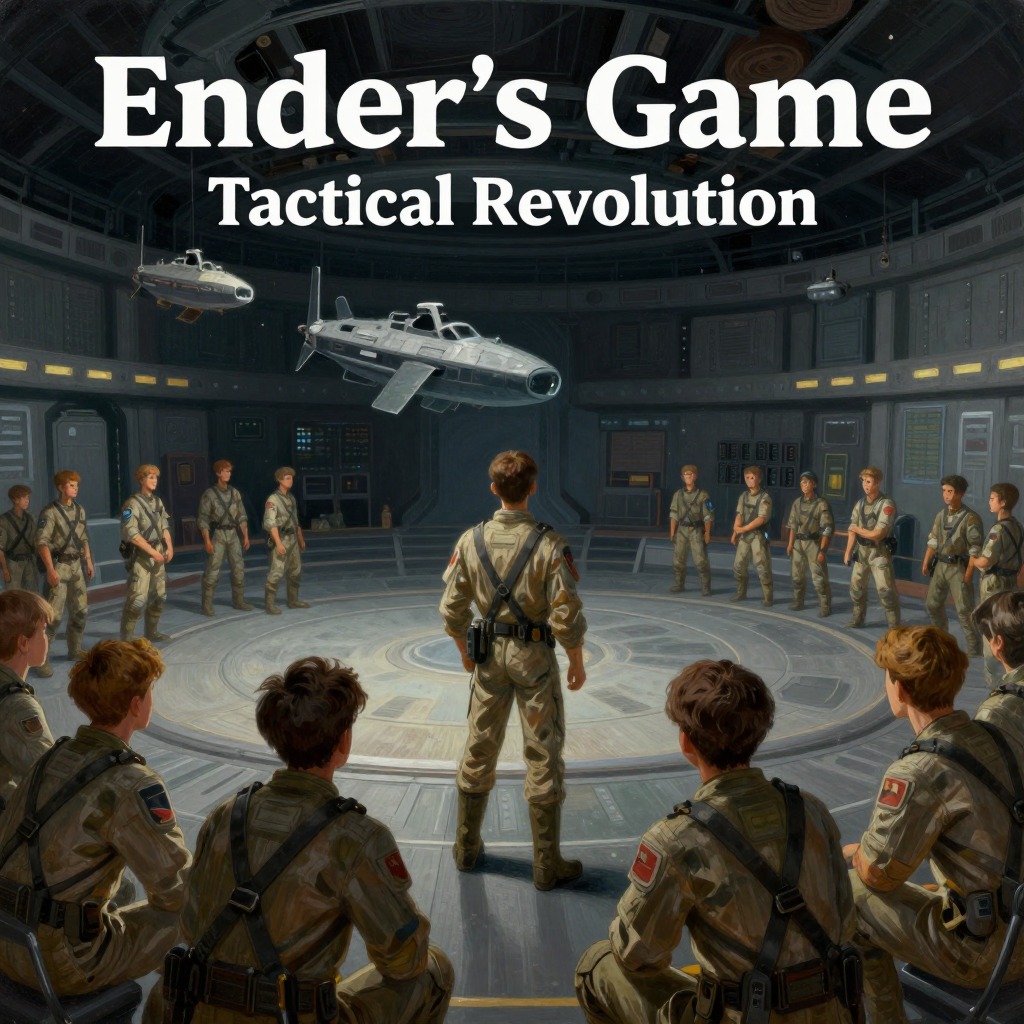
Dink's most significant contribution to Ender's development is his training. He teaches Ender the feet-first attack position, a technique that Ender had already discovered intuitively but that Dink formalizes and drills into his toon. Dink's insistence on this unorthodox method initially makes the other soldiers resent Ender, but they eventually come to appreciate its effectiveness. Dink also introduces Ender to the concept of instant emergence from the corridor, a tactic that revolutionizes Battle School combat after Ender uses it to devastating effect against Centipede Army. Dink's willingness to adopt Ender's innovations and incorporate them into his own training demonstrates his open-mindedness and his commitment to excellence over tradition.
Beyond tactics, Dink imparts a crucial philosophical lesson. He tells Ender, "The other armies, they aren't the enemy. It's the teachers, they're the enemy. They get us to fight each other, to hate each other. The game is everything. Win win win, it amounts to nothing." This warning plants a seed of doubt in Ender's mind that grows throughout the novel, making him more perceptive about the adults' manipulations. Dink also reveals that he has twice refused promotion to commander, explaining, "Because I won't let them do it to me. I can't believe you haven't seen through all this crap yet, Ender." His refusal is a form of resistance against the system that seeks to break children down and rebuild them as tools.
Disillusionment and the Nature of the Game
Dink's most extended conversation with Ender occurs after a practice session, when he explains his philosophy in detail. He argues that the bugger menace is a fabrication, saying, "If the buggers were coming back to get us, they'd be here. They aren't invading again. We beat them and they're gone." He believes the war is a pretext for the International Fleet to maintain power and for certain countries to keep their hegemony. "There is no war," he insists, "and they're just screwing around with us." This conspiracy theory, while ultimately proven wrong, reflects Dink's deep distrust of authority and his recognition that the children are being used. He also warns Ender that a civil war is coming, and that when it does, they will be on opposite sides because of their nationalities—Ender being American, Dink being from the Netherlands under Russian hegemony.
Dink's disillusionment is not merely intellectual; it manifests in his behavior. He is the only soldier who regularly drifts alone in the battleroom, floating in a meditative state that he describes as a way to let the craziness "float out of me, she soak into the walls." This ritual is his coping mechanism, a way to preserve his sanity in an environment designed to break him. He tells Ender, "I be crazy too, little buddy, but at least when I be craziest, I be floating all alone in space and the crazy, she float out of me." This vulnerability makes Dink a sympathetic figure, even as his cynicism threatens to undermine Ender's faith in the mission.
Later Career and the Real War
Despite his refusal to become a commander, Dink eventually accepts the role, succeeding Rose the Nose as commander of Rat Army. This change is noted by Ender, who reflects that "Dink Meeker had finally accepted command and succeeded Rose the Nose in Rat Army's command." The reasons for his change of heart are not explicitly stated, but it suggests that Dink, like Ender, cannot fully escape the system he despises. When Ender becomes commander of Dragon Army, Dink is among the first to congratulate him, though their friendship becomes strained as they become rivals in the game. Dink warns Ender, "You won't beat me," but Ender's victories prove otherwise.
When Ender is transferred to Command School, Dink is revealed to be one of his squadron leaders, along with Alai, Bean, Petra, and others. Ender recognizes Dink's strengths and limitations: "Dink, who deftly carried out instructions but was slow to improvise." Despite this assessment, Dink proves to be a reliable and effective commander in the simulated battles, and he is present for the final, real battle against the buggers. After the war, Dink is among the friends who visit Ender in his recovery, and he reassures Ender, "You don't have to command anybody, but you're always our commander." This moment of solidarity underscores the deep bond that the war has forged among the children, even as it has cost them their innocence.
Thematic Significance
Dink Meeker embodies the novel's critique of the military-industrial complex and the ethical costs of training children for war. His refusal to be a commander is a stand against the dehumanizing process that Graff and Anderson orchestrate, and his eventual acceptance of command represents the inevitability of that process. Dink's warning that "the teachers are the enemy" is a key moment in Ender's development, planting the doubt that ultimately allows Ender to see through the final deception of the Third Invasion. Yet Dink is also a tragic figure, trapped in a system he cannot escape, and his fate—like that of all the children—is to be used as a tool for humanity's survival. His character serves as a foil to Ender, highlighting the difference between those who resist the system and those who, like Ender, are shaped by it into something greater and more terrible.