Mechanical Hound
The Mechanical Hound is a cybernetic hunting machine used by the fire department to track and kill fugitives, serving as the ultimate instrument of state control and the embodiment of technological dehumanization in Fahrenheit 451. It is a creature that "slept but did not sleep, lived but did not live," a paradox of dead and alive, machine and animal, that haunts the firehouse and the narrative alike. More than a mere tool, the Hound represents the logical endpoint of a society that has perfected the art of surveillance, punishment, and the elimination of dissent—a silent, tireless, and nearly infallible enforcer of the status quo.
Design and Nature
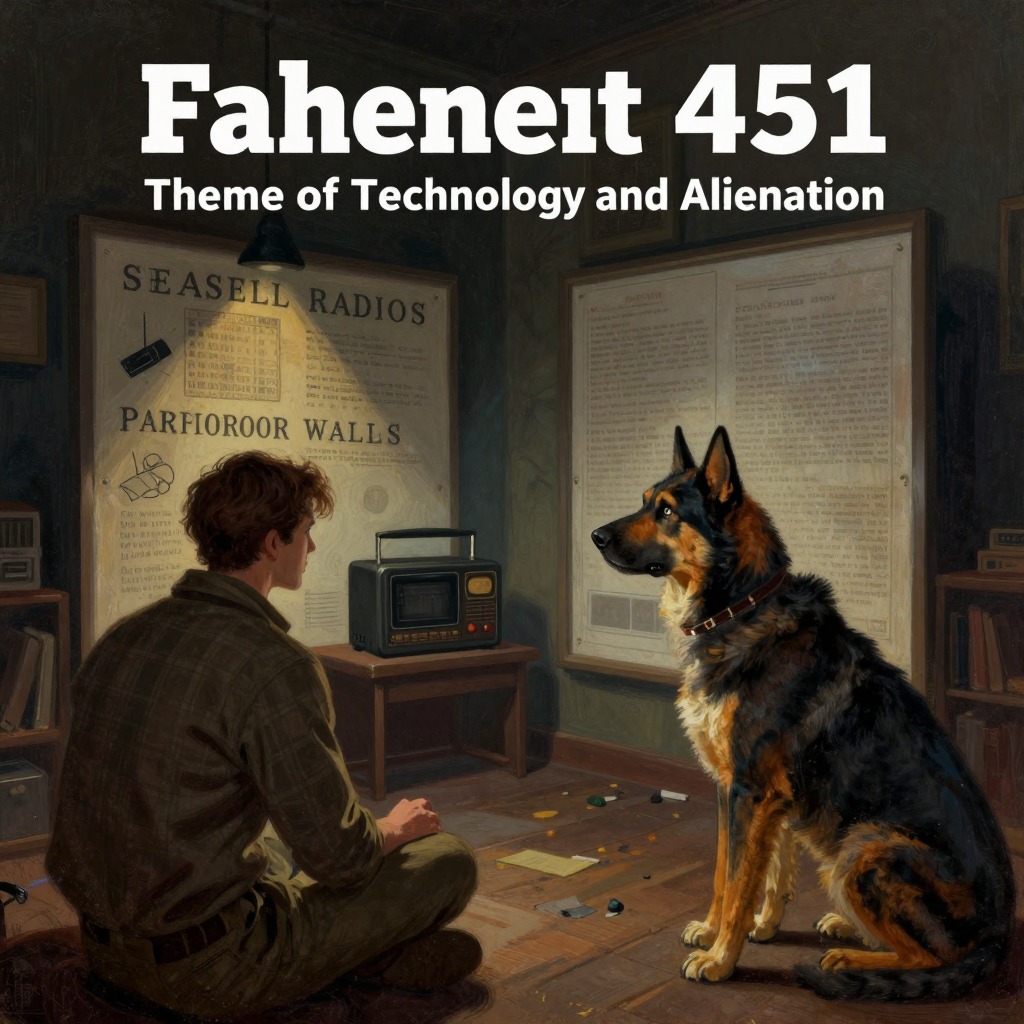
The Mechanical Hound is a complex assembly of copper wire, storage batteries, and electricity, housed in a kennel in a dark corner of the firehouse. Its body is a faintly trembling beast of brass, copper, and steel, with eight spider-like legs on rubber-padded paws, sensitive capillary hairs in its nylon-brushed nostrils, and multi-faceted eyes that glow with green-blue neon light. A four-inch hollow steel needle, capable of injecting massive jolts of morphine or procaine, extends from its proboscis. The Hound's olfactory system can be set to any combination of chemical balances—amino acids, sulphur, butterfat, alkaline—allowing it to remember and identify ten thousand odour-indexes on ten thousand men without resetting. Captain Beatty describes it as "a fine bit of craftsmanship, a good rifle that can fetch its own target and guarantees the bull's-eye every time," emphasizing its function as a perfect, unthinking weapon. Yet Montag senses something more: he wonders what the Hound "thinks about down there nights," and whether it is "coming alive on us, really." This ambiguity—between machine and emergent consciousness—is central to its unsettling power.
Role in the Firehouse
At night, when things grew dull, the firemen would set the Hound's olfactory system and release rats, chickens, or cats into the firehouse area-way, betting on which the Hound would seize first. Within three seconds, the game was done: the animal was caught in gentling paws, the steel needle plunged down, and the carcass tossed into the incinerator. Montag had once participated in these games, losing a week's salary and facing Mildred's anger, but now he stayed upstairs, face turned to the wall, listening to the "whoops of laughter below and the piano-string scurry of rat feet." The Hound's function as entertainment—a carnival of death—mirrors the society's broader consumption of violence as spectacle.
Threat to Montag
The Hound's relationship with Montag is marked by a growing, inexplicable hostility. When Montag touches its muzzle, the Hound growls, half rises, and looks at him with activated eyebulbs, its silver needle extending and retracting. Montag backs away, grabbing the brass pole to escape to the upper level, trembling and green-white. He suspects that someone has set a partial combination of his own chemical balance into the Hound's memory, a suspicion reinforced by the fact that this was not the first time it had threatened him—it had happened twice the previous month. The Hound becomes a constant, invisible presence: Montag senses it outside his house at night, a "faint drift of greenish luminescent smoke, the motion of a single huge October leaf blowing across the lawn." When Beatty confronts Montag at his home, he reveals that he had sent the Hound around Montag's place as a hint. The Hound is thus not merely a tool but a weapon of psychological terror, a reminder that the state's reach is intimate and inescapable.
The Hunt and Destruction
After Montag kills Beatty, the Hound appears on the lawn, moving "with such drifting ease that it was like a single solid cloud of black-grey smoke blown at him in silence." It leaps at Montag from three feet overhead, its spidered legs reaching, the procaine needle snapping out. Montag catches it with a bloom of fire, a "single wondrous blossom that curled in petals of yellow and blue and orange about the metal dog." The fire snaps the Hound up in the air, bursts its metal bones at the joints, and blows out its interior "like a skyrocket fastened to the street." Even as it dies, the Hound manages to stab its needle into Montag's leg, injecting a dose of anaesthetic that numbs his limb. The destruction of the Hound is a violent, cathartic moment, but it also marks Montag's final break from the world of the firemen.
The Media Spectacle
The Hound's pursuit of Montag becomes a national media event. A new Mechanical Hound is brought from another district, and its hunt is followed by camera helicopter, broadcast live on television. The network proudly announces that the "Mechanical Hound never fails" and describes its nose as so sensitive it can remember and identify ten thousand odour-indexes. The hunt is presented as a "big game," a "one-man carnival" for the entertainment of millions. The Hound's movements are tracked on parlour walls across the city, and the police even orchestrate a fake capture, using the Hound to seize an innocent man and present him as Montag to satisfy the audience's demand for a "snap ending." The Hound is thus not only a weapon but a star in the spectacle of state power, its violence packaged and consumed as entertainment.
The Hound as Symbol
The Mechanical Hound embodies the dehumanizing logic of the society it serves. It is a perfect instrument of control: tireless, precise, and utterly without conscience. Yet it also carries a hint of the uncanny, a suggestion that the line between machine and life is not as clear as it seems. Montag's fear of the Hound is not just fear of death but fear of what it represents—a world in which human beings have become objects to be tracked, classified, and eliminated. The Hound's final destruction, and its replacement by a new one, underscores the cyclical nature of this system: the state will always produce new instruments of control, even as individual ones are destroyed. In the end, the Hound is a mirror of the society that created it: cold, efficient, and ultimately hollow.