Mrs. Bowles
Mrs. Bowles is a minor but sharply drawn character in Ray Bradbury's Fahrenheit 451, a friend of Mildred Montag who serves as a living embodiment of the society's hollow, pleasure-driven values. She is a woman who has fully internalized the regime's prohibition on serious thought and emotional depth, and her brief but explosive encounter with Guy Montag reveals the violent defensiveness that lurks beneath the culture's enforced cheerfulness.
Identity and Background
Mrs. Bowles is introduced as one of Mildred's friends who comes to the Montag house for an evening of watching the "parlour families" on the wall-to-wall televisors. She is a woman who has had two children by Caesarian section, not because it was medically necessary—her doctor said she had the hips for a normal birth—but because she insisted on avoiding the pain of natural childbirth. She describes her parenting method with chilling detachment: "I plunk the children in school nine days out of ten. I put up with them when they come home three days a month; it's not bad at all. You heave them into the 'parlour' and turn the switch. It's like washing clothes; stuff laundry in and slam the lid." She admits that her children "would just as soon kick as kiss me," and she responds in kind: "Thank God, I can kick back!" This casual cruelty, presented as a joke, reveals a complete absence of maternal warmth or emotional investment.
Encounter with Montag and the Reading of "Dover Beach"
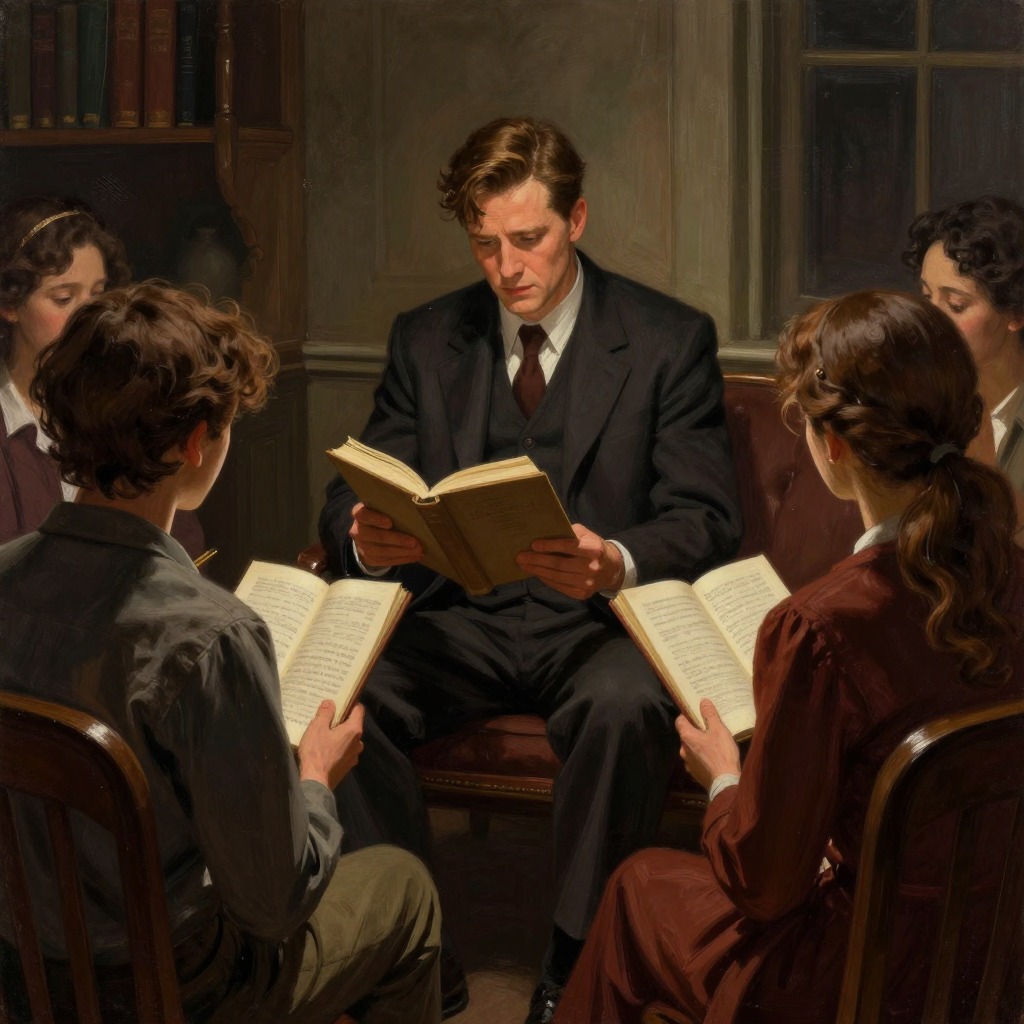
The pivotal scene involving Mrs. Bowles occurs when Montag, increasingly disturbed by his society's emptiness, brings out a book of poetry and reads Matthew Arnold's "Dover Beach" to the assembled women. Mrs. Bowles immediately protests: "As for poetry, I hate it." When Montag asks if she has ever read any, she does not answer. As Montag reads the poem—with its vision of a world "Hath really neither joy, nor love, nor light, / Nor certitude, nor peace, nor help for pain"—Mrs. Phelps begins to cry uncontrollably. Mrs. Bowles's reaction is not empathy but fury. She stands up and glares at Montag: "You see? I knew it, that's what I wanted to prove! I knew it would happen! I've always said, poetry and tears, poetry and suicide and crying and awful feelings, poetry and sickness; all that mush! Now I've had it proved to me. You're nasty, Mr. Montag, you're nasty!" Her response is a perfect illustration of the society's programmed aversion to any art that might provoke genuine emotion or self-reflection.
Montag's Confrontation and Her Departure
After Mrs. Phelps's breakdown and Mrs. Bowles's outburst, Montag turns on the women with a fury that exposes the ugly realities they have been avoiding. He tells Mrs. Bowles directly: "Go home and think of your first husband divorced and your second husband killed in a jet and your third husband blowing his brains out, go home and think of the dozen abortions you've had, go home and think of that and your damn Caesarian sections, too, and your children who hate your guts! Go home and think how it all happened and what did you ever do to stop it?" He then threatens to knock her down and kick her out the door. Mrs. Bowles flees, and the house is left empty. Her departure marks the final rupture between Montag and the world he is leaving behind.
Thematic Significance
Mrs. Bowles functions as a representative of the society's most deeply ingrained pathologies: the refusal to engage with anything that might cause discomfort, the reduction of human relationships to transactional arrangements, and the violent rejection of art that demands emotional honesty. Her hatred of poetry is not a personal quirk but a systemic response—she has been trained to see any art that produces tears or self-examination as a threat to the carefully maintained equilibrium of a pleasure-driven, thought-free existence. In her brief appearance, she encapsulates everything Montag is rebelling against: the emptiness of a life lived entirely on the surface, the cruelty disguised as humor, and the fear that masquerades as contentment. Her character serves as a warning about what happens when a society systematically eliminates the very things—books, reflection, genuine feeling—that make people fully human.