Professor Faber
Professor Faber is a retired English professor who, after decades of fearful silence, becomes the intellectual catalyst and technological ally for Guy Montag's rebellion against the firemen's book-burning society. He represents the surviving conscience of a world that chose to destroy itself, offering not only the philosophical justification for preserving knowledge but also the means—a two-way Seashell radio—to guide Montag through the dangers of his awakening. Faber's arc from cowardice to reluctant courage mirrors the novel's central argument that the preservation of culture requires both the quality of information and the courage to act upon it.
Identity and Background
Faber is a retired English professor who was thrown out of the academic world forty years before the novel's present when the last liberal arts college shut down for lack of students and patronage. He lives alone in a small house, his appearance reflecting his long isolation: he looks very old, fragile, and much afraid, with white in the flesh of his mouth and cheeks, white hair, and faded eyes with white in the vague blueness there. His parlour is nothing but four plaster walls, a deliberate rejection of the immersive television environments that dominate other homes. Faber admits to being a coward who saw the way things were going long ago but said nothing, becoming one of the "innocents who could have spoken up and out when no one would listen to the `guilty,'" but who did not speak and thus became guilty himself. He describes himself as a cowardly old fool, and his hobby—fiddling with electronics and radio transmission—is, he says, proof of his terrible cowardice, a passion that complements the revolutionary spirit living in its shadow.
First Encounter with Montag
A year before the main events, Montag met Faber in a city park. The old man leapt up as if to run when Montag approached, but Montag said "Wait!" and they sat together in the green soft light without speaking for a moment. Faber, trembling, admitted to being a retired English professor. When he finally lost his fear of Montag, he talked in a cadenced voice, looking at the sky and the trees and the green park, and spoke something Montag sensed was a rhymeless poem, then another. Faber held his hand over his left coat-pocket as he spoke these words gently, and Montag knew that if he reached out he might pull a book of poetry from the man's coat, but he did not. Faber told Montag, "I don't talk things, sir. I talk the meaning of things. I sit here and know I'm alive." Before they parted, Faber wrote his address on a slip of paper, saying it was "for your file, in case you decide to be angry with me." Montag kept the address, filing it under "FUTURE INVESTIGATIONS (?)" and neither turning it in nor erasing it.
The Second Meeting and the Green Bullet
When Montag, desperate after the old woman's suicide and his own theft of a Bible, telephones Faber, the professor initially denies any knowledge of surviving books and hangs up, suspecting a trap. But Montag persists, arriving at Faber's house with the stolen Bible. Faber's eyes touch on the book under Montag's arm and he does not look so old any more, nor quite as fragile; slowly his fear goes. He takes the book, turning pages and stopping here and there to read, saying, "It's been a long time. I'm not a religious man. But it's been a long time." He sniffs the book and remarks that books smell like nutmeg or some spice from a foreign land, and that he loved to smell them when he was a boy. Faber then articulates the three things missing from society: quality of information (texture, pores, telling detail), leisure to digest it, and the right to carry out actions based on what one learns. He reveals his secret invention: a small green-metal object no larger than a .22 bullet, a two-way Seashell radio that allows him to sit safely at home and hear and analyse the firemen's world. He inserts one into his own ear and one into Montag's, and his voice speaks directly into Montag's head. Faber admits the device is proof of his cowardice—he is the Queen Bee, safe in the hive, while Montag will be the drone, the travelling ear—but he agrees to guide Montag through his confrontation with Captain Beatty.
Mentorship and Guidance
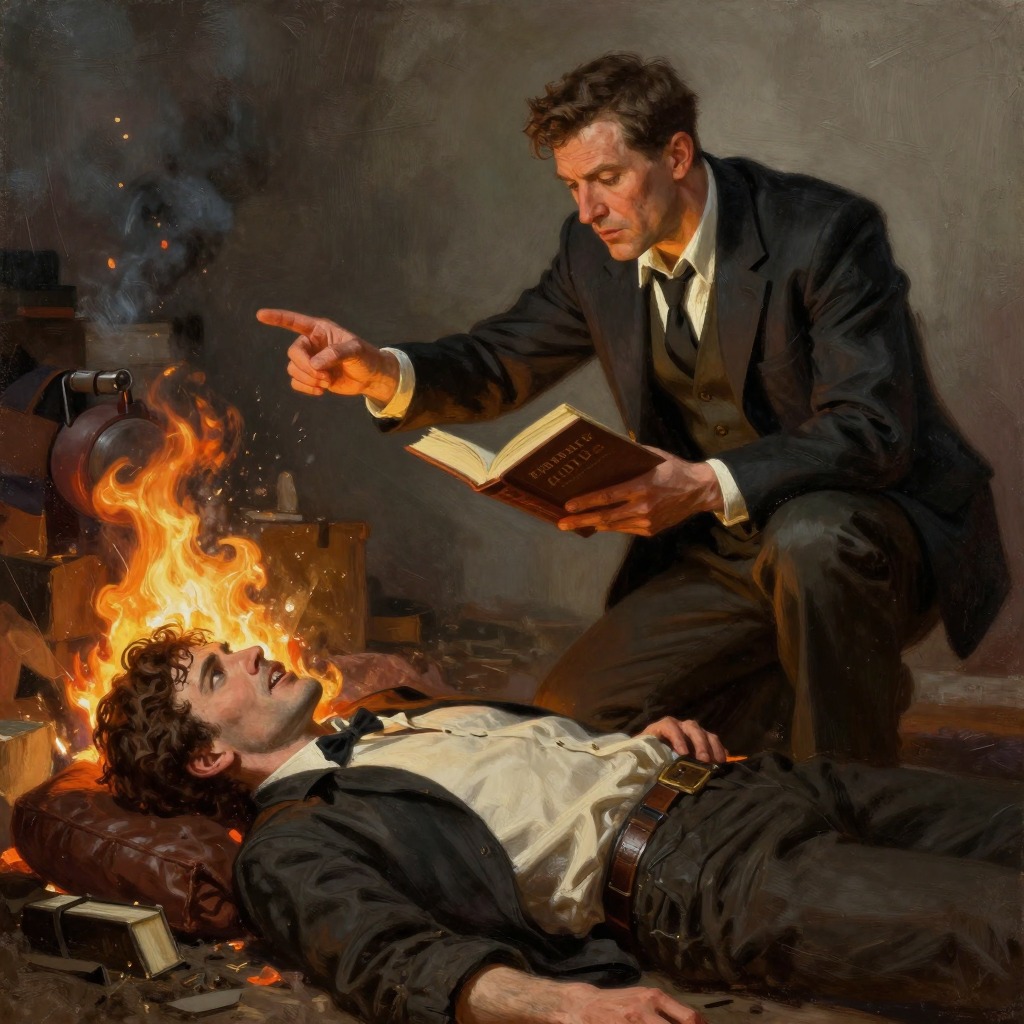
Throughout the night, Faber speaks into Montag's ear, reading from the Book of Job, offering advice, and trying to temper Montag's impulsive rage. When Montag reads "Dover Beach" to the women, Faber pleads with him to stop, warning that he will ruin everything. After the disastrous reading, Faber scolds Montag but also admits that his blind raging invigorated him, making him feel young. He counsels Montag to be careful with Beatty, to let him hear the situation out. When Beatty begins quoting literature to confuse and overwhelm Montag, Faber whispers warnings: "Don't listen. He's trying to confuse. He's slippery. Watch out!" and "He's muddying the waters!" After Beatty's verbal assault, Faber tells Montag that he must take it in and make his own decision, but reminds him that Beatty belongs to "the most dangerous enemy of truth and freedom, the solid unmoving cattle of the majority." When Montag kills Beatty and the Mechanical Hound injects him with procaine, Faber's green bullet falls to the sidewalk and Beatty snatches it up, hearing Faber's distant voice calling, "Montag, you all right?" before switching it off and thrusting it in his pocket, planning to trace it to its owner.
Final Meeting and Parting
After the killing, Montag stumbles to Faber's house. Faber opens the back door and they stand looking at each other in the half-light as if each does not believe in the other's existence. Montag tells Faber he has been a fool all down the line, and Faber replies, "At least you were a fool about the right things." When Montag says he killed Beatty with the flamethrower, Faber sits down and does not speak for a time. But then he says, "I feel alive for the first time in years. I feel I'm doing what I should have done a lifetime ago. For a little while I'm not afraid." Faber tells Montag to head for the river and follow the old railroad tracks out into the country, where there are hobo camps of other fugitive intellectuals. He himself plans to leave on the five a.m. bus for St. Louis to see a retired printer. Before Montag leaves, Faber gives him a valise filled with his dirtiest clothes to confuse the Hound's scent, and they seal it with clear tape. Montag douses the exterior with whisky and they shake hands. Faber says, "Good luck. If we're both in good health, next week, the week after, get in touch. General Delivery, St. Louis." As Montag goes out the back door, he hears the lawn-sprinkling system jump up, washing the sidewalks and draining into the alley, and he thinks he hears the old man call good-bye, but he is not certain.
Thematic Significance
Faber embodies the novel's argument that the preservation of culture requires more than the mere possession of books—it demands quality of information, leisure to digest it, and the courage to act. His self-described cowardice and his invention of the green bullet, which allows him to participate in rebellion from a safe distance, represent the tension between intellectual conviction and personal risk. Yet his final decision to leave for St. Louis and his admission that he feels alive for the first time in years mark a crucial shift: the old man who has hidden for forty years finally steps into the open. Faber's role as the mentor who provides both the philosophical framework and the practical technology for Montag's transformation makes him essential to the novel's vision of how knowledge might survive and be passed on, even in the darkest times.