Robert Walton
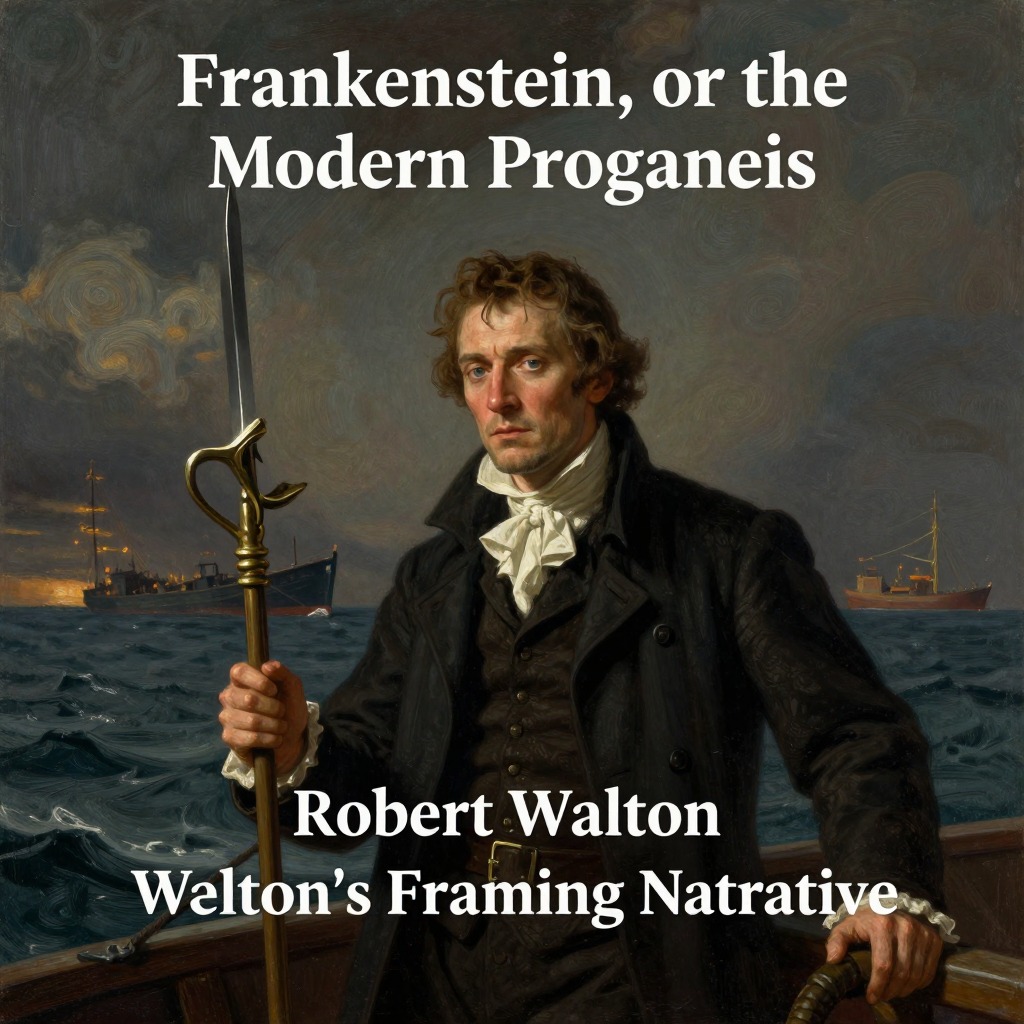
Robert Walton is the ambitious Arctic explorer whose series of letters to his sister, Margaret Saville, opens and closes Mary Shelley's Frankenstein. As the novel's frame narrator, Walton provides the outermost layer of a story-within-a-story structure, encountering Victor Frankenstein in the frozen wastes and becoming the conduit through which the scientist's harrowing confession reaches the reader. Walton's own narrative—his hunger for glory, his loneliness, and his ultimate choice between ambition and prudence—mirrors and comments upon Frankenstein's, making him not merely a passive recorder but a character whose own arc carries the novel's final moral weight.
Identity and Background
Walton is a young English gentleman of twenty-eight, born into a family that discouraged his seafaring ambitions. His father's dying injunction forbade his uncle from allowing him to embark on a maritime life, a prohibition that only deepened Walton's longing. As a child, he devoured his Uncle Thomas's library of voyage narratives, and for a year he attempted to become a poet, nourishing dreams of earning a place beside Homer and Shakespeare. When that ambition failed, an inherited fortune allowed him to return to his earlier bent. He spent six years preparing for his polar expedition, hardening his body by accompanying whale-fishers to the North Sea, voluntarily enduring cold, famine, and sleeplessness, and studying mathematics, medicine, and physical science. Twice he hired himself as an under-mate on a Greenland whaler, acquitting himself so well that his captain offered him the second dignity in the vessel. Despite this practical competence, Walton confesses to Margaret that he is self-educated and, at twenty-eight, feels more illiterate than many schoolboys of fifteen. He is acutely aware of his own romantic temperament, describing a love for the marvellous intertwined in all his projects, and he bitterly feels the want of a friend who could sympathize with him and regulate his mind.
The Arctic Expedition and the Rescue of Frankenstein
Walton's letters trace his journey from St. Petersburgh to Archangel, where he hires a vessel and a crew, and then northward into the polar ice. In his fourth letter, dated August 5th, he records the strange accident that changes his voyage. The ship becomes surrounded by ice, and the crew spots a gigantic figure on a dog-drawn sledge crossing the ice. The next morning, they find a second sledge, with only one dog alive, carrying a European man near death. Walton describes the stranger as the most interesting creature he has ever seen: his eyes express wildness and even madness, yet his countenance lights up with benevolence and sweetness at any act of kindness. The stranger is generally melancholy and despairing, sometimes gnashing his teeth as if impatient of the weight of his woes. Walton nurses him back to health, and the two form an intense bond. Walton begins to love him as a brother, finding in him the friend he had despaired of ever meeting on the wide ocean. The stranger, of course, is Victor Frankenstein, and after several days of convalescence, he agrees to tell Walton his story, warning him that the pursuit of knowledge can become a serpent that stings its seeker.
Walton as Narrator and Moral Witness
Walton resolves to record Frankenstein's narrative as nearly as possible in his own words, making nightly notes. He describes the experience with vivid sensory detail: Frankenstein's full-toned voice swells in his ears, his lustrous eyes dwell on him with melancholy sweetness, and his thin hand rises in animation. Walton's own letters reveal his growing admiration for Frankenstein's noble qualities—his intuitive discernment, his penetrating judgment, his soul-subduing eloquence—even as he witnesses the wreck that misery has made of him. Walton also observes the effect of Frankenstein's story on the sailors, who feel the power of his eloquence and momentarily forget their despair. When a mutiny threatens and the sailors demand that Walton turn south, Frankenstein rouses himself from his sickbed to deliver a stirring speech, calling on the men to be steady to their purposes and firm as a rock, reminding them that the glory of their undertaking lies precisely in its dangers. The speech moves the sailors, but ultimately Walton, unable to lead unwilling men to their deaths, consents to return to England. Frankenstein, too weak to continue his pursuit, dies in Walton's cabin.
Change and Ending
Walton's own arc reaches its climax in the final letters. He has lost his hopes of utility and glory, and he has lost his friend. Yet he does not despair entirely; he resolves to journey towards England and find consolation there. The novel's final scene belongs to the monster, who enters the cabin where Frankenstein's body lies, delivers a long, anguished self-justification to Walton, and then leaps from the cabin window onto an ice raft, vowing to immolate himself on a funeral pyre at the northernmost extremity of the globe. Walton, who had initially felt the duty to destroy the monster, is moved by the creature's eloquence and misery, and he lets him go. The narrative ends with Walton's final words to Margaret, describing the monster borne away by the waves and lost in darkness and distance.
Thematic Significance
Walton functions as a foil to Frankenstein, embodying the same ambition and thirst for glory but ultimately choosing the safety of his crew over the completion of his quest. His letters frame the novel's central questions about the limits of ambition, the dangers of knowledge, and the necessity of human connection. He begins the story longing for a friend and ends it having found one, only to lose him to the very forces he himself narrowly avoids. His final decision to turn south, however prudent, leaves him with a sense of blasted hopes, and his last recorded words are of the monster disappearing into the darkness. Walton thus becomes the reader's surrogate, the one who has heard the full tale and must decide what to make of it, carrying the novel's moral weight into the silence that follows.