Glumdalclitch
Glumdalclitch, the nine-year-old daughter of the Brobdingnagian farmer who first discovers and captures Lemuel Gulliver, is the single most important figure in his survival and emotional stability during his two-year captivity in the giant kingdom. She is not merely a servant but his nurse, teacher, translator, and most loyal friend, a relationship that stands in stark contrast to the exploitative and often dangerous treatment he receives from nearly every other giant. Her name, which Gulliver translates as "little nurse," encapsulates her role: a child who, despite her own small stature for a Brobdingnagian (she is not above forty feet high), becomes the protector of a creature far smaller than herself.
Identity and Introduction
Glumdalclitch is introduced as a child of "toward parts for her age, very dexterous at her needle, and skilful in dressing her baby." It is her mother who first contrives to fit up the baby's cradle for Gulliver to sleep in, placing it in a drawer on a hanging shelf to protect him from rats. From the very beginning, Glumdalclitch takes on the role of his primary caretaker. She makes him seven shirts and other linen, washing them with her own hands, and becomes his schoolmistress, teaching him the Brobdingnagian language by pointing to objects and naming them. She gives him the name "Grildrig," meaning "mannikin," a name that the entire family and eventually the whole kingdom adopt. Gulliver explicitly states, "To her I chiefly owe my preservation in that country. We never parted while I was there; I called her my Glumdalclitch, or little nurse."
Life and Plot Trajectory
Glumdalclitch's life is entirely bound up with Gulliver's fate. When her father, the farmer, decides to exploit Gulliver for profit by exhibiting him in a market-town, she is heartbroken. She weeps with "shame and grief," fearing that rude people will squeeze him to death or break his limbs. She confides in Gulliver that her parents had promised Grildrig would be hers, but she now suspects they will sell him, just as they had sold a lamb the previous year. Despite her distress, she accompanies her father and Gulliver on the journey, riding behind her father on a pillion with Gulliver in a box on her lap. She lines the box with soft cloth and her baby's quilt, and during the grueling ten-week journey to the metropolis Lorbrulgrud, she often takes him out of the box for air, holding him by a leading-string. She continues to instruct him in the language during their leisure hours, carrying a small book from which she teaches him his letters.
Key Actions and Objectives
Glumdalclitch's primary objective is Gulliver's safety and comfort, a mission she pursues with remarkable ingenuity and dedication. When the farmer, seeing Gulliver's health failing, decides to sell him to the Queen of Brobdingnag, Gulliver begs the queen to allow Glumdalclitch to remain as his nurse and instructor. The queen agrees, and the girl is "not able to hide her joy." At court, Glumdalclitch is given her own apartment, a governess, and servants, but the care of Gulliver remains "wholly appropriated to herself." She is constantly vigilant: she stands on a stool near his table at meals to assist him, she takes his bed out every day to air it and makes it with her own hands, and she keeps his set of silver dishes in a silver box in her pocket, cleaning them herself. After the queen's dwarf drops Gulliver into a bowl of cream, it is Glumdalclitch who runs to his relief and pulls him out. When a gardener's dog carries him off in its mouth, she is in "cruel agonies" until he is returned. After the monkey incident, she is "almost distracted" with fear. Her constant care leads her to resolve never to trust him out of her sight again.
Relationships and Conflict
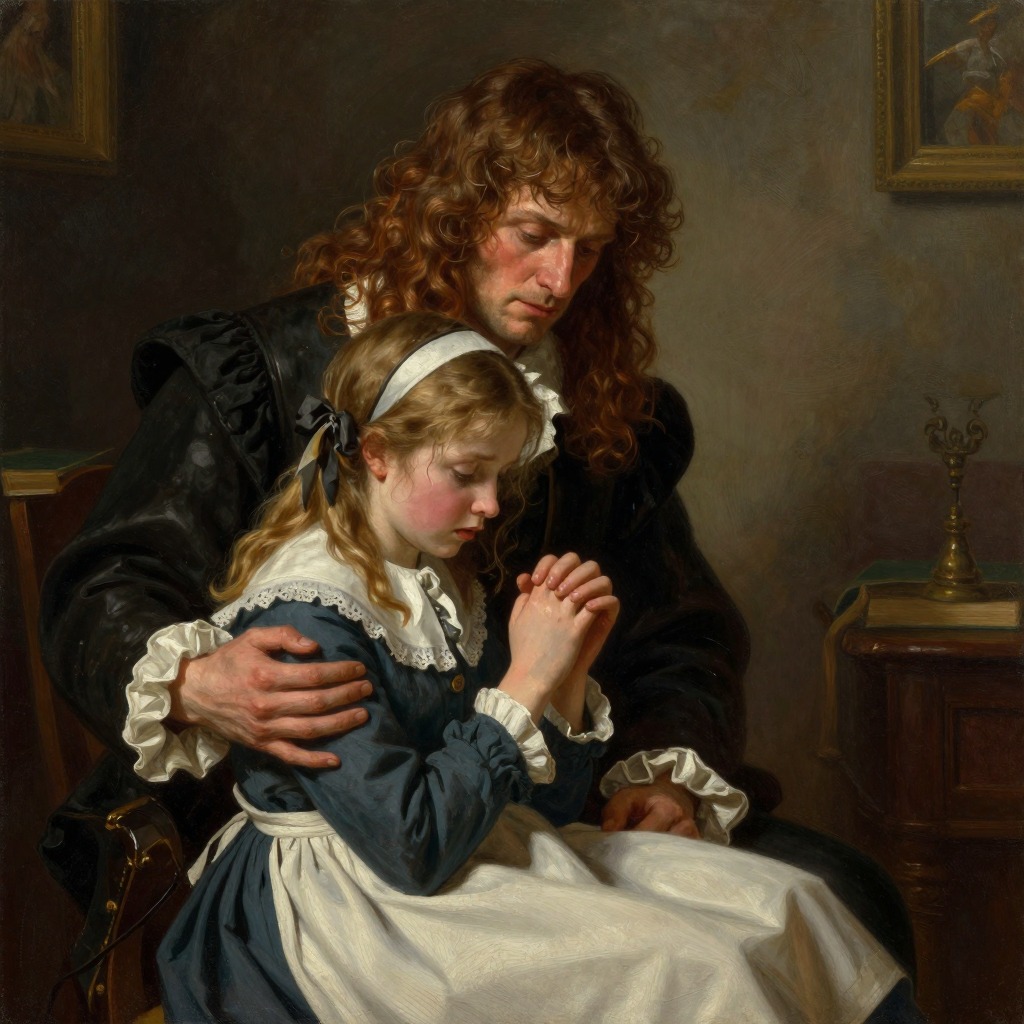
The relationship between Gulliver and Glumdalclitch is one of profound mutual affection and dependence, a stark contrast to the exploitative relationships he has with the farmer and the often dangerous curiosity of the court. Gulliver describes her as "very good-natured" and feels a deep gratitude that he wishes he could requite. She, in turn, loves him "to excess." However, her loyalty creates a subtle conflict: she is also "arch enough to inform the queen" of any folly Gulliver commits that she thinks will be diverting, such as when he falls into a pool of mud. This playful betrayal, while causing him embarrassment, underscores her dual role as both his protector and a child who delights in the court's amusement. Her relationship with her father is also strained by her protective feelings; she is aware that he sees Gulliver primarily as a commodity.
Change and Ending
Glumdalclitch's story ends in heartbreak. Two years into Gulliver's stay, the king and queen make a progress to the south coast. Glumdalclitch falls ill and is confined to her chamber. Gulliver, longing to see the ocean, pretends to be worse than he is and obtains permission to go to the shore with a page. Glumdalclitch consents with great unwillingness, giving the page a strict charge to be careful of him and bursting into a flood of tears, "as if she had some foreboding of what was to happen." An eagle carries off Gulliver's box, which eventually falls into the sea and is rescued by an English ship. Gulliver never sees her again. In his final moments in the box, he wishes himself with his "dear Glumdalclitch," lamenting the grief she would suffer for his loss, the displeasure of the queen, and the ruin of her fortune. Her fate is left unknown, but her devotion is the one unambiguously positive human relationship in Gulliver's entire Brobdingnag adventure.
Narrative Role and Evaluation
Glumdalclitch functions as a crucial narrative and thematic counterweight in the Brobdingnag section. In a land where Gulliver is a helpless curiosity, she provides the only consistent source of kindness, protection, and genuine human connection. Her presence allows Swift to explore the theme of relative scale not just physically but morally: a child in Brobdingnag possesses more compassion and care than the adult giants who either exploit or endanger Gulliver. She is a flat character in the sense that her defining trait is unwavering devotion, but this very flatness makes her a powerful symbol of innocent, selfless love in a world of grotesque proportions and corrupt human nature. Her tearful farewell is one of the most poignant moments in the book, emphasizing the personal cost of Gulliver's relentless, restless journeying.