Mary Burton
Mary Burton is the wife of Lemuel Gulliver, a figure who appears primarily in the background of his narratives, serving as a domestic anchor and a symbol of the ordinary life he repeatedly abandons for his voyages. Her presence in the story is defined by her marriage to Gulliver, her role as a mother, and her function as a point of contrast to his restless, adventurous spirit. Though she rarely speaks or acts directly, her existence shapes Gulliver's motivations and provides a measure of the emotional cost of his travels.
Identity and Background
Mary Burton was the second daughter of Mr. Edmund Burton, a hosier in Newgate Street, London. She brought a portion of four hundred pounds into her marriage with Lemuel Gulliver, whom she wed after he returned from his early voyages and resolved to settle in London. The marriage was arranged following the advice of acquaintances, and Gulliver took part of a small house in the Old Jewry to establish their home. Mary Burton is thus introduced as a woman of respectable but modest means, whose dowry helped Gulliver set up his surgical practice in London.
Life and Plot Trajectory
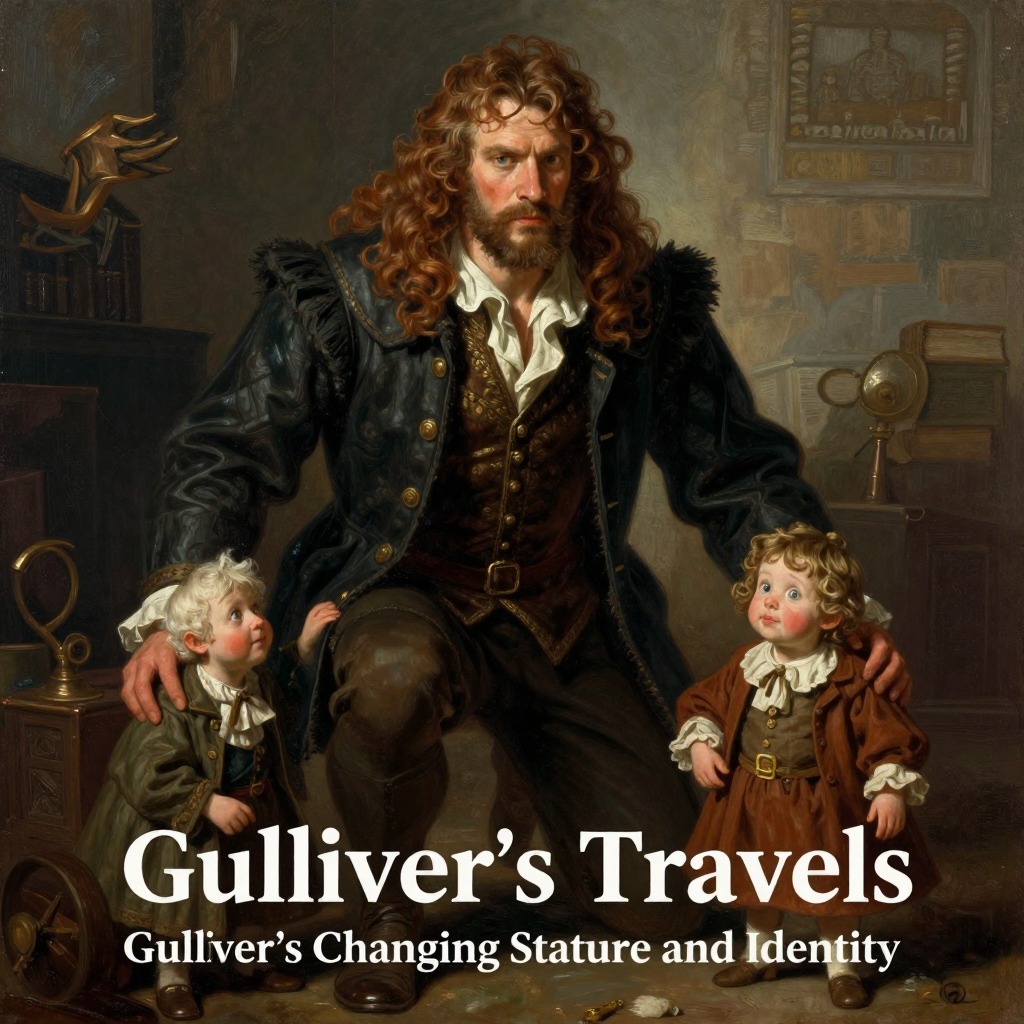
After the death of Gulliver's mentor, James Bates, and the subsequent decline of his medical business, Mary Burton was consulted by her husband about his decision to return to sea. Gulliver records that he "consulted with my wife, and some of my acquaintance" before determining to go again to sea, indicating that she was party to the major decisions affecting their family. During Gulliver's long absences—including his nine-month stay in Lilliput and his two-year sojourn in Brobdingnag—Mary Burton remained at home, managing the household and raising their children. When Gulliver returned from his first voyage, he stayed only two months with his wife and family before his "insatiable desire of seeing foreign countries" drove him to sea again. He left fifteen hundred pounds with her and settled her in a good house at Redriff, demonstrating his concern for her material welfare even as he prioritized his own wanderlust. Upon his return from Brobdingnag, Gulliver found his wife and daughter at home; his daughter Betty was then at her needlework, and his son Johnny was at grammar school. Mary Burton's reaction to his return from Brobdingnag was one of alarm: she ran out to embrace him, but Gulliver, still habituated to the giant scale of Brobdingnag, stooped lower than her knees, thinking she could not reach his mouth. He told her she had been "too thrifty" and had "starved herself and her daughter to nothing," a comment that reflects his distorted perception after his experiences. His behavior was so unaccountable that his family concluded he had lost his wits, echoing the captain's initial assessment. Mary Burton protested that Gulliver should never go to sea any more, but her power to hinder him was insufficient, as the reader learns from his subsequent voyages.
Relationships and Conflict
Mary Burton's relationship with Gulliver is characterized by his repeated departures and her passive endurance. She is the recipient of his financial provisions but not of his sustained presence. After his return from Lilliput, Gulliver stayed only two months with her before embarking on his second voyage, leaving her with fifteen hundred pounds and a house at Redriff. His return from Brobdingnag was marked by a comical and poignant failure of recognition: he could not see his daughter when she knelt for his blessing until she arose, and he attempted to take her up with one hand by the waist, as if she were a Lilliputian. Mary Burton's protest that he should never go to sea again was ultimately futile, underscoring the asymmetry between her domestic desires and his compulsive traveling. She functions as a foil to Gulliver's adventures, representing the stable, ordinary world he continually leaves behind.
Change and Ending
Mary Burton undergoes no personal transformation within the narrative; her role is static, defined by her husband's absences and returns. She remains at home, managing the household and raising their children, while Gulliver's experiences in Lilliput and Brobdingnag transform his perception of scale and humanity. Her final appearance in the text is as a figure of protest against his further voyages, a protest that is noted but not heeded. She thus embodies the domestic sphere that Gulliver both relies upon and repeatedly escapes, a constant in his life of constant change.
Narrative Role and Evaluation
Mary Burton is a minor character whose primary function is to ground Gulliver's extraordinary adventures in a recognizable human context. She provides a measure of his emotional attachments and the costs of his travels, and her reactions to his returns—particularly his distorted perceptions after Brobdingnag—serve to highlight the psychological effects of his experiences. She is a flat character in the sense that she is defined by her role as wife and mother, but her presence is essential to the narrative's exploration of the tension between domestic stability and the lure of the unknown. Her existence also allows Swift to critique the institution of marriage and the gendered division of labor in eighteenth-century England, where women were expected to maintain the home while men pursued their ambitions abroad.