Rubeus Hagrid
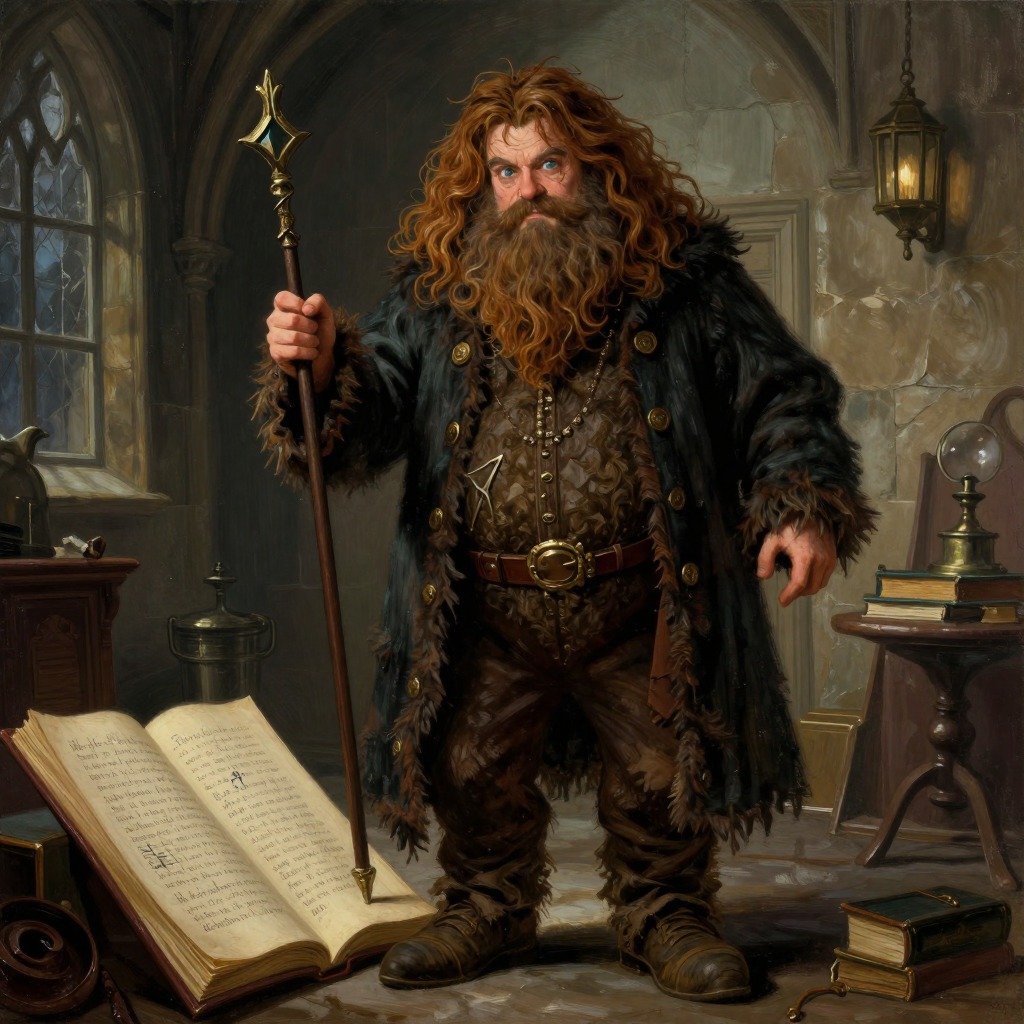
Rubeus Hagrid is the gamekeeper of Hogwarts School of Witchcraft and Wizardry, a towering, wild-haired man whose gentle heart and profound affinity for monstrous creatures make him one of the most beloved and misunderstood figures in the wizarding world. His past is inextricably linked to the novel's central mystery: fifty years before the story's events, he was expelled from Hogwarts, wrongly accused of opening the Chamber of Secrets and unleashing the monster that killed a student. This accusation, and his subsequent arrest in the present day, drive Harry Potter and Ron Weasley's investigation, ultimately revealing that Hagrid was innocent and that the true culprit was Tom Riddle, who would later become Lord Voldemort.
Identity and Background
Hagrid is introduced as a massive, hairy man with beetle-black eyes and a great bristling beard, whose presence fills doorways and whose voice booms. He lives in a small wooden cabin on the edge of the Forbidden Forest, accompanied by his enormous boarhound, Fang. Despite his intimidating appearance, Hagrid is characterized by his warmth, loyalty, and a childlike enthusiasm for all living things, especially those considered dangerous or monstrous. He was expelled from Hogwarts in his third year, a fact he never discusses openly, but which is revealed to be the result of being framed by Tom Riddle for opening the Chamber of Secrets. Riddle, a prefect at the time, caught Hagrid with a large box containing a young Acromantula, which he had been secretly raising in a cupboard. Hagrid's love for the creature, which he named Aragog, led to his downfall, as Riddle used the discovery to pin the blame for the attacks on him.
Life and Role at Hogwarts
As gamekeeper, Hagrid is responsible for the grounds and the creatures that inhabit them, a role he performs with great dedication. He is a constant source of comfort and guidance for Harry, Ron, and Hermione, offering them tea, treacle fudge, and a safe haven in his cabin. His deep connection to the natural world is evident in his care for his giant pumpkins, which he grows for the Halloween feast using an Engorgement Charm, and his distress over the roosters that are mysteriously killed throughout the year. Hagrid's friendship with Aragog, the giant spider he raised from an egg, is a testament to his belief that even the most feared creatures deserve compassion. When Harry and Ron visit the Forbidden Forest seeking answers, Aragog reveals that Hagrid was a good man who protected him, and that he never harmed a human out of respect for his friend. This revelation, while not solving the mystery, proves Hagrid's innocence and highlights his unique ethical stance toward the magical world's outcasts.
The Accusation and Arrest
When the attacks on Muggle-born students resume, suspicion quickly falls on Hagrid due to his past expulsion. Cornelius Fudge, the Minister of Magic, arrives at Hagrid's hut with Dumbledore to take him into custody, despite Dumbledore's firm insistence that Hagrid has his full confidence. Hagrid, terrified, is taken to Azkaban, the wizard prison, leaving his beloved Fang behind. His arrest is a turning point in the novel, as it removes both Hagrid and Dumbledore from the school, leaving the students vulnerable and the mystery unsolved. Hagrid's parting words to Harry and Ron, delivered in a desperate whisper, provide the crucial clue that leads them to the truth: "If anyone wanted ter find out some stuff, all they'd have ter do would be ter follow the spiders." This hint, combined with the spiders' strange behavior, ultimately guides Harry and Ron to Aragog and the revelation that the monster in the Chamber is a Basilisk.
Relationships and Significance
Hagrid's relationships are defined by his unwavering loyalty and his ability to see the good in others, regardless of their reputation. His friendship with Harry is one of mutual trust and affection, with Hagrid serving as a fatherly figure who believes in Harry's innocence without question. His bond with Aragog, forged in his youth, demonstrates his commitment to protecting the vulnerable, even at great personal cost. Hagrid's arrest and subsequent vindication serve as a powerful commentary on the dangers of prejudice and the importance of looking beyond appearances. His innocence is proven not only by Aragog's testimony but also by the eventual discovery that the true Heir of Slytherin was Tom Riddle, who had manipulated events to frame him. Hagrid's story arc reinforces the novel's central theme that one's choices and character, not their blood or reputation, define who they truly are. His return to Hogwarts at the end of the year, celebrated by Harry and Ron, restores a sense of normalcy and justice to the school, and his unwavering faith in the goodness of creatures, even those feared by others, remains one of the most enduring aspects of his character.