Remus Lupin
Remus Lupin arrives at Hogwarts as the new Defense Against the Dark Arts teacher in Harry Potter's third year, a shabbily dressed, exhausted-looking man who nevertheless proves to be the most competent and compassionate instructor the school has seen in that notoriously jinxed post. He is immediately distinguished by his quiet authority, his practical teaching methods, and his deep, personal understanding of the dark forces he teaches students to confront. More than any other teacher, Lupin becomes a mentor to Harry, helping him master the advanced Patronus Charm and, in the process, revealing a hidden connection to Harry's dead father that reshapes Harry's understanding of his own past and identity.
Identity and Hidden Burden
Lupin is introduced on the Hogwarts Express as a man asleep in a compartment, his shabby robes darned in several places, his light brown hair flecked with gray despite his relative youth. Hermione Granger identifies him from the name stamped on his battered case: Professor R. J. Lupin. He is immediately assigned to fill the vacant Defense Against the Dark Arts post, a position rumored to be jinxed after two previous teachers each lasted only a single year. What the students do not know is that Lupin is a werewolf, bitten as a small boy. He was allowed to attend Hogwarts only through the intervention of Headmaster Albus Dumbledore, who had the Whomping Willow planted and the Shrieking Shack built to provide a safe place for Lupin's monthly transformations. Throughout the year, Lupin relies on a complex Wolfsbane Potion, brewed for him by Professor Severus Snape, to retain his human mind during the full moon. This hidden condition explains his frequent illnesses, his pale and exhausted appearance, and the deep self-disgust that colors his interactions with those who know his secret.
Teaching and Mentorship
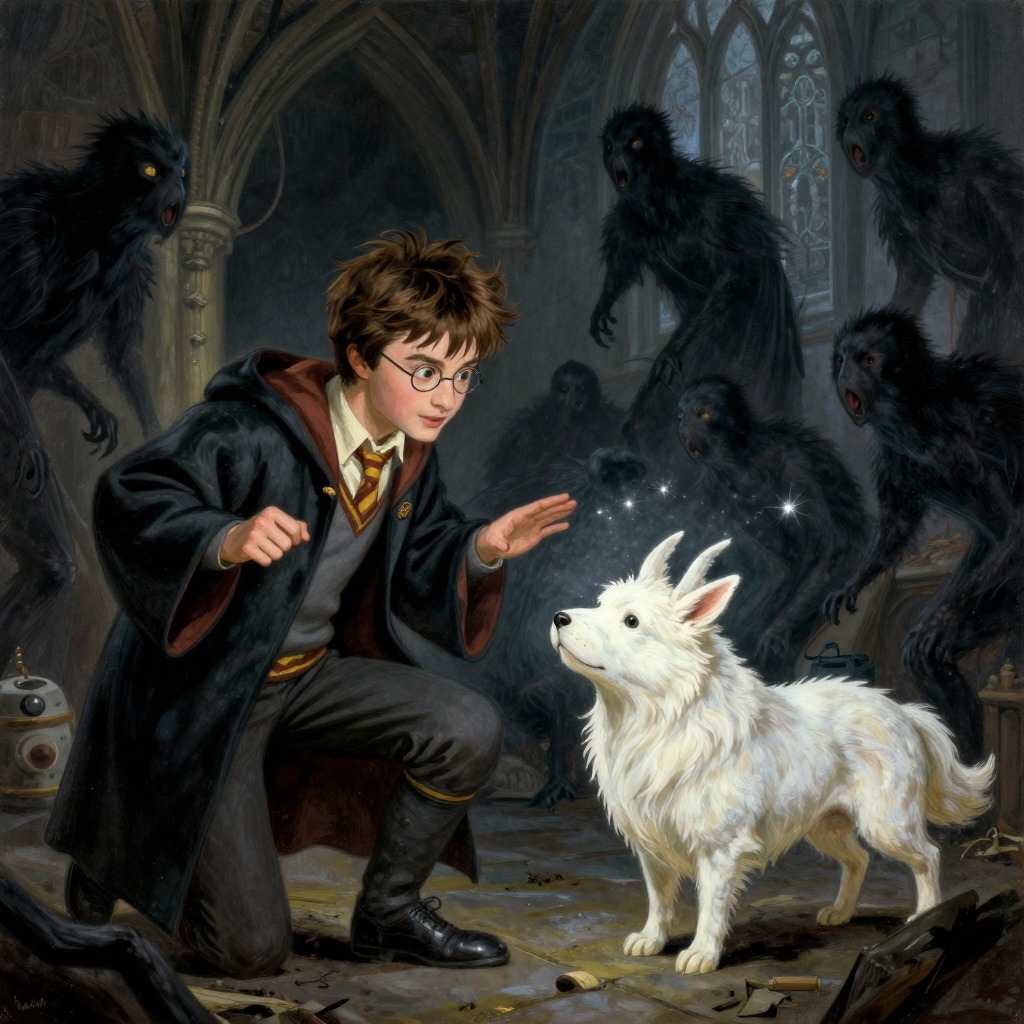
Lupin's teaching style is immediately effective and engaging. His first lesson, on Boggarts, is a practical exercise in the staff room where he teaches the class the Riddikulus charm, forcing the shape-shifting creature to assume a comical form. He deliberately prevents Harry from facing the Boggart, later explaining that he assumed it would take the shape of Lord Voldemort and cause panic. When Harry confesses that he actually feared the Dementors, Lupin responds with profound insight: "That suggests that what you fear most of all is — fear. Very wise, Harry." This moment establishes Lupin's ability to see into Harry's character with unusual clarity. He later takes on the task of teaching Harry the Patronus Charm, a highly advanced piece of magic, to defend against the Dementors that haunt the school. In their private lessons, Lupin reveals that the charm requires concentrating on a single, very happy memory, and he patiently guides Harry through repeated failures, never losing faith in his ability. It is during these sessions that Harry first hears his father's voice, a traumatic but revelatory experience that Lupin helps him process.
The Marauders and the Past
Lupin's past is inextricably linked to Harry's father, James Potter. At Hogwarts, Lupin was one of four close friends who called themselves the Marauders: Moony (Lupin himself), Wormtail (Peter Pettigrew), Padfoot (Sirius Black), and Prongs (James Potter). When his friends discovered he was a werewolf, they did not abandon him. Instead, they illegally became Animagi — James as a stag, Sirius as a dog, and Peter as a rat — so they could keep him company during his transformations. Together, they created the Marauder's Map, a magical document that reveals every person's location within Hogwarts. This shared history means that Lupin knows Sirius Black, the escaped prisoner believed to have betrayed the Potters, as a former friend. When Sirius breaks into the castle, Lupin is torn between his loyalty to Dumbledore and his old friendship. He eventually confronts Sirius in the Shrieking Shack, where the truth emerges: it was Peter Pettigrew, not Sirius, who betrayed the Potters, and Pettigrew has been living for twelve years as Ron Weasley's pet rat, Scabbers.
The Night of Revelation and Transformation
The climax of Lupin's story occurs on the night of Buckbeak's execution. Using the Marauder's Map, Lupin watches Harry, Ron, and Hermione leave Hagrid's hut and sees that they are accompanied by another person — Sirius Black. He follows them into the Shrieking Shack, where he embraces Sirius as a brother and helps force Peter Pettigrew back into human form. However, as the group returns to the castle, the full moon rises and Lupin, having forgotten to take his Wolfsbane Potion, transforms into a werewolf. In his feral state, he attacks Sirius, who transforms into a dog to fight him. During the chaos, Pettigrew escapes. Lupin's transformation is witnessed by Snape, who reveals Lupin's lycanthropy to the entire school the next morning.
Resignation and Departure
Faced with the inevitable backlash from parents and the school community, Lupin resigns his post. He tells Harry that he cannot risk another such incident, and that he understands why parents would not want a werewolf teaching their children. Before leaving, he returns the Invisibility Cloak and the Marauder's Map to Harry, acknowledging that James would have been disappointed if his son had never discovered the castle's secrets. Dumbledore, who has always trusted Lupin, accepts his resignation with regret. Lupin's departure is a profound loss for Harry, who has come to see him as the best teacher he has ever had and a living link to his father.
Thematic Significance
Lupin embodies the novel's central themes of prejudice, hidden identity, and the redemptive power of friendship. His lycanthropy is a metaphor for the stigma that society attaches to those who are different, and his quiet dignity in the face of that stigma makes him a deeply sympathetic figure. His relationship with Harry is built on mutual respect and a shared understanding of loss and fear. By teaching Harry the Patronus Charm, Lupin not only gives him a practical defense against the Dementors but also helps him discover his own inner strength and the legacy of his father. Lupin's departure, while tragic, underscores the novel's message that even the best people are sometimes forced to leave, but that their influence endures. He remains a figure of profound moral complexity: a man who was once a reckless teenager, a loyal friend, a victim of circumstance, and a teacher who changed a boy's life.