Bertha Antoinetta Mason
Bertha Antoinetta Mason is the hidden madwoman confined to the third storey of Thornfield Hall, whose existence as Mr. Rochester's legal wife constitutes the central secret and catastrophic impediment of the novel. Married to Edward Fairfax Rochester in Spanish Town, Jamaica, on October 20th, fifteen years before the main narrative, she is the daughter of Jonas Mason, a West India planter and merchant, and his Creole wife. Her presence, concealed from Jane Eyre and from the world, turns Rochester's attempted second marriage into a legal impossibility and drives the novel's climactic crisis. More than a plot device, Bertha functions as the Gothic embodiment of a repressed colonial and marital past, whose violent eruptions—arson, assault, and self-destruction—shatter the domestic order of Thornfield and force the novel's moral reckoning.
Origins and Marriage
Bertha Mason was the boast of Spanish Town for her beauty: tall, dark, and majestic, in the style of Blanche Ingram. Her family wished to secure Rochester because of his good race, and she flattered him, lavishly displaying her charms and accomplishments. Rochester, dazzled, stimulated, and ignorant, thought he loved her. The marriage was arranged by his avaricious father and his brother Rowland, who knew of the family's hereditary madness but concealed it for the sake of Bertha's thirty-thousand-pound fortune. Her mother was both a madwoman and a drunkard; idiots and maniacs had run through three generations. A younger brother was a complete dumb idiot. Rochester discovered the truth only after the honeymoon: his bride's mother was not dead but shut up in a lunatic asylum. Bertha herself proved to have a nature wholly alien to his—common, low, narrow, coarse, and intemperate. Her vices sprang up fast and rank; she was at once intemperate and unchaste. The doctors eventually discovered that her excesses had prematurely developed the germs of insanity.
Confinement at Thornfield
Rochester conveyed Bertha to England in a fearful voyage, lodging her in the third-storey room of Thornfield Hall, whose secret inner cabinet she made for ten years a wild beast's den and a goblin's cell. He hired Grace Poole from the Grimsby Retreat as her keeper, paying her two hundred pounds a year. Only Grace and the surgeon Carter were admitted to the secret. Bertha had lucid intervals of days or sometimes weeks, which she filled with abuse of Rochester. She was both cunning and malignant, never failing to take advantage of her guardian's temporary lapses. She twice possessed herself of the key of her cell and issued forth at night. On the first occasion, she perpetrated the attempt to burn Rochester in his bed; on the second, she paid a ghastly visit to Jane's chamber, where she took the wedding veil, gazed at it long, threw it over her own head, then rent it in two parts and trampled on them. She also secreted the knife with which she stabbed her brother Richard Mason when he came to see her, biting his flesh and worrying him like a tigress.
The Final Conflagration
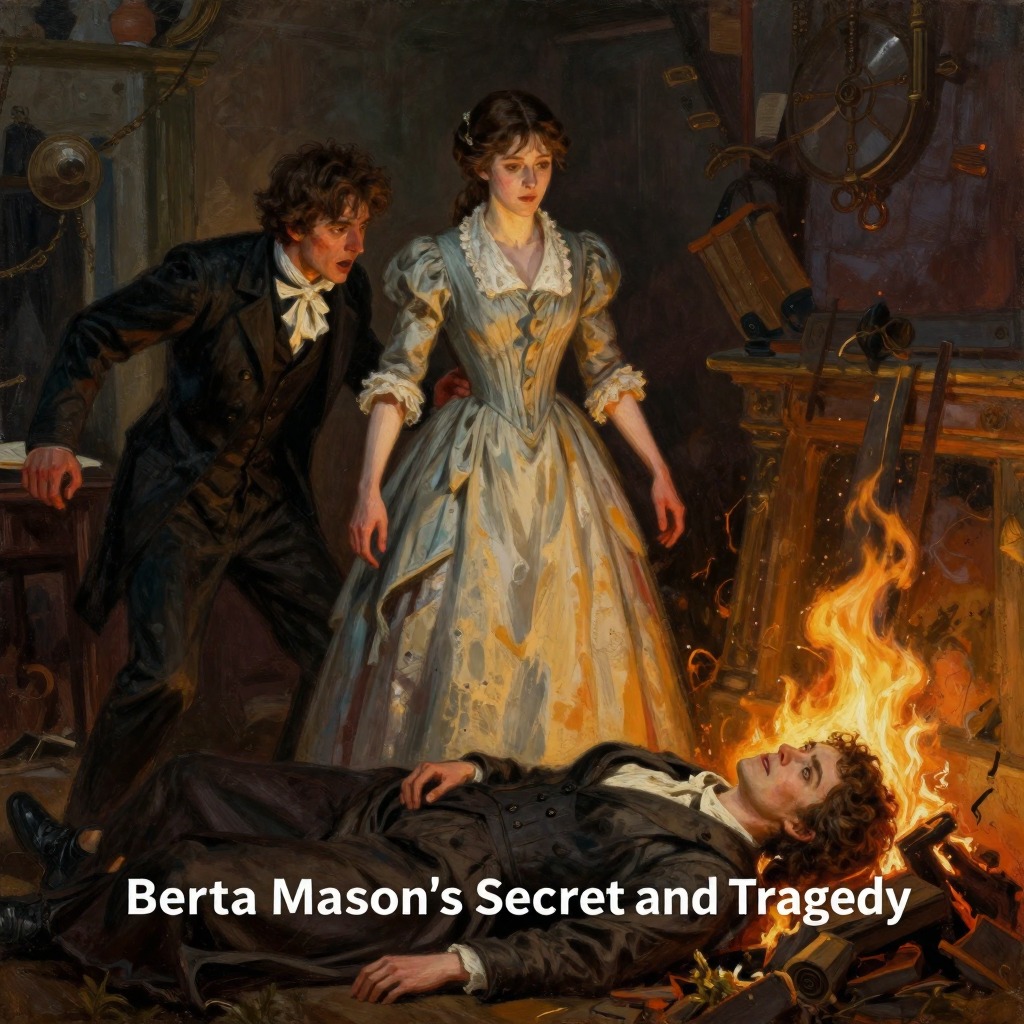
On the night of the fire, Bertha set flame first to the hangings of the room next her own, then made her way to the chamber that had been the governess's and kindled the bed there. When the servants called out that she was on the roof, Rochester ascended through the skylight and approached her. She yelled, gave a spring, and the next minute lay smashed on the pavement, dead as the stones on which her brains and blood were scattered. The house burnt to the ground, leaving only bits of walls standing. Rochester, who had gone back to rescue her, was taken out from under the ruins alive but sadly hurt: a beam knocked out one eye and crushed one hand so that it had to be amputated; the other eye inflamed and lost its sight as well.
Narrative Role and Thematic Significance
Bertha Mason is the novel's most potent Gothic figure—a creature who snatches and growls like a strange wild animal, grovels on all fours, and is described as a clothed hyena, a demon, and a fiend. Yet she is also a figure of profound pathos: a woman trapped in a marriage she did not choose, confined for a decade in a windowless room, and ultimately destroyed by the fire she herself set. Her presence exposes the colonial and patriarchal violence at the heart of the Rochester fortune and the English country house. She is the living impediment that prevents Jane's marriage to Rochester, but she is also, in a deeper sense, the figure who makes possible Jane's moral integrity: it is the discovery of Bertha's existence that forces Jane to flee Thornfield rather than become Rochester's mistress. Bertha's final act of arson and suicide destroys the old order of Thornfield, purges the secret, and—paradoxically—clears the way for Jane's eventual return and marriage to a humbled and blinded Rochester. She is at once the novel's most monstrous and most tragic figure, the repressed that returns with a vengeance and, in returning, transforms the world that tried to hide her.