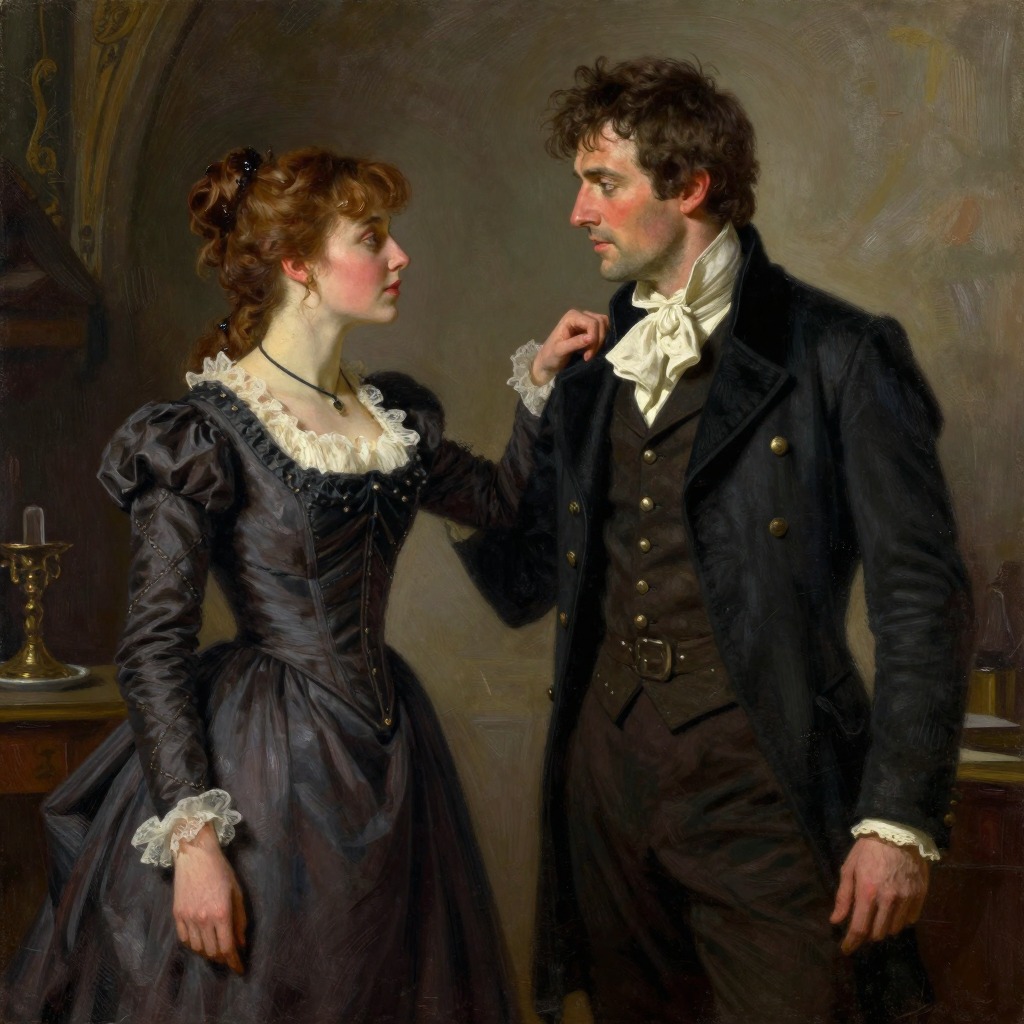
Lady Ingram
Lady Ingram, the Dowager Lady Ingram, is the mother of Blanche Ingram and Mary Ingram, and a central figure among the aristocratic guests who descend upon Thornfield Hall during Mr. Rochester's house party. She embodies the haughty, rigidly class-conscious world of the landed gentry, a world that stands in stark opposition to Jane Eyre's own position as a dependent governess. Her presence at Thornfield serves to crystallize the social and moral chasm that Jane must confront, and her behavior provides a vivid illustration of the prejudices and cruelties that Jane has faced since childhood.
Appearance and Bearing
Lady Ingram is described as a woman of imposing stature and formidable presence. She is tall, with a shape that is still fine for a woman between forty and fifty, and her hair, at least by candlelight, remains black. Her teeth are apparently perfect. Yet her physical attributes are overshadowed by an expression of almost insupportable haughtiness in her bearing and countenance. She has Roman features and a double chin that disappears into a throat like a pillar; these features appear to Jane not only inflated and darkened but even furrowed with pride. Her chin is sustained by the same principle in a position of almost preternatural erectness. She possesses a fierce and hard eye that reminds Jane of Mrs. Reed's, and she mouthes her words in speaking, her voice deep, its inflections very pompous, very dogmatical, and very intolerable. A crimson velvet robe and a shawl turban of gold-wrought Indian fabric invest her, she supposes, with truly imperial dignity. This description, filtered through Jane's keenly observant and critical gaze, immediately establishes Lady Ingram as a figure of intimidating, almost theatrical, arrogance.
Attitude Toward Governesses and Inferiors
Lady Ingram's most revealing moments occur in her open contempt for governesses, a class to which Jane belongs. When the conversation turns to the subject, she declares with pious venom, "My dearest, don't mention governesses; the word makes me nervous. I have suffered a martyrdom from their incompetency and caprice. I thank Heaven I have now done with them!" When Mrs. Dent whispers a reminder that a governess—Jane herself—is present, Lady Ingram responds with a dismissive "Tant pis!" and expresses the hope that her words "may do her good!" She then adds, in a lower tone still loud enough for Jane to hear, "I noticed her; I am a judge of physiognomy, and in hers I see all the faults of her class." This casual, public cruelty is not an isolated outburst but a reflection of her deeply ingrained belief in the natural inferiority of those who work for their living. Her daughter Blanche, echoing her mother's sentiments, recounts with relish the tricks she and her brother Theodore used to play on their governesses, and Lady Ingram fully endorses this behavior, asserting that "liaisons between governesses and tutors should never be tolerated a moment in any well-regulated house." Lady Ingram's worldview is one of absolute hierarchy, where the lower orders are not merely different but inherently deficient and deserving of scorn.
Role in the House Party and the Gipsy Episode
During the charades and entertainments at Thornfield, Lady Ingram is a constant, if often silent, presence. She and Lady Lynn consort in solemn conferences, nodding their two turbans at each other and holding up their four hands in confronting gestures of surprise, mystery, or horror, like a pair of magnified puppets. When the gipsy fortune-teller is announced, Lady Ingram is the first to object, crying out, "Surely, colonel, you would not encourage such a low impostor? Dismiss her, by all means, at once!" She cannot countenance any such inconsistent proceeding. Yet her authority is overruled by her daughter Blanche, who insists on seeing the fortune-teller. Lady Ingram's reaction—wringing her hands and crying "Oh, my best! oh, my dearest! pause! reflect!"—reveals a mother's anxious, if ineffectual, concern for her daughter's dignity. When the gipsy is revealed to be Mr. Rochester in disguise, the episode underscores the limits of Lady Ingram's social power: she can command servants and intimidate governesses, but she cannot control the master of Thornfield.
Significance and Thematic Role
Lady Ingram functions as a foil to Jane Eyre and as a living embodiment of the aristocratic values that Jane must reject. Her pride, her cruelty, and her absolute conviction in the rightness of her social station mirror the attitudes of Mrs. Reed, creating a continuity of oppression that Jane has faced from childhood. Yet Lady Ingram is also a figure of limited power: her authority is confined to the domestic sphere and is ultimately subordinate to the will of men like Mr. Rochester. Her inability to prevent her daughter's disappointment in the marriage market, and her own reduction to a figure of comic pomposity in Jane's narrative, suggest that the system she upholds is itself brittle and hollow. She represents a world that Jane, through her moral integrity and her eventual marriage to Rochester, will transcend, not by becoming like Lady Ingram, but by asserting a different, more authentic form of worth.