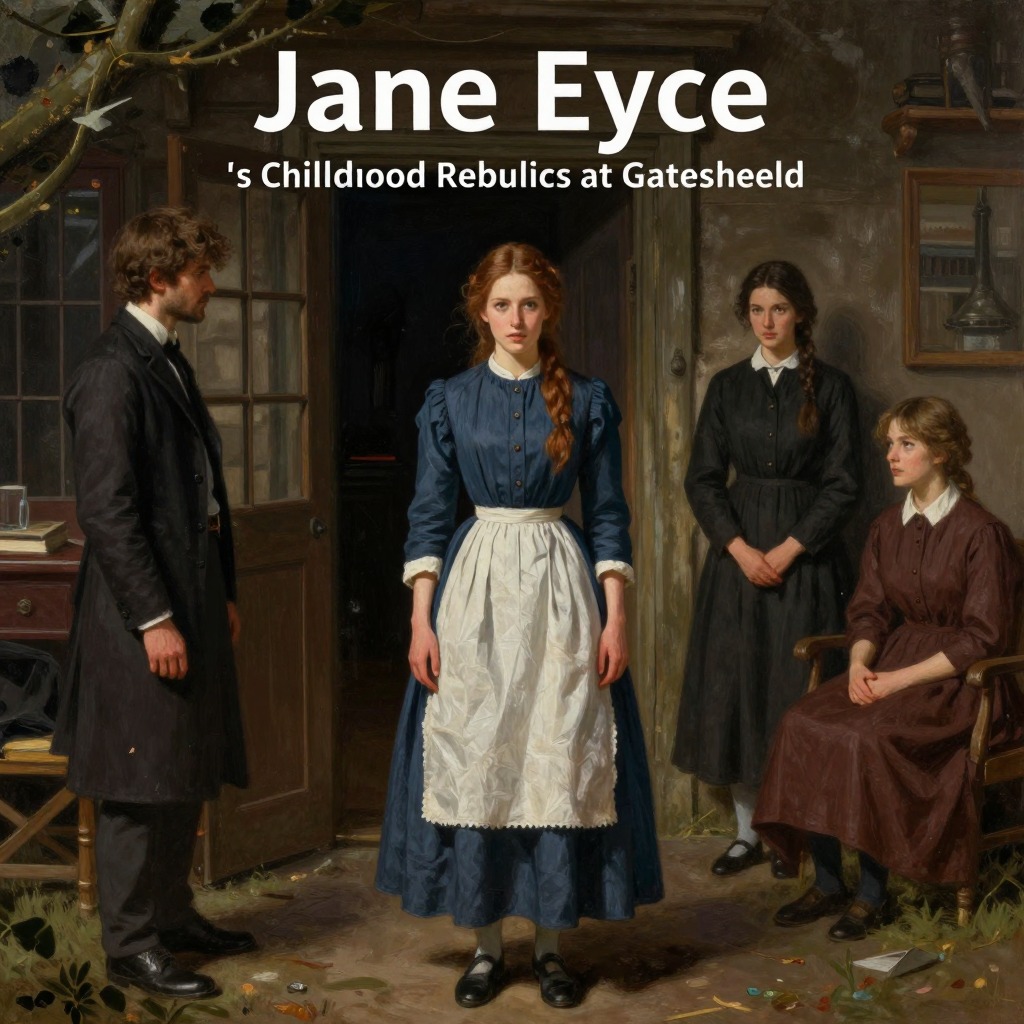
Martha Abbot
Martha Abbot, always referred to as Miss Abbot or simply Abbot by the other servants, is the lady's-maid at Gateshead Hall. She appears almost exclusively in the early chapters of Jane Eyre, where she acts as a secondary enforcer of Mrs. Reed's authority and a vocal exponent of the household's view of Jane as a morally defective interloper. Her function is to give voice, in the bluntest terms, to the class contempt and religious condemnation that structure Jane's childhood oppression.
Role in Jane's Imprisonment and the Red-Room Incident
Abbot is one of the servants who physically subdues Jane after the violent confrontation with John Reed. When Jane resists being taken to the red-room, Abbot holds her arms and calls her "a mad cat" . She then participates in the preparation to tie Jane down, offering her garters as bonds when Bessie fears her own will break . Throughout the scene, Abbot articulates the household's official judgment of Jane's character, telling Bessie that Jane's outburst was "always in her" and that she is "an underhand little thing" with "so much cover" for her age . When Jane is locked in the red-room, Abbot warns her that God will punish her, possibly striking her dead in the midst of her tantrums, and that "something bad might be permitted to come down the chimney and fetch you away" if she does not repent . This threat, blending religious terror with folk superstition, deepens Jane's psychological ordeal.
Later, when Jane's screams bring Bessie and Abbot running, Abbot dismisses the episode as a deliberate trick, declaring that Jane "screamed out on purpose" and that she knows her "naughty tricks" . She thus frames Jane's genuine terror as manipulative performance, a reading that Mrs. Reed eagerly adopts.
Articulating Jane's Social Inferiority
Abbot is the most explicit voice of the class ideology that defines Jane's place at Gateshead. When Jane asks, "Am I a servant?" Abbot replies, "No; you are less than a servant, for you do nothing for your keep" (E00077–E00078). She later tells Jane that she must not think herself on an equality with the Reed children, because they will have money and Jane will have none: "it is your place to be humble, and to try to make yourself agreeable to them" . These statements crystallize the logic of dependency that makes Jane's position at Gateshead so precarious: she is neither family nor servant, but a tolerated burden whose only value lies in submissive gratitude.
Commentary on Jane's Appearance and Prospects
After Mr. Lloyd's visit, when Bessie expresses pity for Jane, Abbot dismisses the sentiment: "if she were a nice, pretty child, one might compassionate her forlornness; but one really cannot care for such a little toad as that" (E00229–E00230). She contrasts Jane unfavorably with Georgiana Reed, declaring that "a beauty like Miss Georgiana would be more moving in the same condition" . Abbot's preference for Georgiana is emphatic: "I doat on Miss Georgiana! Little darling!—with her long curls and her blue eyes, and such a sweet colour as she has; just as if she were painted!" . This comparison reinforces the novel's theme of how physical appearance governs the sympathy a child receives.
Role in Jane's Departure for School
Abbot is also the source of the information that finally explains Jane's orphaned condition. In a conversation with Bessie that Jane overhears, Abbot reveals that Jane's father was a poor clergyman, that her mother married him against her family's wishes and was disinherited, and that both parents died of typhus within a month of each other . Abbot then speculates that Mrs. Reed is "glad enough to get rid of such a tiresome, ill-conditioned child, who always looked as if she were watching everybody, and scheming plots underhand," giving Jane "credit for being a sort of infantine Guy Fawkes" . This assessment, though harsh, confirms Jane's sense that she is being sent away not for her own benefit but because her presence has become intolerable.
Significance
Martha Abbot functions as the voice of the Gateshead establishment's most unsoftened judgment of Jane. Where Bessie occasionally shows kindness, Abbot never relents; she embodies the household's conviction that Jane's poverty, plainness, and rebellious spirit make her not merely an inconvenience but a moral danger. Her role is to make explicit the social and religious arguments that justify Jane's exclusion, giving the reader a clear target for the novel's critique of how the powerful rationalize their cruelty toward the dependent.