Jones
Jones is a shadowy but decisive figure in Nineteen Eighty-Four: one of the three last surviving leaders of the original Revolution to be purged in the 1960s, he appears in the novel only as memory, rumour and a single piece of dated print. His staged confession and rehabilitation, his re-arrest and execution, and above all the photograph that proves his innocence give Winston Smith his one concrete proof that the Party rewrites the past.
Identity and Historical Background
Jones belonged to a founding generation of the Party that was eliminated wholesale in the middle sixties, when the original leaders of the Revolution were wiped out once and for all; by 1970 only Big Brother remained. He was among the last survivors, and in 1965 he, Aaronson and Rutherford were arrested together. After vanishing for a year or more they were brought forth to incriminate themselves in the usual way, and confessed to intelligence with the enemy — at that date Eurasia — to embezzlement of public funds, to the murder of trusted Party members, to intrigues against Big Brother's leadership alleged to have begun before the Revolution, and to acts of sabotage causing the death of hundreds of thousands of people. The Party then pardoned them, reinstated them and gave them sinecures that sounded important, and all three wrote long, abject articles in the Times analysing the reasons for their defection and promising to make amends.
The Chestnut Tree Café
Some time after their release Winston saw all three in the Chestnut Tree Café, the ill-omened haunt of painters and musicians where discredited Party leaders had gathered before their final purges. Watching them out of the corner of his eye, he felt a terrified fascination: they were relics of the ancient world, almost the last great figures of the Party's heroic early days, and at the same time outlaws doomed to extinction, corpses waiting to be sent back to the grave. They sat in silence over the clove-flavoured gin that was the café's speciality, a chessboard beside them with the pieces set out but no game started. When the telescreen played "Under the spreading chestnut tree", with its rhyme of mutual betrayal — "I sold you and you sold me" — Rutherford's ruinous face filled with tears, and Winston noticed for the first time that Aaronson and Rutherford had broken noses.
The Photograph and the Discovery
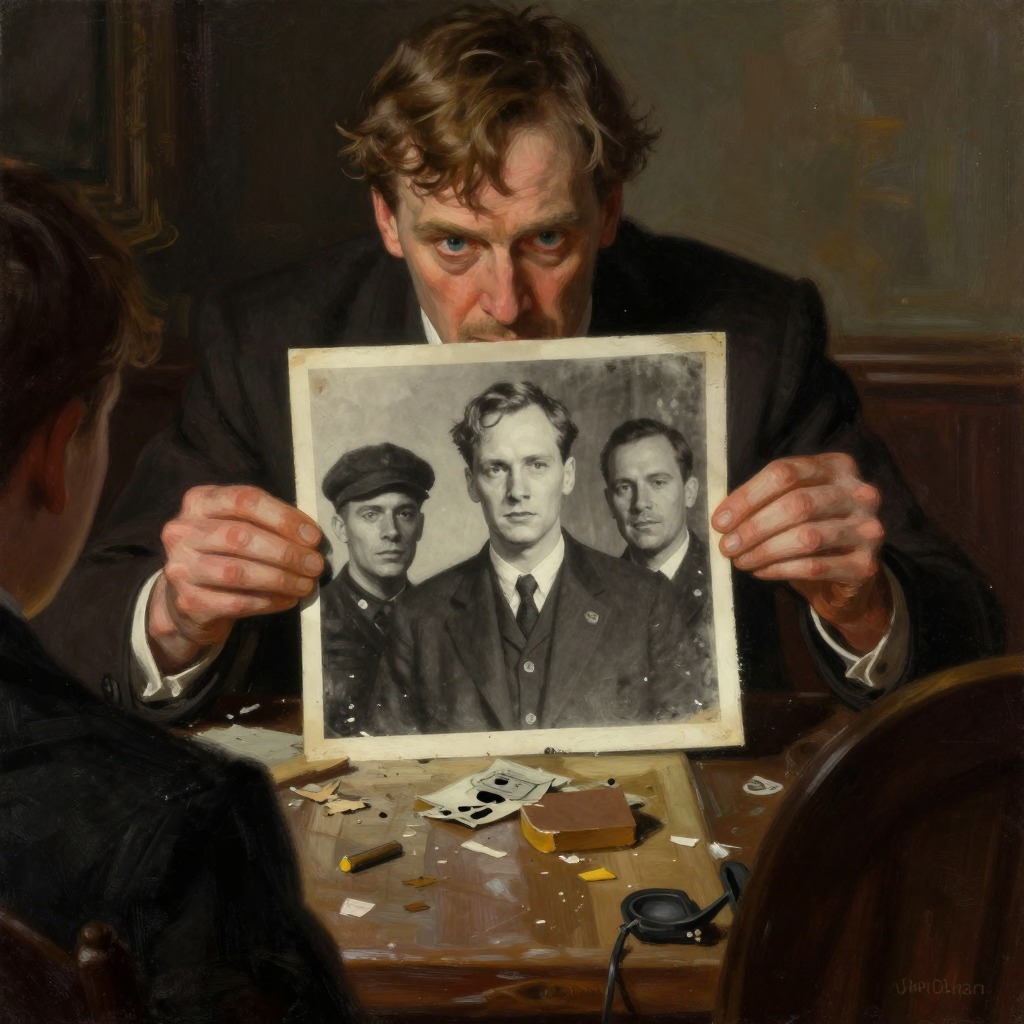
About five years after the executions, in 1973, Winston unrolled a wad of documents in the Ministry of Truth and found a half-page torn from an issue of the Times some ten years earlier; the top half of the page, including the date, carried a photograph of delegates at a Party function in New York, with Jones, Aaronson and Rutherford prominent in the middle and named in the caption. The point was devastating. At both trials the three men had confessed that on exactly that date they had been on Eurasian soil, having flown from a secret airfield in Canada to a rendezvous in Siberia to confer with the Eurasian General Staff and betray military secrets; the date, which Winston remembered, chanced to be midsummer day. There was only one possible conclusion: the confessions were lies. Winston covered the photograph, waited ten minutes in terror that the telescreen would pick up his heartbeat, and dropped it into the memory hole. Years later he reflected that if the same evidence had come to him again he would have kept it, though the war had by then been re-aligned and the confessions re-written so often that even a resurrected photograph might no longer prove anything.
Aftermath and O'Brien's Confession
Jones's end was converted into a Party legend and then into a lesson in conversion. In the Ministry of Love, during Winston's re-education, O'Brien revealed that he himself had taken part in the interrogation of the three traitors, describing how they were worn down until they wept not with pain or fear but with penitence, left as shells of men whose only remaining contents were sorrow for their crimes and love of Big Brother. They begged to be shot quickly, O'Brien said, so that they might die while their minds were still clean. Later, testing Winston's grasp of reality, O'Brien produced another copy of the New York photograph, held it before him for perhaps five seconds, and then dropped it into a memory hole. "It does not exist. It never existed," he said — and Winston could not be certain whether the denial was a lie or a genuine act of doublethink.
Narrative Role and Thematic Significance
Jones matters less as a person than as the novel's clearest demonstration that the past is a manufactured article. The Ministry of Truth exists to deny memories and rewrite records, so that a prediction can be made to match an event, a promise can be erased, and a life can be abolished and forgotten; the photograph is what Winston experiences as a fragment of the abolished past, like a fossil bone that turns up in the wrong stratum and destroys a geological theory — evidence strong enough to blow the Party to atoms if it could only be published. That it cannot be published is the point. The same mechanisms that could announce an increase in the chocolate ration the day after a cut to that same figure had been announced, and that channel the rage of the Two Minutes Hate from one enemy to another, also govern Jones's memory: doublethink makes it possible to know the confessions were lies and to accept the official version at the same time. Winston's own suppression of the photograph, and O'Brien's denial of its duplicate, complete the cycle: Jones was erased once by execution, and again whenever the evidence of his innocence is declared never to have existed.