Syme
Syme, a small, protrusive-eyed Newspeak philologist from the Research Department, is one of the sharpest intellectual presences in the early chapters of Nineteen Eighty-Four. As part of the team compiling the Eleventh Edition of the Newspeak Dictionary, he speaks with fierce joy about the destruction of words and the shrinking of mental horizons, only to vanish from the novel without warning, his name struck from a committee list as though he had never existed. His arc condenses the novel's deepest paradox about the Party: it consumes the very servants who serve its ideology most purely.
Identity and Background
Syme first appears in the crowded underground canteen, where Winston Smith meets him in the lunch queue. The narration calls him Winston's 'friend', then immediately qualifies the term: you did not have friends nowadays, you had comrades, though some comrades were pleasanter company than others. Syme was smaller than Winston, with dark hair and large, protuberant eyes, at once mournful and derisive, that seemed to search your face closely while he spoke. He worked in the Research Department and was a specialist in Newspeak, indeed one of the enormous team of experts engaged in compiling the Eleventh Edition of the Newspeak Dictionary. When Winston asks how the Dictionary is getting on, Syme brightens at once, and his answer shows how completely the language project has absorbed him. He can even rebuke Winston for writing in Oldspeak and failing to appreciate the beauty of word-destruction.
The Apostle of Newspeak
Sym's most striking contribution is his exposition of what Newspeak is for. Over a canteen lunch he tells Winston that the team's chief job is not inventing new words but destroying them: scores, hundreds every day, cutting the language down to the bone. In the perfected version every concept will be expressed by exactly one word, rigidly defined, with all subsidiary meanings rubbed out and forgotten. In a world where 'good' exists but 'bad' has been replaced by 'ungood', the range of thought narrows until thinking itself becomes unnecessary. Syme identifies the language with the ideology itself: Newspeak is Ingsoc and Ingsoc is Newspeak. He even predicts that by 2050, not a single living person will understand the kind of conversation he and Winston are having.
The appendix 'The Principles of Newspeak' confirms what Syme describes. Newspeak was devised to make heretical thought literally unthinkable, by eliminating undesirable words and stripping the surviving ones of all unorthodox meanings. Its vocabulary grows smaller every year, not larger, and a word like 'free' survives only in such usages as free from lice or free from weeds. Syme, as a compiler of the Dictionary, is an active agent of this reduction. Yet the same ideological purity that makes him valuable also makes him vulnerable: his intelligence, his habit of saying things better left unsaid, and his fondness for the Chestnut Tree Café all mark him as a person the Party will not tolerate for long.
Relations with Winston Smith
In the canteen Syme's conversation oscillates between the technicalities of Newspeak and a gloating orthodoxy. In an intellectual way he is venomously orthodox, taking a disagreeable satisfaction in helicopter raids on enemy villages, the trials and confessions of thought-criminals, and the executions in the cellars of the Ministry of Love. Winston is drawn to him but watches him with dread, reflecting that one of these days Syme will be vaporized: he is too intelligent, sees too clearly and speaks too plainly; the Party does not like such people, and one day he will disappear; it is written in his face.
The chocolate-ration incident sharpens the point. When the Party announces that the ration has been raised to twenty grammes a week, although only the day before it had announced a reduction to twenty grammes, Winston watches the others swallow the contradiction. Parsons swallows it with animal stupidity; the eyeless creature at the next table swallows it fanatically; but Syme, in some more complex way, involving doublethink, swallows it too. Syme knows the contradiction and accepts it at once, exactly as doublethink requires. Winston reflects that of all people, Syme should have been the one to notice, and the fact that even he assimilates the lie shows how deep the Party's hold over memory has become. At the same time Winston knows that Syme would betray him instantly if he ever guessed at Winston's secret opinions, and that does not make Winston's later grief any easier.
Disappearance and Erasure
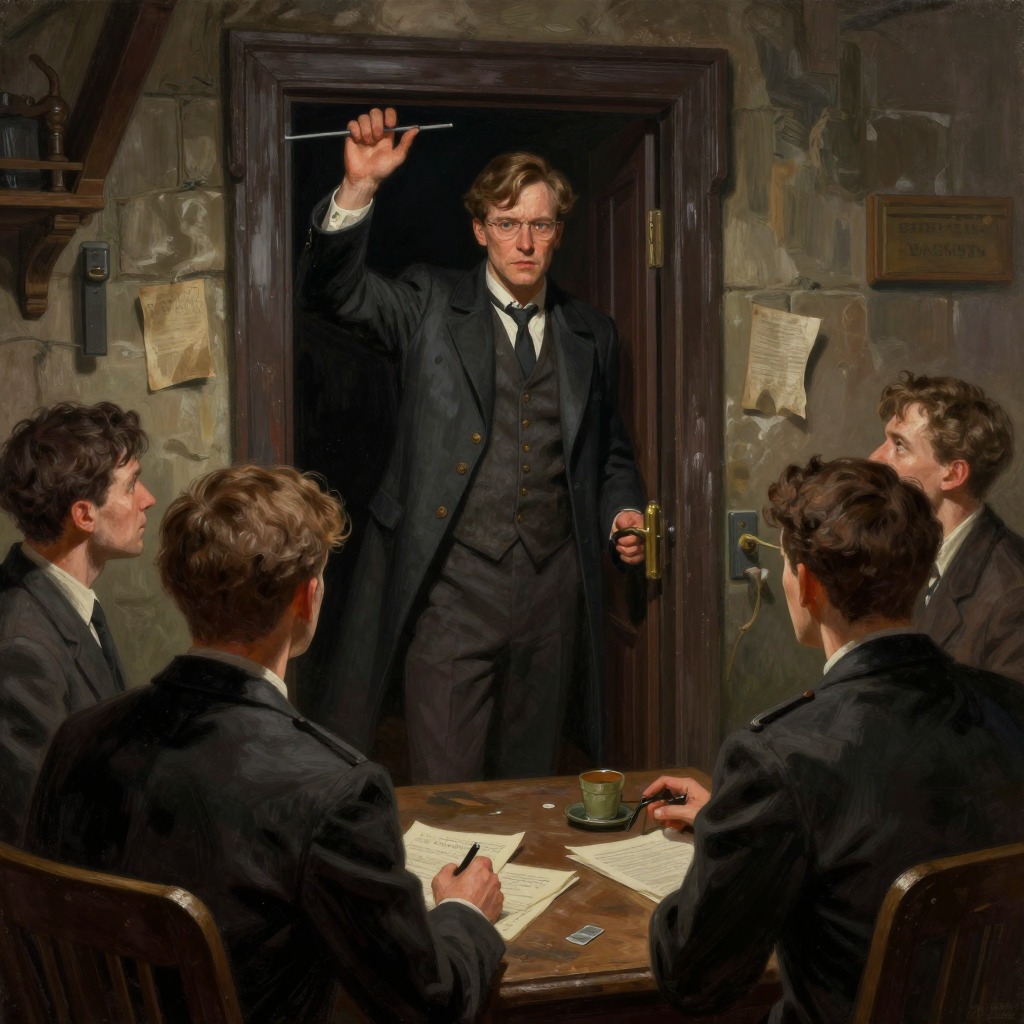
Syme's disappearance is narrated almost casually. A morning comes when he is missing from work; a few thoughtless people comment on his absence, and the next day nobody mentions him. On the third day Winston goes to the vestibule of the Records Department to look at the notice board. One of the notices carries a printed list of the members of the Chess Committee, of whom Syme had been one. It looks almost exactly as it had looked before – nothing has been crossed out – but it is one name shorter. That is enough for Winston. Syme has ceased to exist: he has never existed. No trial, no report, no crossing-out, only the erasure of a name from a list, and with it the erasure of a life. The scene gives concrete form to the novel's concept of the unperson, and to Winston's earlier meditation that people simply disappeared, always during the night, their names removed from the registers.
Narrative Significance
Narratively, Syme matters because he embodies the Party's ultimate ambition – to control thought by controlling language – and because his own fate illustrates the cost of that ambition. He is not a rebel; he is an enthusiastic servant, and the Party still discards him. His disappearance prefigures Winston's own fate and demonstrates that in Oceania no one, however loyal, is safe from the rewriting of history. Syme's devotion to Newspeak also anchors the novel's philosophical argument about language and consciousness, an argument the appendix later spells out. Winston's memory of Syme becomes one of the few places where the vanished man still exists, just as the glass paperweight preserves a fragment of an older world. In that sense Syme is both a warning and a relic: a man of words whose life was erased without a word.