Winston Smith
Winston Smith is the protagonist and narrative consciousness of Nineteen Eighty-Four, an Outer Party worker in the superstate of Oceania whose secret rebellion -- a diary, an illicit love affair and the forbidden thought that two plus two make four -- carries him from the Ministry of Truth to the Ministry of Love, and ends in his total conversion. Through him Orwell dramatizes the Party's power over memory, desire and language, and in him the novel's warning against totalitarianism becomes a case study in how a human being can be unmade.
Identity and Introduction
Winston is introduced on a bright cold day in April when the clocks are striking thirteen, slipping through the glass doors of Victory Mansions with his chin nuzzled into his breast to escape the vile wind while a swirl of gritty dust follows him in. He is thirty-nine, a smallish, frail figure whose meagre body is emphasized by the blue overalls that are the uniform of the Party; his hair is very fair, his skin roughened by coarse soap, blunt razor blades and the cold of the winter just ended, and he has a varicose ulcer above his right ankle. His flat is seven flights up in a decaying building that smells of boiled cabbage, the lift is seldom working, and the telescreen in his room can be dimmed but never switched off, receiving and transmitting simultaneously so that every sound above a very low whisper and every movement in its field of vision can be watched. On every landing the poster of Big Brother follows him with its caption 'BIG BROTHER IS WATCHING YOU.' He cannot pin down the date with certainty: he believes he was born in 1944 or 1945 and is therefore about thirty-nine, which would make it roughly 1984, but exact dates no longer exist. He has learned to live in the assumption that every sound he makes is overheard and, except in darkness, every movement scrutinised.
Work and the Forged Past
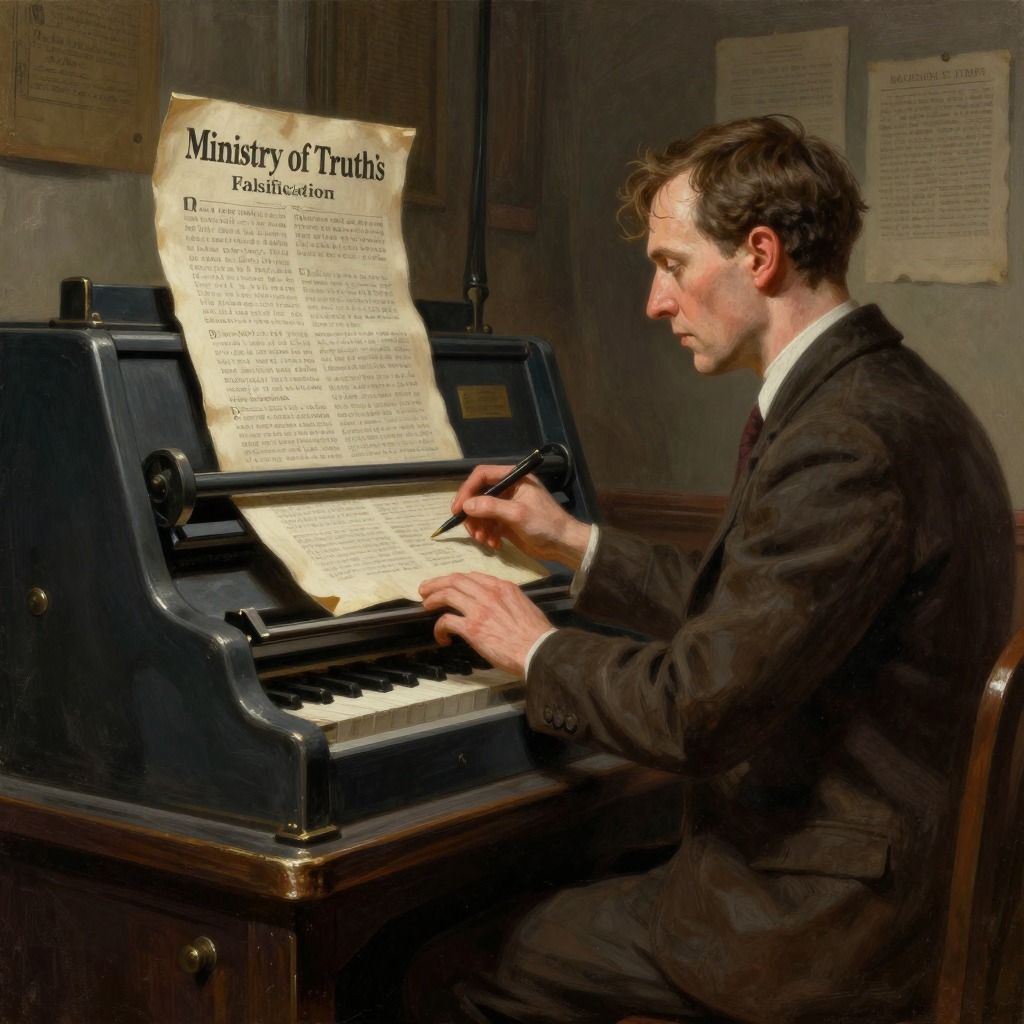
Winston works in the Records Department of the Ministry of Truth, the enormous pyramidal building of glittering white concrete that towers three hundred metres over London with the slogans WAR IS PEACE, FREEDOM IS SLAVERY, IGNORANCE IS STRENGTH on its face. Each day he pulls the speakwrite towards him, unrolls paper cylinders from the pneumatic tube and sets about 'rectifying' the past: a speech of Big Brother's is rewritten so that he appears to have predicted an offensive that actually happened, a categorical pledge that the chocolate ration will not be cut is replaced by a warning that a cut may be necessary, and the corrected copies are filed while the originals drop into the memory hole and are whirled away to the furnaces. He is trusted with the most intricate jobs, including the rewriting of Times leading articles written entirely in Newspeak, and his greatest pleasure in life is this work, in which he can lose himself as in the depths of a mathematical problem.
The scale of the falsification is staggering. Winston rewrites a Ministry of Plenty forecast of boot production from a hundred and forty-five million pairs to fifty-seven million, so that the later actual figure of sixty-two million can be presented as over-fulfilment; he reflects that it is not even forgery, merely the substitution of one piece of nonsense for another, and that very likely nobody knows how many boots are produced while half the population of Oceania goes barefoot. He invents out of nothing a heroic dead comrade named Comrade Ogilvy, complete with a faked photograph and a fabricated biography, and reflects that the dead man will now exist as authentically, on the same evidence, as Charlemagne. The Ministry of Love, by contrast, is the really frightening one -- windowless, reachable only through barbed-wire entanglements, steel doors and hidden machine-gun nests, its approaches roamed by gorilla-faced guards in black uniforms with jointed truncheons. Yet what strikes Winston most about modern life is not cruelty or insecurity but its bareness, dinginess and listlessness: the deadening jobs, the leaking shoes, the patched nineteenth-century houses, the struggle for a Tube seat and the cadging of saccharine tablets.
The Diary and Thoughtcrime
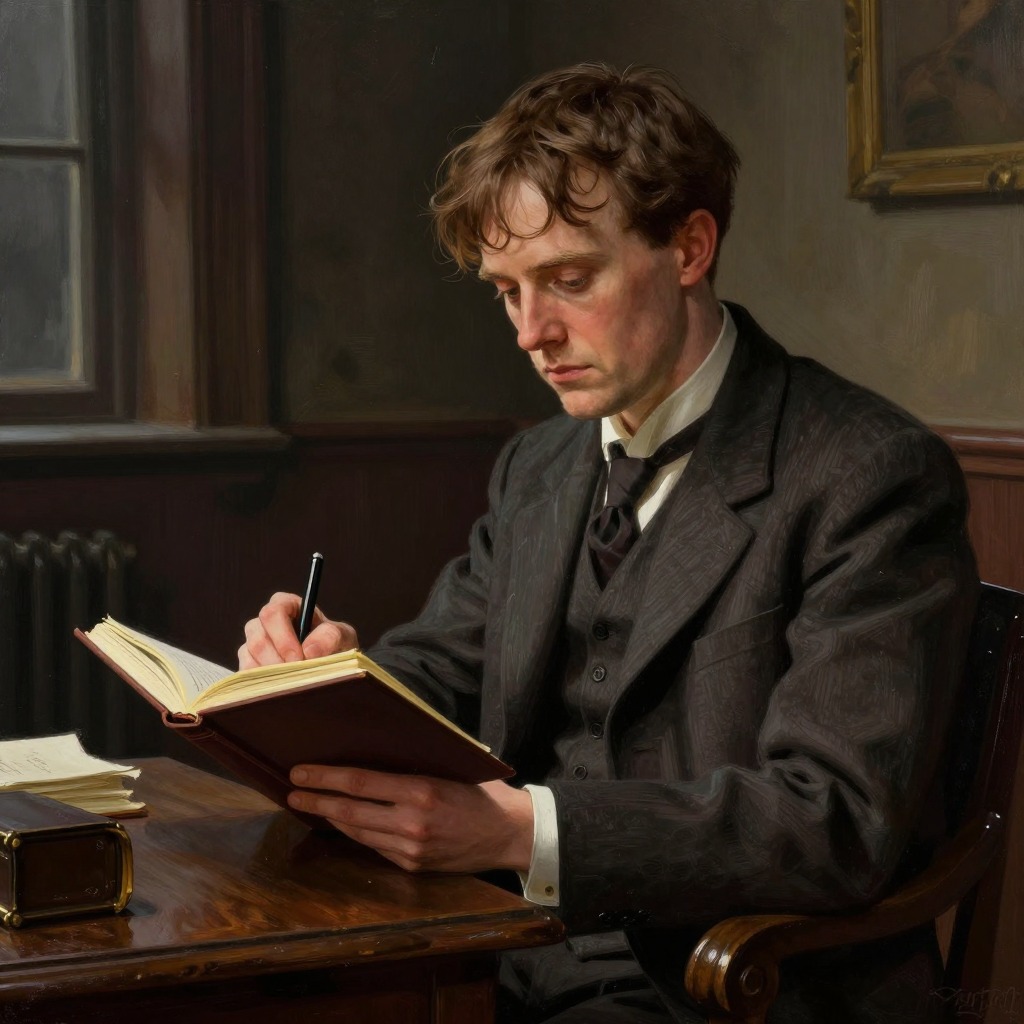
Winston's rebellion begins with an object: a thick quarto-sized blank book with a red back and a marbled cover, bought for two dollars fifty in a frowzy junk-shop in a slummy quarter and carried guiltily home in his briefcase, because even with nothing written in it it is a compromising possession. Sitting in an alcove that the telescreen cannot see, he opens it as a diary, writes 'April 4th, 1984' in small clumsy letters, and knows that to mark the paper was the decisive act. He wonders for whom he is writing -- for the future, for the unborn -- and the thought brings him up against the Newspeak word doublethink: if the future resembles the present it will not listen to him, and if it is different his predicament will be meaningless. In panic he finds himself printing 'DOWN WITH BIG BROTHER' over and over until it covers half a page, then reflects that it makes no difference whether he writes it or not: the Thought Police will get him just the same, since thoughtcrime is not a thing that can be concealed for ever. He writes 'Thoughtcrime does not entail death: thoughtcrime IS death,' addresses the diary 'To the future or to the past,' and finally lays a single grain of whitish dust on the cover so that he can tell if the book has been moved.
The diary forces him to confront doublethink as a lived condition. During the Physical Jerks his mind slides into its labyrinthine definition -- to know and not to know, to hold simultaneously two opinions which cancel out, to use logic against logic, to forget whatever it is necessary to forget and then draw it back again. The Two Minutes Hate demonstrates the same principle collectively: the horrible thing about it is not that one is obliged to act a part but that it is impossible to avoid joining in, and the rage that floods the room is so abstract and undirected that at one moment Winston's hatred is against Goldstein and at the next against Big Brother, the Party and the Thought Police. In the same scene, however, he momentarily catches O'Brien's eye, and for a fraction of a second is certain that O'Brien is thinking the same thing he is -- an equivocal flash of contact that keeps alive his belief that others besides himself are enemies of the Party.
Memory, Dreams and Forbidden Desire
Beneath the orthodoxy Winston carries a buried life of memory and dream. He dreams of his mother and baby sister sinking beneath green water in the saloon of a ship, looking up at him without reproach while they die so that he may live, and he knows with a dreamer's certainty that their lives were sacrificed to his own and that his mother's death had a tragic dignity no longer possible today. The same dream landscape contains the Golden Country, an old rabbit-bitten pasture with a foot-track, a molehill here and there and a stream with dace under the willow trees; there the dark-haired girl tears off her clothes with a gesture that seems to annihilate a whole culture, and Winston wakes with the word 'Shakespeare' on his lips. He remembers his father's hand clutching his own on a spiral staircase during an air raid, the crowded Tube station, and an old man repeating 'We didn't ought to 'ave trusted 'em' -- fragments of a past that has been systematically destroyed and that he cannot reconstruct.
His sexual history is a second front of the same war. He recalls a prostitute in a basement kitchen, bought for two dollars, whose thick paint concealed a toothless old woman; and he recalls Katharine, his wife, who lay rigid as a jointed wooden image and called their weekly intercourse 'our duty to the Party.' He understands that the Party's real, undeclared purpose is to remove all pleasure from the sexual act: marriages between Party members must be approved by committee, permission is refused to couples who appear physically attracted to one another, and the only recognised purpose of marriage is to beget children for the service of the Party. He wants, more than to be loved, to break down that wall of virtue once in his life, because 'The sexual act, successfully performed, was rebellion. Desire was thoughtcrime.' To the proles he attaches a desperate hope: 'If there is hope, it lies in the proles,' he writes, because only they have stayed human, loyal to one another rather than to a party or an idea. Remembering how he once kicked a severed hand into the gutter as though it were a cabbage-stalk, he tells Julia, 'The proles are human beings. We are not human.'
Rebellion and Love
The rebellion takes human form when the dark-haired girl from the Fiction Department -- the girl Winston once suspected of being an agent of the Thought Police and imagined killing with a cobblestone -- stumbles in the corridor and slips into his hand a scrap of paper folded into a square. Reading 'I love you', he feels the desire to stay alive well up in him. They meet in the crowd at Victory Square while a convoy of Eurasian prisoners passes, and a week later she leads him through the woods to a hidden clearing that matches his dream of the Golden Country; there she tells him her name is Julia. She is twenty-six, works on the novel-writing machines in the Fiction Department, has been a troop-leader in the Spies, does voluntary work for the Junior Anti-Sex League and carries one end of a banner in processions as camouflage; her revolt is purely personal, and she is cynical about the Brotherhood. Their love-making, Winston reflects, is not pure love or pure lust but a battle and a victory -- a blow struck against the Party, a political act.
They rent the room above Mr Charrington's shop, a pocket of the past with a mahogany bed, a gate-leg table, a twelve-hour clock and, above all, no telescreen; there Julia paints her face, wears scent, and produces black-market sugar and real Inner Party coffee, and there Winston gazes into the glass paperweight he has bought, feeling that he is inside it, in a tiny world fixed at the heart of the crystal. It is through O'Brien that the private rebellion touches something larger. Invited to O'Brien's flat, Winston and Julia hear him turn off the telescreen -- 'We have that privilege' -- drink a health to Emmanuel Goldstein, and enrol in the Brotherhood; later, during Hate Week, a stranger returns Winston's brief-case with a copy of The Theory and Practice of Oligarchical Collectivism inside it, and in the room over the shop he reads the book's account of High, Middle and Low, of doublethink and the mutability of the past, feeling that it tells him nothing new but systematises everything he already knows.
Arrest, Re-education and Room 101
The end comes in the room that had seemed a sanctuary. Standing at the window with Julia, watching the singing woman in the yard, Winston says 'We are the dead,' and an iron voice answers from behind the picture: 'You are the dead.' The telescreen has been hidden behind the steel engraving of St Clement's Dane; the picture falls with a crash of broken glass, the room fills with men in black uniforms, the glass paperweight is smashed on the hearthstone, and Winston sees the fragment of coral roll across the mat, 'how small it always was.' Julia is doubled up by a blow to the solar plexus and carried out like a sack; his last glimpse of her is her face, upside down, yellow and contorted, still smeared with rouge. Mr Charrington, no longer a stooping old prole, stands transformed -- his white hair black, his spectacles gone, his cockney accent vanished -- and Winston realises that he is looking, with knowledge, for the first time in his life at a member of the Thought Police.
In the Ministry of Love the lights never go out; it is the place with no darkness, and Winston understands at last what O'Brien meant. Beaten by guards and interrogated by Party intellectuals, he becomes simply a mouth that utters and a hand that signs whatever is demanded, confessing to murdering his wife, spying for Eastasia and years of contact with Goldstein. O'Brien then takes over his re-education personally, strapping him to a bed with a dial that can administer pain up to a hundred; holding up four fingers, he demands that Winston see five, and through the rising needle of pain Winston at last screams 'Five! Five! Five!' O'Brien tells him that the Party is not interested in the overt act but in the thought, that there are no martyrdoms in this place, and that the Party does not destroy its enemies but changes them: 'We make him one of ourselves before we kill him.'
The final ordeal is Room 101, the place where the worst thing in the world is kept. For Winston the worst thing is rats, and O'Brien brings a wire cage whose mask will fit over his head while starving rats leap onto his face and bore into it. Winston, whose recurring nightmare has always been a wall of darkness with something unendurable on the other side, knows now that the rats were what lay behind the wall. To save himself he must interpose another human being between his body and the cage, and he screams it out: 'Do it to Julia! Not me! Julia! I don't care what you do to her. Tear her face off, strip her to the bones.' The cage door clicks shut, not open, and afterwards he knows that something was killed in his breast, burnt out, cauterised out; the one thing that had made him human, his love for Julia, has been destroyed.
End and Significance
Released, Winston lives a ghostly half-life in the Chestnut Tree Café, where the waiters know his habits, the chessboard is always waiting, and the gin is flavoured with cloves and saccharine. He has a sinecure on a sub-committee of a sub-committee engaged on the Eleventh Edition of the Newspeak Dictionary, something to do with whether commas belong inside or outside brackets. In the Park one vile March day he meets Julia again: she has a scar across her forehead, her waist has thickened and stiffened, and each says baldly, 'I betrayed you.' He traces '2 + 2 = 5' in the dust on the café table and lets himself be drawn back to the Chestnut Tree's warmth rather than follow her. When the telescreen announces a great victory in Africa and the crowd roars outside, he looks up at the enormous face of Big Brother and understands, after forty years, what kind of smile was hidden beneath the dark moustache. The novel ends with his surrender: he had won the victory over himself, and he loved Big Brother.
Winston's trajectory is the novel's demonstration of brainwashing. As the introduction to this edition observes, something very much like the Pavlovian conditioning attributed at the time to Soviet and Chinese communists happens to Winston in lengthy and terrifying detail, and readers determined to take the novel as a simple condemnation of Stalinist atrocity found what they expected. Orwell's own purpose was different: he wrote in 1946 that every line of serious work he had written since 1936 was written, directly or indirectly, against totalitarianism and for democratic socialism as he knew it, and the manner of thinking he described as schizophrenic -- in which words like 'democracy' can bear two irreconcilable meanings -- became the doublethink that governs Winston's world. Winston himself is both the hero and the most complete victim of that world: the man who once wrote that freedom is the freedom to say that two plus two make four is the man who ends by tracing two plus two make five in the dust and loving the power that has annihilated him. Memory, the novel insists, is relatively easy to control from the totalitarian point of view, and Winston's defeat is what happens when a single memory is set against the whole apparatus of the Party.