Mr. Bumble
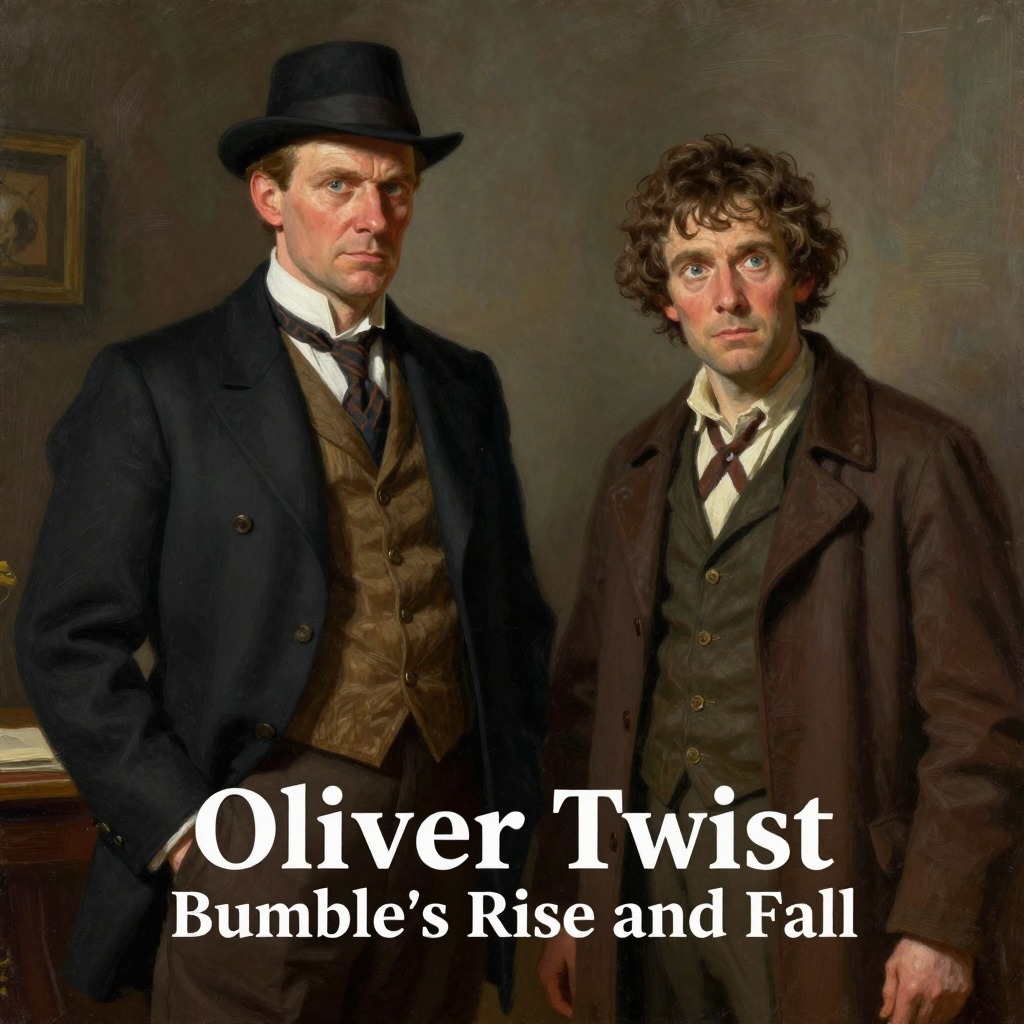
Mr. Bumble, the parish beadle, is one of the most vividly satirical figures in Charles Dickens's Oliver Twist, a man whose entire identity is built upon the authority of his office and the grandeur of his cocked hat. He is first encountered as a fat, choleric man who rules the workhouse and its inmates with a cane and a sense of his own immense importance, yet his trajectory from a petty tyrant to a thoroughly subdued husband charts a devastating comic fall. Bumble is not merely a functionary; he is the living embodiment of the Poor Law's indifference, a man whose every action is calculated to preserve his own dignity and power, even as he is ultimately undone by the very system he serves and the woman he marries.
Identity and Introduction
Mr. Bumble is introduced as the beadle of the parish workhouse, a position he fills with an almost theatrical sense of his own grandeur. He is described as a fat man and a choleric, who carries a cane and a cocked hat as the symbols of his authority. He invented the name "Twist" for Oliver, following the parish's alphabetical naming system for foundlings, a fact he relates with immense pride, declaring himself "quite a literary character." His first appearance at Mrs. Mann's farm is marked by a furious shaking of the garden gate and a kick that "could have emanated from no leg but a beadle's," establishing his character as one of bluster and petty tyranny. He is a man who believes deeply in the dignity of his office, and he expects—and usually receives—deference from all beneath him.
Arc Through the Plot: From Beadle to Henpecked Husband
Bumble's narrative arc is one of a steep and comic decline. He begins as the undisputed master of the workhouse's internal affairs, a man who can terrify paupers and command respect from the likes of Mrs. Mann. He is the one who delivers Oliver to the board, who orchestrates his apprenticeship to Mr. Sowerberry, and who later travels to London to blacken Oliver's name to Mr. Brownlow, pocketing five guineas for his trouble. His power, however, is entirely dependent on his office. The turning point comes with his marriage to Mrs. Corney, the workhouse matron. After their union, he is stripped of his beadle's position and becomes the master of the workhouse, a promotion that proves to be a gilded cage. His wife, the former Mrs. Corney, quickly establishes dominance, and Bumble is reduced to a cowering, henpecked figure. His famous lament, "I sold myself for six teaspoons, a pair of sugar-tongs, and a milk-pot," marks his complete fall from grace. The final humiliation comes when he and his wife are exposed for their role in the plot against Oliver, and he is dismissed from his post, eventually becoming a pauper in the very workhouse where he once lorded it over others.
Relationships and Conflict
Bumble's relationships are defined by a rigid hierarchy of power. With inferiors like Mrs. Mann and the paupers, he is overbearing and cruel, using his cane freely and demanding absolute obedience. His relationship with Oliver is one of pure institutional authority; he sees the boy not as a human being but as a "porochial 'prentis" and a "dead-weight." His interactions with the board of guardians are marked by a fawning deference, though he is secretly proud of his own oratorical skills. The most significant and transformative relationship is with Mrs. Corney, whom he marries. He initially believes he is making a shrewd bargain, gaining a wife and a position, but he quickly discovers that he has met his match. Mrs. Bumble dominates him physically and verbally, and his attempts to assert his "prerogative" as a man are met with violent resistance. This relationship is the engine of his downfall, as it is his wife who ultimately leads him into the criminal dealings with Monks that result in their exposure and ruin.
Change and Ending
Mr. Bumble undergoes a profound and humiliating transformation. He begins as a figure of pompous authority, a man who believes that "a beadle can do no wrong." He ends as a broken, degraded pauper, stripped of his office, his dignity, and his freedom. His final appearance in the novel is as a witness in the revelation of Oliver's parentage, where he is exposed as a petty criminal and a fool. His famous line, "If the law supposes that, the law is a ass—a idiot," is his last defiant, yet pathetic, assertion of his own worldview. He and his wife are reduced to paupers in the same workhouse, a final, ironic twist that completes his journey from master to inmate. His story serves as a darkly comic warning about the corrupting nature of petty power and the perils of a marriage built on calculation rather than affection.
Thematic Significance
Mr. Bumble is a central vehicle for Dickens's satire of the Poor Law and the institutional cruelty of the parish system. He is not a villain in the manner of Fagin or Sikes, but a far more insidious figure: a man who is cruel not out of malice but out of a blind adherence to the system that gives him his identity. His pomposity and self-regard are a mask for a profound moral emptiness. His fall from grace is a comic but pointed critique of the very institutions he represents. Through Bumble, Dickens shows that the system is not merely broken but is actively upheld by petty, self-interested men who are themselves ultimately victims of its logic. His transformation from beadle to pauper is a perfect, ironic circle that underscores the novel's central theme: that the world's judgments are often arbitrary and that true worth is found not in office or title, but in the heart.