The Wendigo
The Wendigo is the dark, sentient presence that animates the Micmac burying ground, the place of power beyond the Pet Sematary. It is not a character in the conventional sense but a force of nature—ancient, hungry, and utterly malevolent. The novel presents it as the explanation for why the dead who are buried in that cursed soil do not simply return, but return wrong, carrying something of the Wendigo's own corruption within them. It is the ultimate antagonist, the source of the story's horror, and the reason why the Creed family's tragedy unfolds with such inexorable, nightmare logic.
Origins and Folklore
The Wendigo is rooted in the folklore of the Algonquian peoples, particularly the Micmac tribe, who originally inhabited the land where the story takes place. Jud Crandall, the elderly neighbor who knows the woods' secrets, explains that the Micmacs believed the Wendigo had "soured the ground" of their burying ground, making it a place of evil power. The Wendigo is a spirit of the north country, associated with cannibalism and insatiable hunger. Jud recounts the old stories: during harsh winters, when food was scarce, some tribes would resort to cannibalism, and the story they told to explain this taboo act was that the Wendigo had walked through their village and touched them, giving them a taste for human flesh. The Wendigo, then, is a supernatural embodiment of the ultimate transgression, a force that corrupts and consumes from within. This legend is not merely background color; it provides the theological framework for the novel's central horror. The Micmacs, understanding the Wendigo's nature, abandoned their burying ground, recognizing that the power there was not holy but demonic.
The Power of the Place
The Wendigo's power is inextricably linked to the Micmac burying ground itself. Jud warns Louis that the place has a power that "goes through phases, same as the moon," and that it is "an evil, curdled place." This power is not passive; it is active and seductive. It draws people to it, offering a solution to the unbearable pain of loss. Jud confesses that he took Louis to the burying ground not out of pure kindness, but because "the place gets hold of you. You do it because that burial place is a secret place, and you want to share the secret." The Wendigo's influence is a form of spiritual contagion. It uses the good intentions of the living—their love, their grief, their desire to undo death—as a vector for its own evil. The power is strongest in the deep woods beyond the Pet Sematary, in the area around Little God Swamp, where the air feels "heavier, more electrical." It is here that Louis, on his second journey to the burying ground, has his most direct encounter with the Wendigo.
Direct Encounter and Manifestation
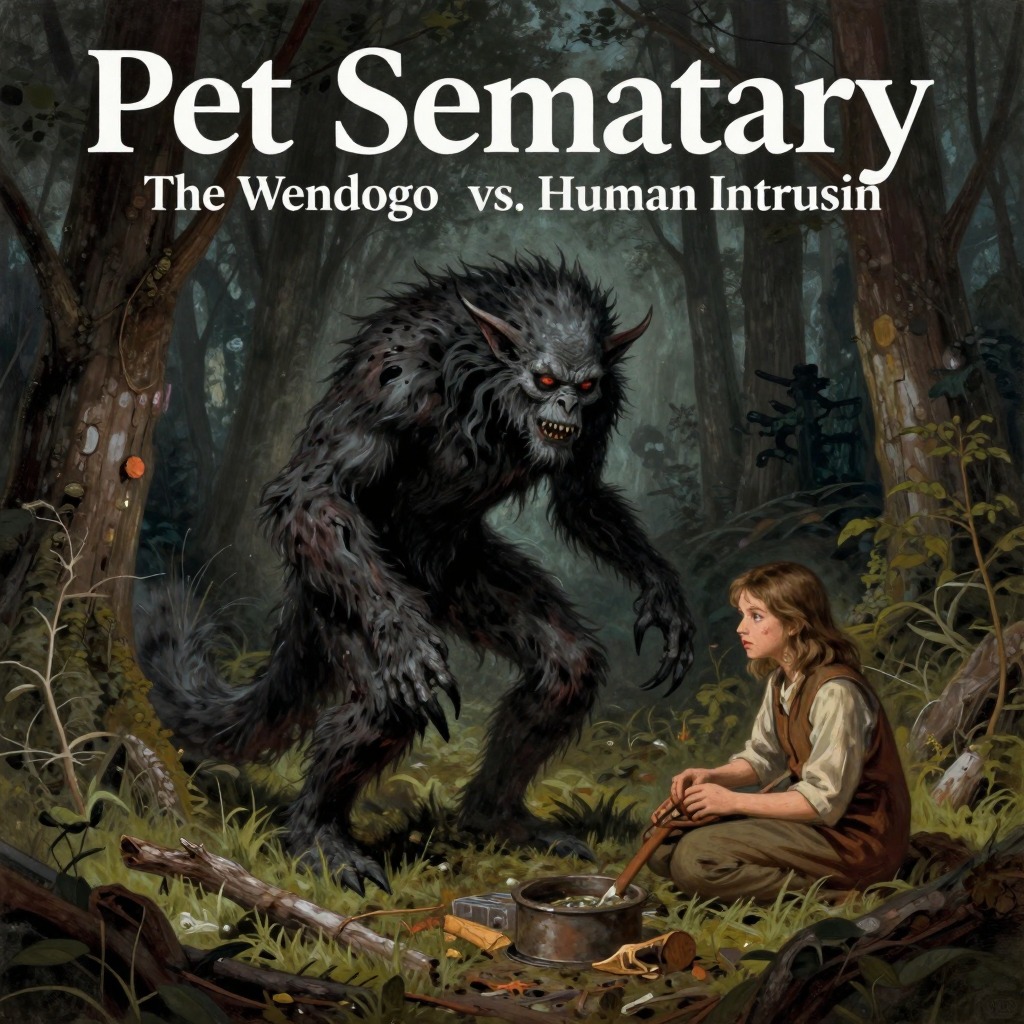
Louis's journey to rebury his son Gage in the Micmac burying ground brings him face-to-face with the Wendigo's terrifying reality. As he crosses Little God Swamp, he hears a sound like nothing he has ever known: a living, big sound of branches snapping and underbrush breaking under "unimaginable feet." The ground shakes. The air fills with a sickening smell of warm, spoiled pork. Louis sees a diffuse watermark in the mist, a shape over sixty feet high, and feels the displaced air of its passage. He sees twin yellow-orange sparks high above him, like eyes. This is the Wendigo, a creature of immense size and power, moving through the woods. Later, as he climbs the stone steps to the burying ground, he sees a face in the mist: a leering, gibbering visage with tilted, yellowish-gray eyes and ram's horns instead of ears. This grisly, floating head seems to speak and laugh, its tongue lolling out, coated with peeling scales. Jud had warned Louis that he might see St. Elmo's fire or hear sounds like voices, but he also told him that if he saw shapes that bothered him, he should "just look the other way." The Wendigo's manifestations are designed to terrify and unnerve, to break the will of those who trespass in its domain.
Corruption and Consequences
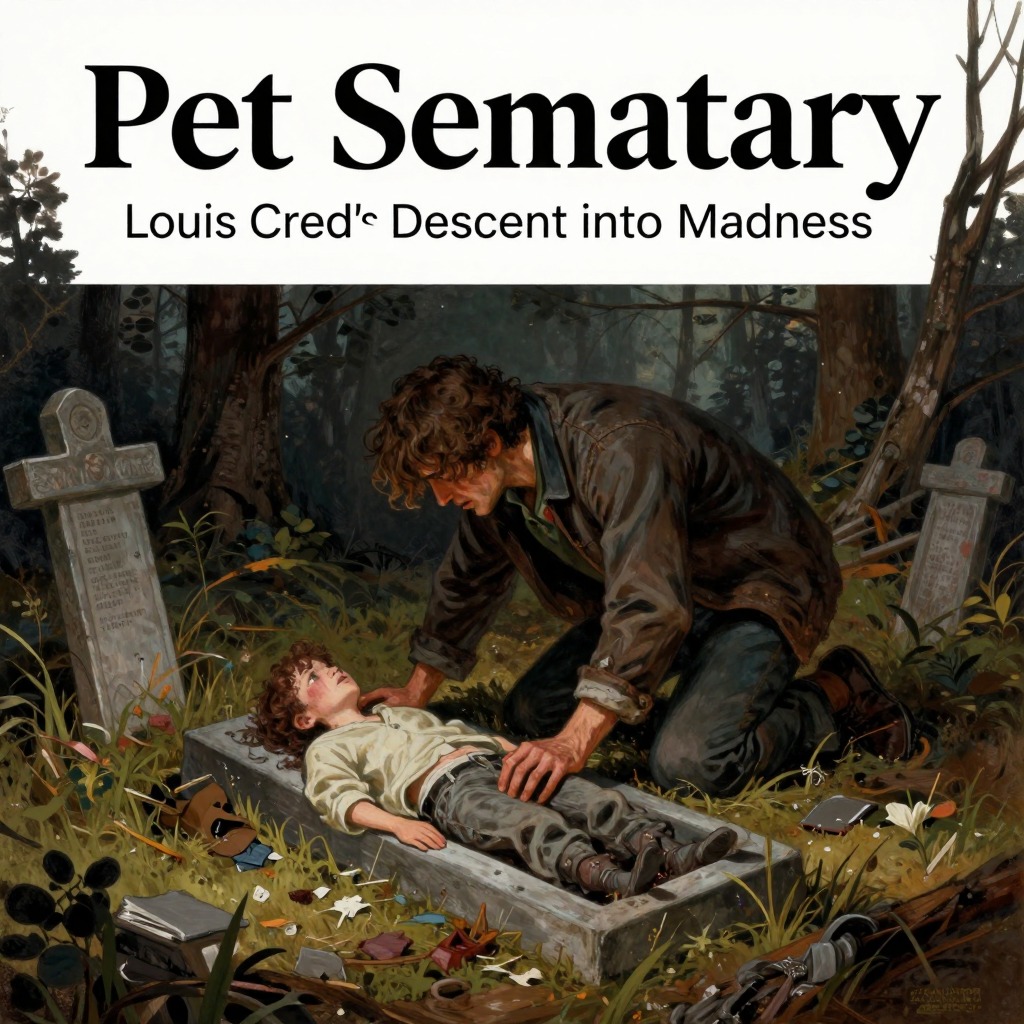
The Wendigo's ultimate horror is not its physical form but its spiritual corruption. It does not simply kill; it twists and perverts. Jud's story of Timmy Baterman is the novel's clearest example. Timmy, a young soldier killed in World War II, was brought back by his grieving father, Bill, who buried him in the Micmac burying ground. What returned was not Timmy but a monster. It walked the roads, pale and shambling, its eyes "like raisins stuck in bread dough." It knew the darkest secrets of everyone it met, whispering them aloud to cause pain and shame. It was filled with a sly, malevolent intelligence that delighted in torment. Bill Baterman was ultimately forced to shoot his own son and then burn down his house with himself inside. The Wendigo's touch does not restore life; it creates a zombie-like parody animated by pure evil. This is the fate that awaits anyone buried in that ground. Louis sees this pattern repeated with his own son. When Gage returns, he is not the sweet, laughing boy Louis remembers. He is a cunning, murderous thing that kills Jud Crandall and then Rachel, using a scalpel stolen from Louis's own medical bag. The Wendigo's power is a trap, a cruel joke that offers hope only to deliver damnation.
Thematic Significance
The Wendigo serves as the novel's ultimate symbol of the perversion of love and the danger of refusing to accept death. It is the dark answer to Louis's desperate prayer to have his son back. The Wendigo represents the monstrous consequences of trying to play God, of believing that human will can overturn the natural order. It is the embodiment of the novel's central, terrible truth: that sometimes, dead is better. The Wendigo is not a force that can be reasoned with or defeated; it can only be resisted, and that resistance requires an acceptance of loss that is almost superhuman in its difficulty. Louis fails that test, and the Wendigo consumes his family. The novel's final, chilling image—Rachel's cold hand on Louis's shoulder, her voice "full of dirt"—is the Wendigo's ultimate victory. It has not only taken Louis's family; it has made him complicit in their corruption, ensuring that the cycle of grief, resurrection, and horror will continue.