Fatima
Fatima is the woman of the desert whom Santiago meets at the well of Al-Fayoum Oasis, and she becomes the embodiment of love as a force that does not hinder but rather completes the pursuit of one's Personal Legend. Her role is decisive because she redefines love not as possession or stasis but as the willingness to let the beloved go, transforming the desert from a place of waiting into a symbol of hope.
Identity and Background
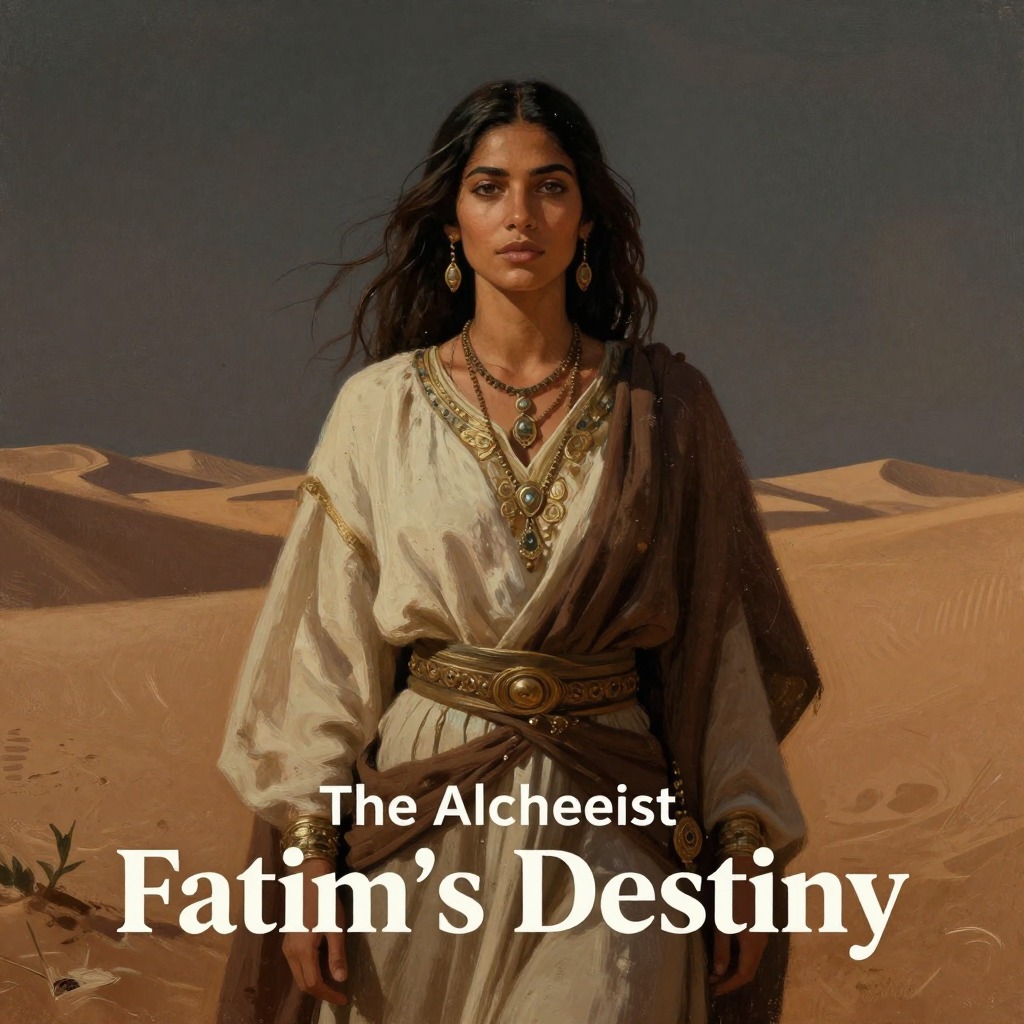
Fatima is introduced when Santiago, searching for the alchemist, approaches a young woman at the well who is not dressed in black, her face uncovered. She tells him her name is Fatima, explaining that it is the name of the Prophet's daughter, carried everywhere by the invaders, and she speaks of the invaders with pride. She is a woman of the desert, deeply rooted in its traditions and its harsh, beautiful reality. When Santiago first sees her, time seems to stand still, and he feels the Soul of the World surge within him; he learns the most important part of the universal language—love—as their eyes meet. She points south to where the man who knows all the secrets of the world lives, then fills her vessel with water and leaves.
Love and the Language of the World
The encounter at the well is the moment Santiago recognizes Fatima as the only woman in his life, with no need for words. He returns the next day and declares his love, telling her he wants her to be his wife. Fatima drops her water container, and the water spills. She tells him that the tribesmen are always in search of treasure and that the women of the desert are proud of their tribesmen. Over the following days, they become friends; he tells her about his life as a shepherd, the king, and the crystal shop. She explains that because he taught her something of the universal language and the Soul of the World, she has become a part of him. She reveals that she has been waiting for him at the oasis for a long time, that she has dreamed the desert would bring her a wonderful present, and that present is him. She tells him that the dunes are changed by the wind but the desert never changes, and that will be the way with their love. She says, "Maktub," and tells him that if she is really a part of his dream, he will come back one day.
The Choice to Let Go
When Santiago decides to continue his quest with the alchemist, he goes to Fatima's tent before dawn, violating the Tradition. He tells her he is going away but will return. Fatima interrupts him, saying one is loved because one is loved, no reason is needed. She embraces him for the first time. She tells him that before this she always looked to the desert with longing, but now it will be with hope; her father went away one day but returned to her mother, and has always come back since then. She cries, and when Santiago asks why, she says she is a woman of the desert but above all a woman. After he leaves, the oasis becomes an empty place for her; from that day on, the desert represents only one thing: the hope for his return. She will look to it every day, trying to guess which star he is following, and send her kisses on the wind, hoping it will touch his face and tell him she is alive.
Thematic Significance
Fatima embodies the principle that love never keeps a man from pursuing his destiny. The alchemist tells Santiago that if he abandons his quest, it is because it was not true love—the love that speaks the Language of the World. Fatima, as a desert woman, understands that men have to go away in order to return. She does not ask Santiago to stay; instead, she becomes a part of his dream and his destiny. At the novel's end, when Santiago finds the treasure at the abandoned church, the levanter wind brings the scent of a perfume he knows well and the touch of a kiss that comes from far away, slowly, until it rests on his lips. He smiles, saying, "I'm coming, Fatima." Her love is not a barrier but the force that makes the treasure meaningful, and her waiting is an active, hopeful participation in his journey.