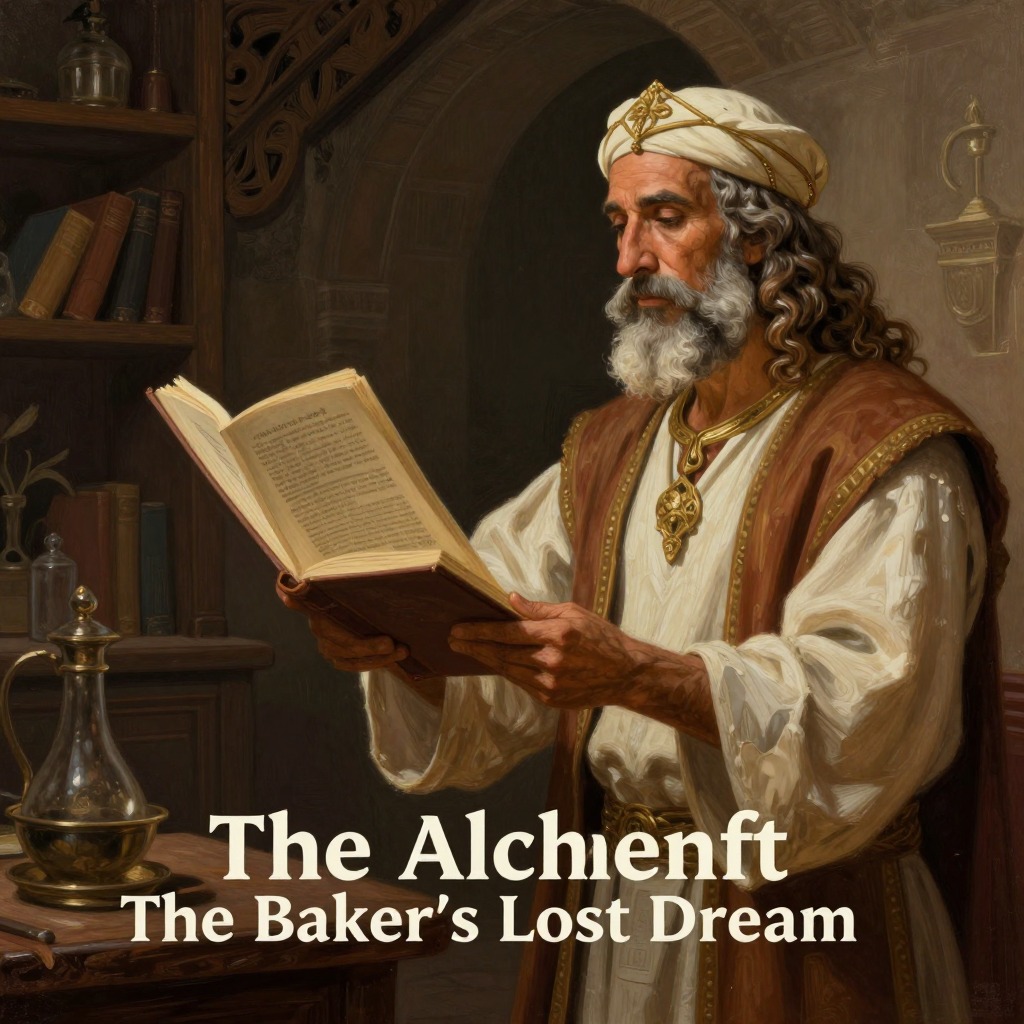
the baker
The baker is a minor but symbolically charged figure in Paulo Coelho's The Alchemist, a man who once dreamed of travel but chose the safety of a bakery and a settled life instead. He appears only briefly, yet his story becomes a recurring reference point for Santiago as the shepherd weighs his own desire for adventure against the comforts of home and the expectations of others. The baker embodies the novel's central warning: that the fear of change and the pressure to conform can trap a person in a life that is safe but spiritually empty.
Identity and Background
The baker is introduced through Melchizedek, the King of Salem, who points him out to Santiago in the plaza of Tarifa. As a child, the baker wanted to travel, but he decided first to buy his bakery and put some money aside, planning to spend a month in Africa when he was old. He never realized, Melchizedek explains, that people are capable at any time in their lives of doing what they dream of. The baker's choice reflects a broader social pressure: bakers are considered more important people than shepherds, they have homes while shepherds sleep out in the open, and parents would rather see their children marry bakers than shepherds. Santiago feels a pang in his heart, thinking about the merchant's daughter and the baker who surely lives in her town.
Narrative Role and Thematic Significance
The baker functions as a foil to Santiago, illustrating the cost of abandoning one's Personal Legend. When Santiago considers telling the baker what Melchizedek said about him, he decides against it, reasoning that the baker would spend three days thinking about giving it all up, even though he had gotten used to the way things were. The boy does not want to cause that kind of anxiety. Later, when Santiago works for the crystal merchant, he reflects that it is good he refrained from saying anything to the baker in Tarifa, recognizing that the merchant, too, is a man who has let his dream—a pilgrimage to Mecca—become a mere fantasy that keeps him alive rather than a goal to be achieved. The baker thus represents the first of several characters Santiago encounters who have traded their dreams for security, and whose unfulfilled lives serve as both warning and motivation for the shepherd to continue his own quest.
Contrast with Santiago's Journey
The baker's static existence stands in direct opposition to Santiago's dynamic path. While the baker remains in his shop, Santiago sells his sheep, crosses the strait to Africa, is robbed, works for a crystal merchant, joins a caravan across the Sahara, and eventually reaches the Pyramids. The baker's choice is the one Santiago nearly makes at several points: when he is tempted to return to his sheep after being robbed in Tangier, when he considers staying at the oasis with Fatima, and when he stands at the Pyramids and thinks he could go back to being a shepherd. Each time, the memory of the baker—and of others like him—helps Santiago resist the pull of a safe but unfulfilled life. The baker's story is also echoed in the crystal merchant's confession that he prefers to dream about Mecca rather than actually go, because he is afraid the reality would be a disappointment.
The Baker as a Universal Type
Beyond his specific role in the plot, the baker represents a universal human type: the person who lets practical considerations and social expectations override their deepest desires. Melchizedek's observation that "in the long run, what people think about shepherds and bakers becomes more important for them than their own destinies" applies not only to the baker but to the crystal merchant, the Englishman (who spends years studying alchemy rather than practicing it), and countless others Santiago meets on his journey. The baker is thus not a fully developed character but a symbolic figure, a warning carved into the narrative that Santiago must heed if he is to reach his treasure. His presence in the story is brief, but his shadow extends across the entire novel, reminding both Santiago and the reader of the high price of a dream deferred.