Lard Ass Hogan
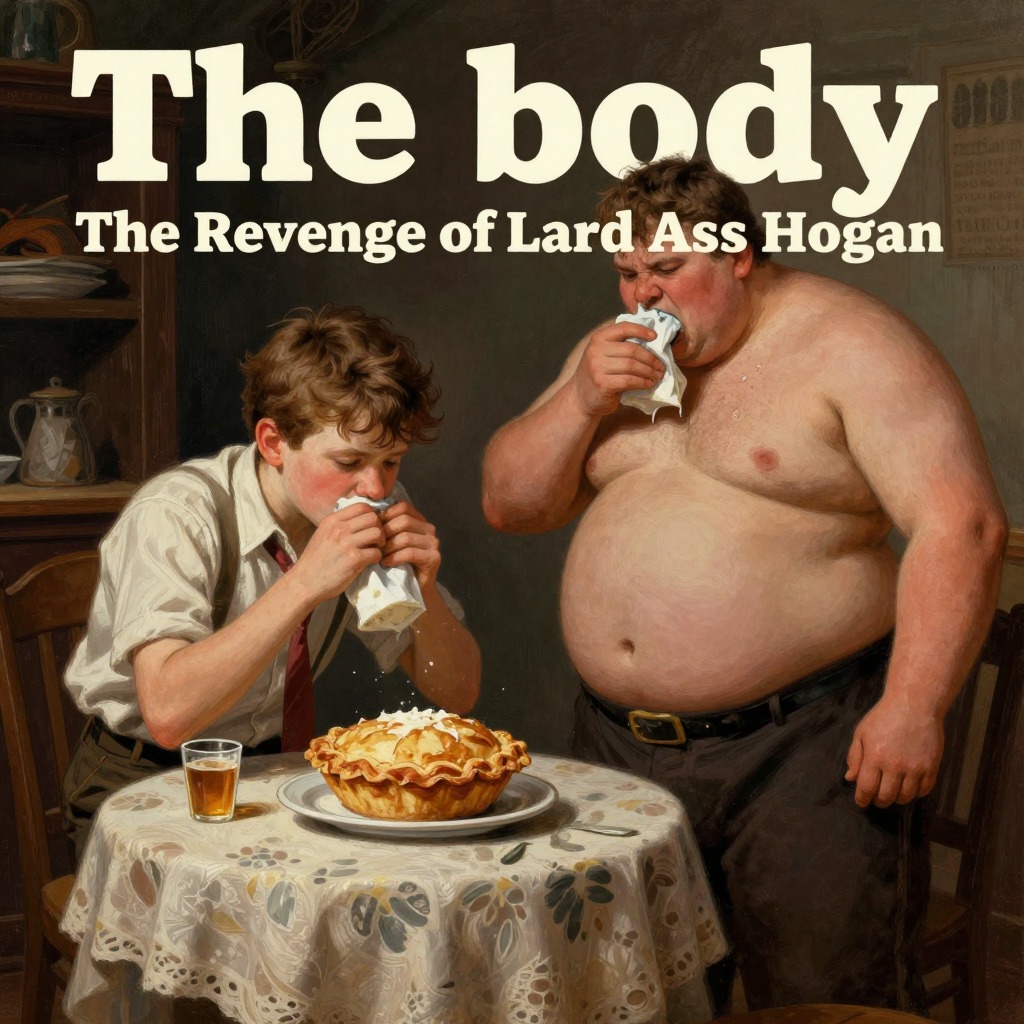
Lard Ass Hogan, whose real name is David Hogan, is the central figure in a story-within-a-story told by Gordon Lachance to his friends Chris Chambers, Teddy Duchamp, and Vern Tessio during their hike to find the body of Ray Brower. The tale, later published as "The Revenge of Lard Ass Hogan" in Cavalier magazine in 1975, is a darkly comic fable of humiliation and revenge set in the fictional town of Gretna, Maine. Lard Ass is a twelve-year-old boy who weighs around one hundred and eighty pounds, and his weight makes him a constant target for relentless bullying and mockery from his peers, who call him "Lard Ass" instead of his real name. He is friendless and despised, and his parents, rather than offering comfort, seem to have already spent the five-dollar prize money he is expected to win in the upcoming pie-eating contest. The story, as Gordon later reflects, is an early attempt to use fiction to process the painful realities of his own childhood, including the feeling of being invisible in his own family after his brother Dennis's death, and it contains the same kind of controlled, cathartic violence that would later appear in his published novels. The tale is a product of an undergraduate creative writing workshop, and Gordon, looking back as an adult, finds it both embarrassing and revealing, a piece of work that is "ugly but alive" and that shows the "true face of Gordon Lachance lurking just behind the lines of print."
Identity and Background
Lard Ass Hogan is defined by his obesity, which he cannot help; Gordon explains that he has "weird fuckin glands" that cause his condition. He is the youngest contestant ever to enter the Great Gretna Pie-Eat, a major event during the town's Pioneer Days celebration. The reigning champion is Bill Travis, a lanky mechanic who is a local hero and who has bet a substantial amount of money on himself at one-for-five odds. The other contestants are Calvin Spier, the fattest man in town who runs the jewelry store; Bob Cormier, a disc jockey from WLAM in Lewiston; and John Wiggins, the principal of Gretna Elementary School. The contest is a serious betting affair, with townspeople analyzing each contestant's eating habits, belching ability, and tolerance for the official pie—blueberry that year—as if they were handicapping thoroughbreds. Lard Ass is a seven-to-one underdog, considered too young and inexperienced to pose a real threat to the champion.
The Plan and the Contest
Lard Ass's revenge is meticulously planned. In the days leading up to the contest, he endures constant taunts from classmates who ask how many pies he will eat, and he responds with feigned indifference. His great idea is not to win, but to make everyone else lose. Before the contest, he drinks an entire bottle of castor oil, a noxious fluid that he forces down, his mouth twisting and his belly gagging, with the sole purpose of inducing violent vomiting at the climactic moment. On the night of the contest, the Main Street of Gretna is closed off, and a large platform is set up with bunting and a sign reading "THE GREAT GRETNA PIE-EAT OF 1960!" The contestants are introduced one by one by Mayor Charbonneau, who ties a white bib around each of their necks. Lard Ass receives a round of applause, but it is followed by a rehearsed Greek chorus of children shouting "Go-get-’em-Lard-Ass!" from the darkness. He appears not to notice, his face calm and beaming.
The Revenge
When the contest begins, Lard Ass eats with astonishing speed. He finishes his first regulation-size pie in just forty-two seconds, a contest record, and his second even faster. He is eating like a boy possessed, his jaws machine-gunning up the crust, his whole head disappearing into the pie-plate. Blueberries fly everywhere, staining his hair, his bib, and the tablecloth. He finishes his third pie and calls for his fourth, now a full pie ahead of Bill Travis, who throws him a worried glance. The fickle crowd, sensing an upset, begins to cheer him on. But Lard Ass has no intention of winning. As he works through his fourth pie, he deliberately tortures himself with grisly fantasies, imagining he is eating cowflops, greasy gopher guts, and diced-up woodchuck intestines with rancid blueberry sauce. His stomach, loaded beyond endurance with castor oil and pie, finally revolts. He raises his head, grins at Bill Travis with blue teeth, and vomits a huge blue-and-yellow torrent that covers Travis, who only has time to utter "Goog!" before he too is sick. The vomiting spreads like a chain reaction: Calvin Spier pukes on the mayor's wife, Bill Travis blows a jet of vomit over the first two rows of spectators, the principal throws up in his own pie-plate, the mayor vomits all over the microphone, and Sylvia Dodge, the head of the Ladies' Auxiliary, adds her fried clams and Bosco chocolate cake to the mess. People stagger around in drunken circles, holding their throats, and a man throws up on a Pekingese dog.
Aftermath and Significance
Lard Ass Hogan watches it all, his large face calm and beaming, his stomach suddenly sweet and steady with a feeling of utter and complete satisfaction. He stands up, takes the microphone from the trembling mayor, and declares the contest a draw. He then walks off the back of the platform and goes straight home, still wearing his bib and covered in pie-drool and vomit. When his mother asks if he won, he says nothing, goes upstairs to his room, locks the door, and lies down on his bed. The story ends there, with no further resolution. Gordon's friends, Teddy and Vern, are disappointed by the ending, wanting to know what happened next—whether Lard Ass's father beat him, or whether the kids went on calling him "Lard Ass" or started calling him "Puke-Yer-Guts." Chris, however, understands that the story's power lies in its ambiguity and its refusal to provide a neat, happy conclusion. The tale, as Gordon later reflects, is a product of his own adolescent insecurity and hostility, but it also represents a breakthrough: it was the first story he ever wrote that felt like his own, the first one that used the place he knew and the things he felt, and it contained a kind of "dreadful exhilaration" in seeing things that had troubled him for years come out in a new, controlled form. The image of Lard Ass's revenge, with its grotesque, carnivalesque chaos, becomes a symbol of the powerless finding a way to fight back, however messy and destructive that fight might be.