Sordini
Sordini is a minor but pivotal official in the castle's vast administrative apparatus, a figure whose name surfaces in the village mayor's account of the bureaucratic confusion surrounding K.'s appointment. He is an Italian, described as one of the most industrious of the officials, yet inexplicably left in one of the lowest-ranking positions. His extreme conscientiousness and distrust of everyone, even those he has recognized as trustworthy, drive him to pursue the land surveyor case with relentless zeal, inadvertently turning a minor administrative error into a prolonged and nerve-racking affair that ultimately determines K.'s reception in the village.
Identity and Role in the Bureaucracy
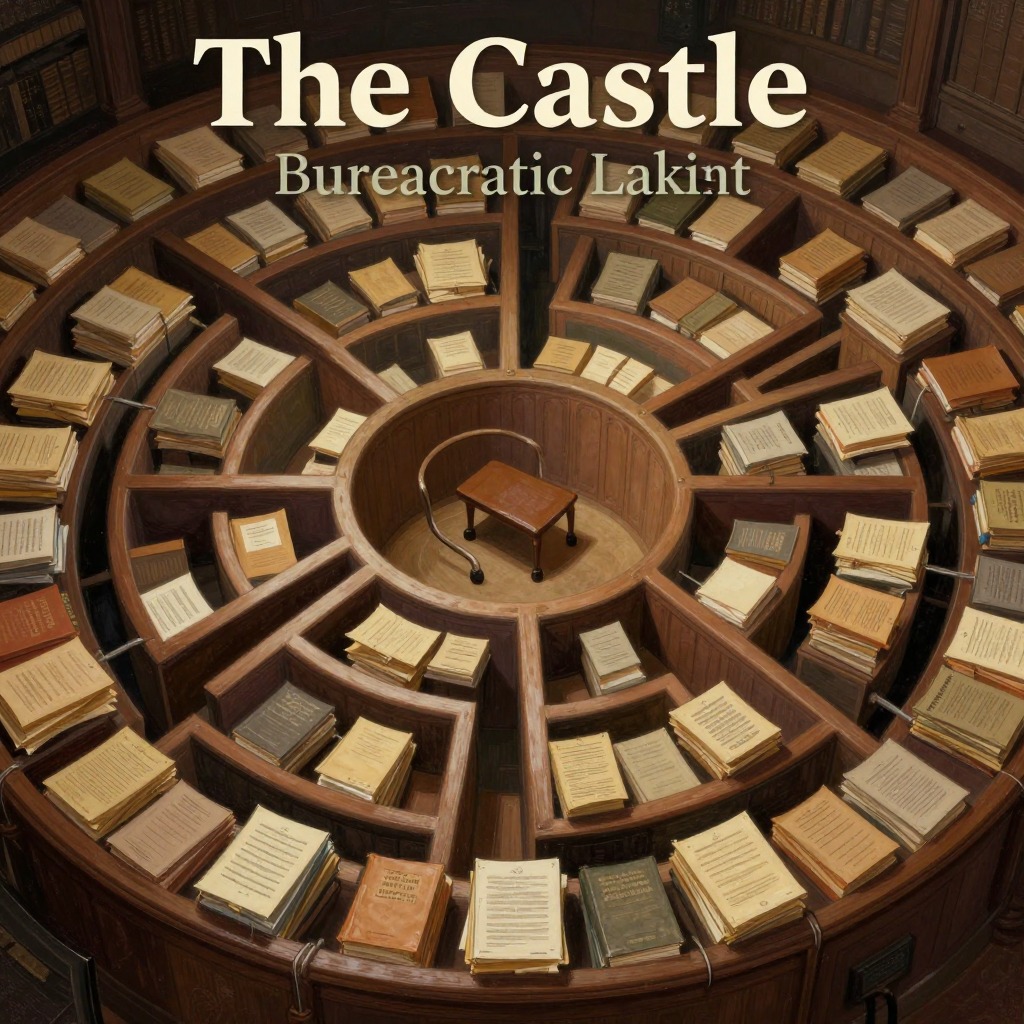
Sordini is introduced through the village mayor's narrative as a key figure in the castle's official machinery. He is an Italian official, a detail that sets him apart in the otherwise homogeneous administrative world. The mayor describes him as "one of the most industrious of the officials," yet wonders why a man of his abilities is "left languishing in one of the lowest-ranking positions of all." This paradox—great competence coupled with low rank—suggests a system where merit does not necessarily dictate position. Sordini's office is said to be so overworked that its walls are hidden behind towers of files, which constantly collapse, producing a sound that has become "typical of Sordini's office." He is a real worker, devoting the same attention to the smallest cases as to the largest, a trait that proves both admirable and disastrous in the context of K.'s case.
The Land Surveyor Case and Its Complications
Sordini's involvement in K.'s appointment stems from a bureaucratic error. Years before K.'s arrival, a decree from Department A ordered the appointment of a land surveyor, but the village's reply—stating that no surveyor was needed—was mistakenly sent to Department B. There, the file cover reached Sordini, who, with his characteristic distrust, refused to accept the village's vague response. He initiated a long correspondence with the village mayor, demanding explanations and questioning the existence of the original decree. The mayor, Mizzi, and later the schoolteacher were drawn into this exchange, which dragged on for years. Sordini's insistence on uncovering the truth, despite the authorities' principle that mistakes are impossible, led to daily hearings at the Castle Inn and the involvement of the parish council. His efforts, though meticulous, were ultimately rendered futile when a supervisory authority discovered the original error, forcing Sordini to realize he had been dealing with a case outside his competence.
Relationship with K. and the Castle's Authority
Sordini never appears directly in the narrative; he is known only through the mayor's account and the general awe he inspires. K. initially confuses him with Sortini, another official with a similar name, but the mayor corrects this, noting that Sordini is "very well known" while Sortini is "extremely reserved." Sordini's role in K.'s appointment is indirect but significant: his relentless pursuit of the case, even after it was effectively settled, contributed to the confusion that led K. to be summoned to the village. The mayor explains that Sordini's distrust and the bureaucratic tangle he created were part of the "ridiculous confusion" that could determine a man's life. K. listens to this story with a mixture of fascination and frustration, recognizing that his own fate is entangled in the machinations of an official he will never meet.
Significance and Thematic Resonance
Sordini embodies the castle's bureaucratic absurdity and the inaccessibility of its authority. His extreme conscientiousness, which should be a virtue, becomes a source of chaos, illustrating the novel's theme that the system's perfection is its own undoing. The mayor's description of Sordini's office—with its collapsing towers of files—serves as a metaphor for the castle's administration: vast, overworked, and perpetually on the verge of collapse. Sordini's distrust, which the mayor admires as "the way an official ought to proceed," highlights the paranoid logic of the bureaucracy, where even the most trustworthy individuals are treated as potential rogues. Through Sordini, Kafka critiques the dehumanizing nature of bureaucratic systems, where individual competence is subsumed by the relentless machinery of officialdom. Sordini's story also underscores K.'s powerlessness: despite his efforts to engage with the castle, he is merely a pawn in a game played by unseen officials like Sordini, whose decisions are made far above his head.