the landlady
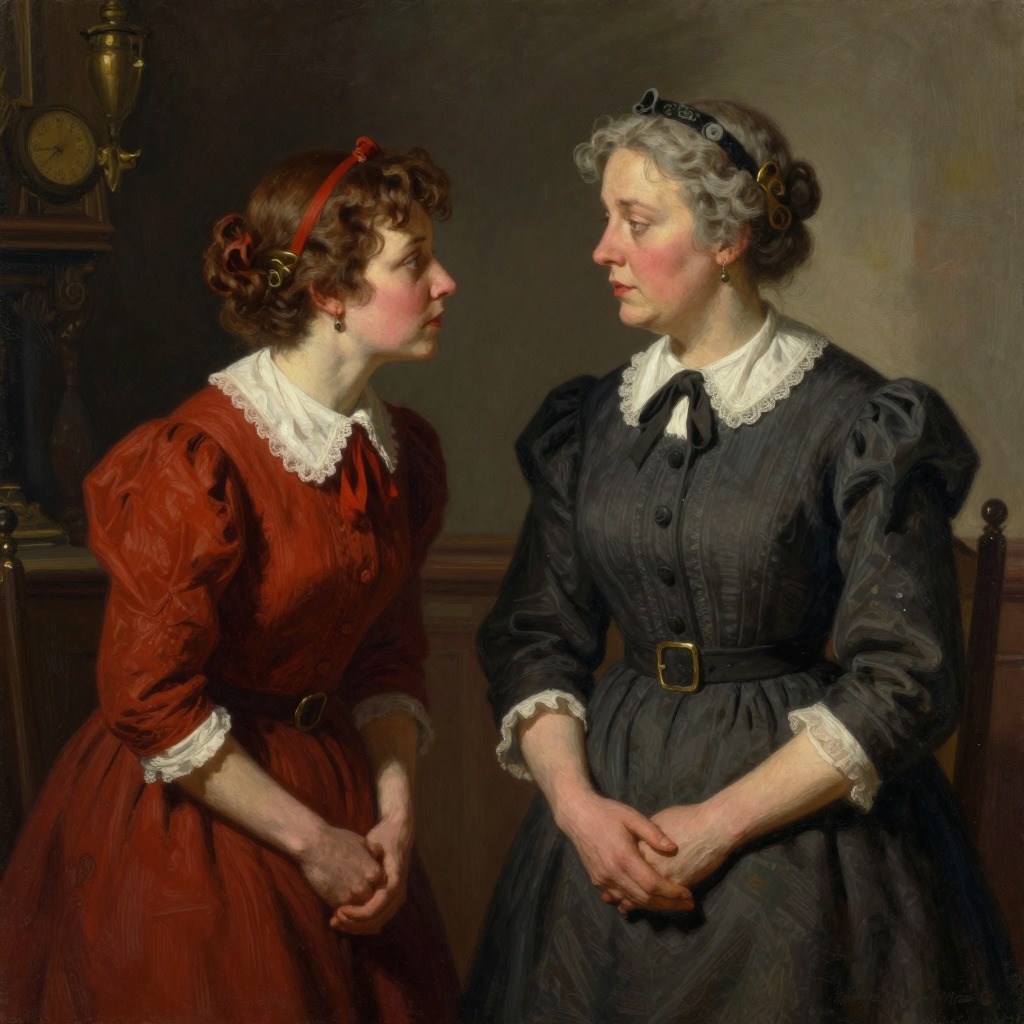
The landlady of the Bridge Inn, whose given name is Gardena, is one of the most powerful and enigmatic figures in the village. A stout, once-beautiful woman with a serious heart condition, she rules her household with an iron will, compensating for her husband's weakness. Her authority is rooted not only in her formidable personality but in a past that sets her apart from ordinary villagers: she was once Klamm's mistress, summoned by him three times over twenty years ago. This history has left her with a permanent sense of loss and a fierce, almost religious devotion to Klamm's memory, which she preserves through three treasured mementos: a photograph of a messenger, a shawl, and a nightcap, all gifts from him. This past makes her both a guardian of the village's social hierarchy and a bitter enemy of anyone who threatens it, especially K.
Identity and Background
Gardena is the landlady of the Bridge Inn, a position she earned through relentless hard work after her marriage. She is the daughter of the village blacksmith and married Hans, a former groom, shortly after Klamm stopped summoning her. She threw herself into running the inn, cooking so well that she even lured guests away from the Castle Inn, and eventually bought the establishment outright. This success came at a great personal cost, undermining her health and leaving her with a serious heart condition. She is acutely aware of her status, describing herself as the landlady of "the lowest kind of inn," yet she wields considerable influence, particularly over her husband, whom she considers a good but irresponsible young man, and over Frieda, whom she treats as a surrogate daughter. Her life is dominated by the memory of Klamm, and she admits that without her three mementos of him, she could not have borne her life in the village for a single day.
Relationship with Frieda and Opposition to K.
Gardena's primary concern is Frieda's welfare, which she interprets through the lens of her own experience with Klamm. She sees Frieda's relationship with Klamm as the highest possible honor and is horrified when Frieda leaves him for K., a man she considers a "nothing"—a stranger, a vagrant, and a disruptive force. She accuses K. of seducing Frieda only to gain access to Klamm, and she repeatedly tries to warn Frieda against him, using her own story as a cautionary tale. In her first conversation with K. about Frieda, she delivers a blistering tirade, telling him that Klamm will never speak to him and that he is a "superfluous person getting in everyone's way." She even threatens to turn K. out of the inn, a threat she later attempts to carry out. Despite her hostility, she is also capable of a grudging, manipulative concern, offering to use her connections to arrange a meeting with Klamm if K. will promise to do nothing on his own account. This offer is a trap, designed to control him, and when K. refuses, she is furious.
The Landlady's Past and Its Influence
Gardena's entire worldview is shaped by her brief, intense relationship with Klamm. She was summoned by him only three times, and after that, he never called for her again. She has spent the intervening decades obsessively wondering why, discussing it with her husband night after night. She believes that Klamm forgets people entirely once he stops summoning them, a fate she considers worse than death. This belief fuels her conviction that Frieda's abandonment of Klamm for K. is a catastrophic mistake. She contrasts her own patient, long-suffering devotion with Frieda's impulsive passion, claiming that she, unlike Frieda, was wise enough to take mementos from Klamm when she had the chance. Her story reveals a woman trapped by her own past, unable to move beyond the moment when she was chosen and then discarded by a power she still worships.
Narrative Role and Thematic Significance
The landlady functions as a threshold guardian and a voice of the village's entrenched social order. She embodies the novel's central themes of inaccessibility, the crushing weight of authority, and the impossibility of genuine connection across social hierarchies. Her fierce opposition to K. is not merely personal malice but a defense of a system in which Klamm is an unapproachable, almost divine figure. She represents the tragic consequences of that system: a woman whose entire life has been defined by a brief, unequal relationship with a man she can never reach again. Her final, strange conversation with K. about her dresses reveals a vanity and a need for validation that undercuts her formidable exterior, suggesting a deep, unfulfilled longing beneath her rigid authority. She is a round character, capable of surprising the reader with her vulnerability, yet her core is fixed by her unwavering devotion to Klamm and her absolute rejection of anyone who challenges his primacy.