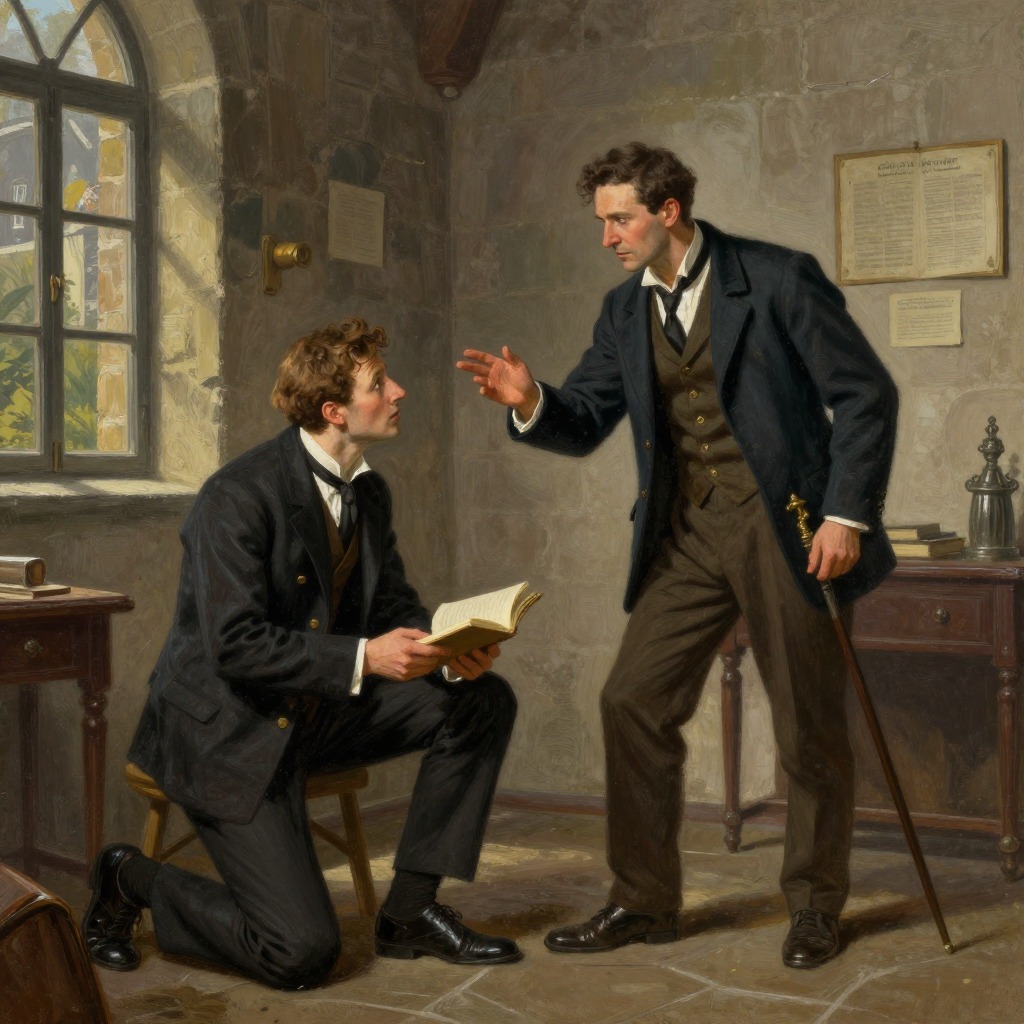
the village mayor
The village mayor is the official head of the village council and, according to Klamm's first letter, K.'s immediate superior. He is a friendly, stout, clean-shaven man who suffers from a severe attack of gout and receives K. in bed. His role is pivotal in the novel's exploration of bureaucratic absurdity, as he delivers the unwelcome truth that the village has no need for a land surveyor, unraveling the official confusion that brought K. to the village. He embodies the castle's administrative labyrinth, where mistakes are inevitable yet never acknowledged, and where communication is paradoxically both essential and unreliable.
Identity and Background
The village mayor is introduced as a friendly, stout, clean-shaven man, ill with a severe attack of gout, who receives K. in bed. He is assisted by his wife, Mizzi, a quiet woman who appears almost shadowy in the dimly lit room. The mayor's illness is a recurring motif, symbolizing the paralysis of the village's official machinery. He has been village mayor for many years, having held the post when the original decree about a land surveyor arrived, and he keeps a vast collection of files, which he stores in cupboards and a barn, reflecting the overwhelming and chaotic nature of village administration. He is a farmer at heart, as he tells K., 'I'm not enough of an official for that, I'm a farmer and that's that,' yet he is burdened with official duties as a sideline, which he cannot keep up with, especially when ill.
The Bureaucratic Confusion of K.'s Appointment
The mayor's central function in the narrative is to explain the bureaucratic tangle that led to K.'s appointment. He recounts that many years ago, a decree from Department A ordered the appointment of a land surveyor, but the village replied that none was needed. This reply was mistakenly sent to Department B, which received only the cover of the file, leading to a long correspondence with the conscientious Italian official Sordini. The mayor describes how Sordini, distrustful by nature, initiated a lengthy investigation, which was further complicated by the interference of Brunswick, who led a faction that questioned the village's refusal. The case dragged on for years, and eventually, a supervisory authority discovered the original mistake, but by then, K. had already been summoned. The mayor concludes that K.'s appointment was a mistake, but he also suggests that in the castle's view, there are no mistakes, only decisions that may or may not be correct in the long run. This explanation highlights the castle's principle of infallibility and the villagers' acceptance of its arbitrary authority.
The Mayor's Interpretation of Klamm's Letter
When K. presents Klamm's letter, the mayor offers a deflating interpretation. He reads it with his wife, Mizzi, and concludes that it is not an official communication but a private letter, as evidenced by the salutation 'Dear Sir.' He points out that it does not confirm K.'s appointment as land surveyor but merely refers to service to the castle, and that the burden of proof lies on K. The mayor asserts that the letter's significance is private, not official, and that it means only that Klamm personally intends to concern himself with K. should he be accepted into service. This interpretation undermines K.'s hopes and demonstrates the mayor's expertise in reading official and unofficial communications, a skill born of long experience with the castle's ways.
The Mayor's Views on the Castle and Communication
The mayor also educates K. about the nature of the castle's communication systems. He explains that the telephone, which K. used to contact the castle, is unreliable: there is no real connection to the castle, and calls are answered by lower departments or even by tired officials playing jokes. The only trustworthy information the telephone conveys is the rushing, singing sound on the line. He further explains that the castle's authorities are organized to prevent mistakes, and that supervisory authorities exist not to detect errors but to ensure the smooth functioning of the system. The mayor's insights reveal the castle's inaccessibility and the villagers' resigned acceptance of its power, as he tells K., 'You have never really been in contact with our authorities. All your contacts are only apparent.'
The Mayor's Role in K.'s Life
Despite his initial refusal to accept K. as a land surveyor, the mayor offers K. a provisional post as school janitor, a position that K. eventually accepts under pressure from Frieda. The mayor's decision is motivated by a desire to keep K. from acting rashly, as he fears K. might do something thoughtless if the decision on his affairs is delayed. The mayor's offer, though humiliating, provides K. with a foothold in the village, and the mayor later refuses to dismiss K. even when the teacher demands it, showing a measure of goodwill. The mayor's character thus embodies the castle's ambiguous benevolence, which is both helpful and constraining, and his interactions with K. illustrate the protagonist's struggle to navigate a system that is both arbitrary and absolute.