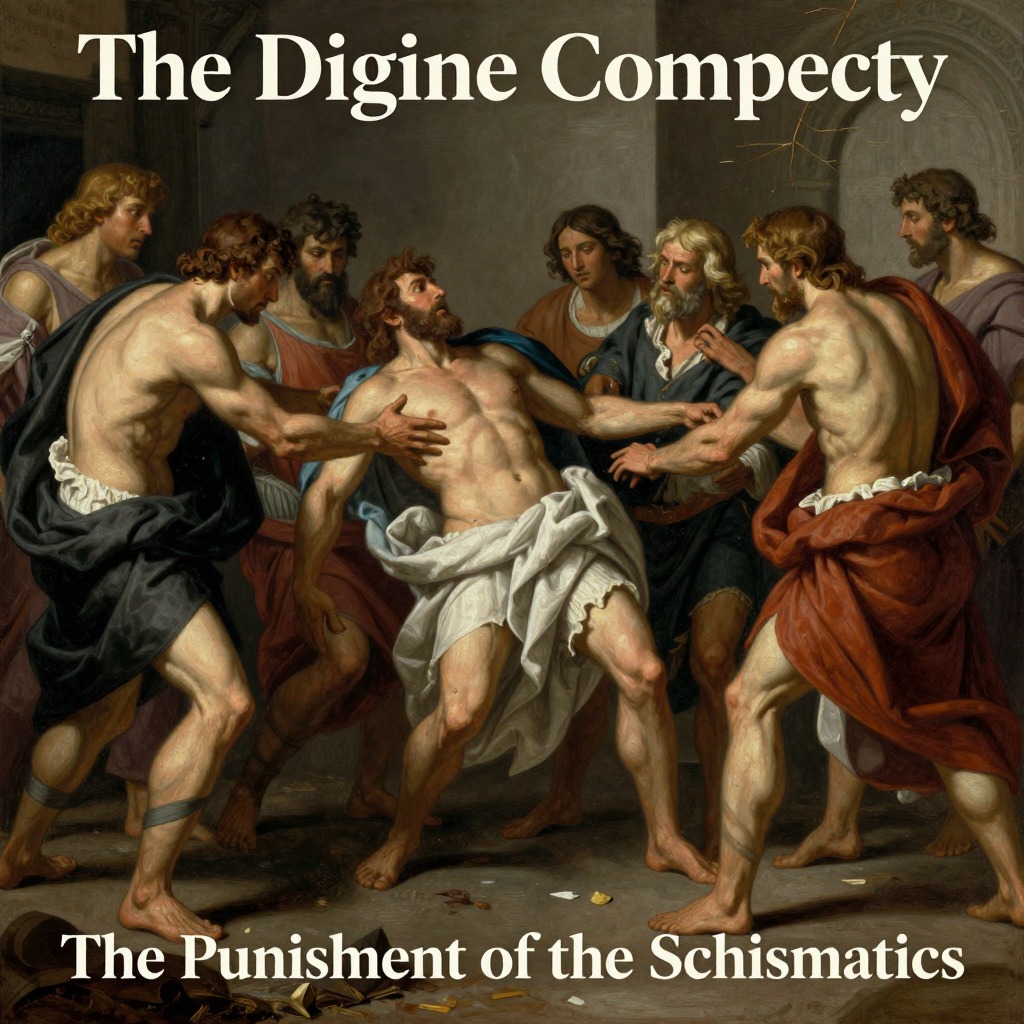
Bertrand de Born
Bertrand de Born, the 12th-century troubadour and lord of Hautefort, appears in Dante's Inferno as a mutilated shade in the Ninth Bolgia of Malebolge, where the Schismatics—those who sowed discord—are eternally punished. His penalty is the most physically extreme of the entire circle: he walks as a headless trunk, carrying his own severed head by the hair, swinging it like a lantern. This grotesque image is not mere horror but a precise instance of contrapasso, the law of symbolic retaliation that governs all suffering in Hell. Bertrand's crime was to divide what should have been united—a father and a son—and his punishment is to be divided from himself, his brain separated from its bodily origin forever.
Identity and Historical Background
Bertrand de Born was a nobleman and poet of the Limousin region in southern France, celebrated for his martial sirventes (war songs) and his involvement in the political intrigues of the late 12th century. He is best known for his role in the rebellion of Henry the Young King against his father, King Henry II of England, a conflict that pitted son against father and threatened the stability of the Angevin empire. Dante, writing a century later, places him among the Schismatics—those who "disseminators of scandal and of schism / While living were"—and gives him the most memorable punishment of the entire bolgia. Bertrand himself identifies his crime in the poem: he "gave to the Young King the evil comfort" and "made the father and the son rebellious." The reference is to Achitophel, the biblical counselor who incited Absalom to rebel against King David, a parallel that elevates Bertrand's offense from a local political act to a universal archetype of treachery against natural bonds.
Punishment and Contrapasso
When Dante encounters Bertrand, the shade is carrying his own severed head by the hair, "in fashion of a lantern," and the head speaks, saying "O me!" The trunk walks among the other mutilated souls, and the head gazes at the poet and his guide. The contrapasso is explicit: "Because I parted persons so united, / Parted do I now bear my brain, alas! / From its beginning, which is in this trunk." The punishment literalizes the crime—just as Bertrand divided the closest of human bonds, the bond between father and son, so his own body is divided, the head (the seat of the will and intellect that conceived the rebellion) severed from the body that carried out its commands. The head serves as a lamp, illuminating the darkness of Hell with the very organ that once plotted in darkness. This image of self-display—the head held up for all to see—also suggests a terrible fame: Bertrand's crime is made eternally visible, a warning to all who would follow his path.
Narrative Role and Thematic Significance
Bertrand de Born appears at the climax of Canto XXVIII, the most graphically violent canto of the Inferno, which is filled with the hacked and mutilated bodies of the Schismatics. His entrance is preceded by the prophet Mahomet, who is split from chin to groin, and by Pier da Medicina, whose throat is pierced and nose cut off. But Bertrand's punishment surpasses them all in its symbolic completeness. Dante emphasizes the wonder of the sight: "I truly saw, and still I seem to see it, / A trunk without a head walk in like manner / As walked the others of the mournful herd." The poet then adds a theological note: "It of itself made to itself a lamp, / And they were two in one, and one in two; / How that can be, He knows who so ordains it." This acknowledgment of mystery—that the divided body can still function as a unified witness—underscores the divine justice that transcends human understanding. Bertrand's final words to Dante are a direct address: "Behold now the sore penalty, / Thou, who dost breathing go the dead beholding; / Behold if any be as great as this." He thus becomes a self-conscious exhibit of God's justice, his punishment a sermon in flesh. The episode also serves as a warning to Dante's own contemporary political world, where the strife between Guelphs and Ghibellines, and between popes and emperors, mirrored the division Bertrand had fomented. In the larger structure of the Comedy, Bertrand de Born represents the ultimate perversion of the troubadour's art: instead of using poetry to unite lovers or celebrate virtue, he used his words to sever the most sacred of human ties, and his eternal reward is to be severed from himself.