Celestial Eagle
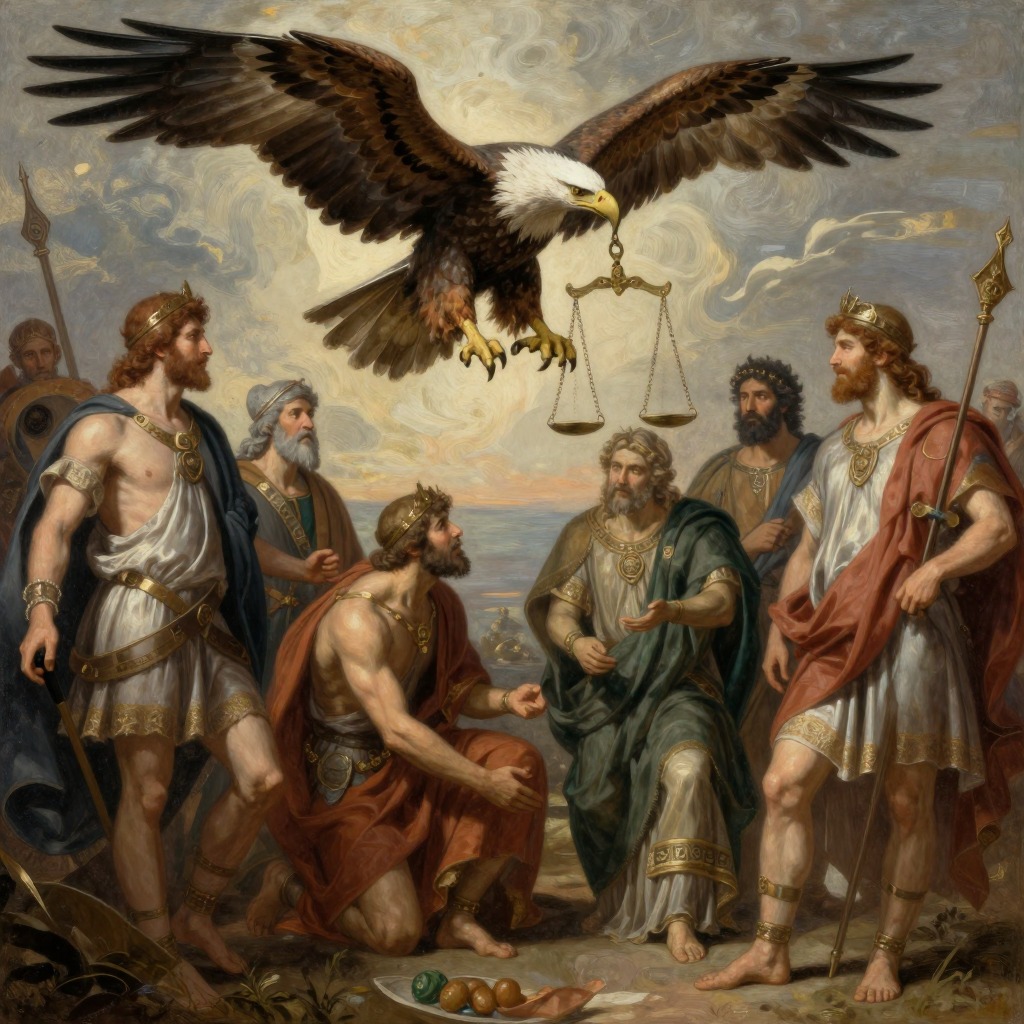
The Celestial Eagle is the central symbolic figure of the Sixth Heaven, the sphere of Jupiter, in Dante Alighieri's Paradiso. It is not a single soul but a collective image formed by the scintillating lights of the just rulers and righteous souls who dwell there, a living emblem of divine justice that speaks with one voice while comprising many. Its appearance and its discourse constitute one of the most theologically intricate and politically charged episodes in the poem's final cantica, addressing the nature of God's judgment, the fate of the virtuous pagan, and the corruption of contemporary monarchs.
Formation and Appearance
The Eagle takes shape gradually before Dante's eyes. In the sphere of Jupiter, the blessed spirits first arrange themselves into letters, spelling out the opening of the Book of Wisdom: "Diligite justitiam, qui judicatis terram" ("Love justice, you who judge the earth"). From the final letter M of this inscription, the lights then ascend and reconfigure themselves into the head and neck of an eagle, a figure formed by the inlaid fire of the souls themselves. The poet describes the process as akin to sparks flying from burning logs, with the lights rising to form the image. The Eagle is thus a self-assembling, living symbol, not a static emblem, and its beauty is such that Dante declares the one who paints it has no guide but Himself—that is, God. The star Jupiter itself is described as a "gentle star" and a "Jovial torch," and the Eagle's appearance is one of silver inlaid with gold, a vision of serene and temperate majesty.
The Single Voice of Collective Justice
Though composed of many individual lights, the Eagle speaks with a single voice, using the first-person singular "I" and "My" even as its conception is "We" and "Our." This paradox is central to its nature: it is a unity of many wills, all perfectly aligned with divine justice. The Eagle explains that it is exalted to its glory because it was "just and merciful" on earth, and that its memory on earth, though commended by the evil-minded, is not followed by them. The voice that issues from the beak is described as a murmuring that travels up the hollow neck of the image, like wind entering a pipe, before forming into articulate words. This collective voice then delivers a lengthy discourse that addresses Dante's deepest doubts about the justice of condemning the unbaptized virtuous.
The Discourse on Divine Justice and the Virtuous Pagan
The Eagle's central theological argument responds to Dante's unspoken question: how can a man born on the banks of the Indus, who lives a morally good life but never hears of Christ, be damned for lack of faith? The Eagle's answer is a profound meditation on the limits of human reason. It states that the primal will, which is itself the Good Supreme, never moves from itself, and that "so much is just as is accordant with it." Human vision cannot penetrate the depth of the eternal judgment, just as the eye cannot see the bottom of the ocean far from shore. The Eagle then makes a startling revelation: some who never knew Christ in the flesh are nonetheless saved. It names two specific figures among the lights of its eyebrow: the Trojan Ripheus and the Emperor Trajan. Ripheus, a pagan from Virgil's Aeneid, is said to have set all his love on righteousness, and through grace, God unclosed his eye to the future redemption, so that he believed in Christ to come and was baptized by the three theological virtues more than a thousand years before baptizing existed. Trajan, a just Roman emperor, was briefly returned to life from Hell through the prayers of Pope Gregory the Great, allowing him to believe in Christ and earn salvation. These examples illustrate that predestination is a mystery whose root is far from the sight of those who do not behold the First Cause entire.
The Condemnation of Corrupt Kings
The Eagle's discourse is not limited to abstract theology; it also delivers a fierce and specific condemnation of the wicked Christian rulers of Dante's own era. Speaking of the volume of divine judgment that will be opened at the end of time, the Eagle names a litany of corrupt monarchs: Albert of Germany, whose deeds will cause the realm of Prague to be deserted; Philip the Fair of France, who falsifies the coin and will die by a wild boar; the wasteful king of Spain; the cowardly king of Bohemia; the cripple of Jerusalem, whose goodness is represented by an I and his evil by an M; the avaricious king of Sicily; and the dishonorable kings of Portugal, Norway, and Rascia. The Eagle also prophesies that the Ethiopians will condemn the Christians at the Last Judgment, for many who cry "Christ, Christ!" will be less near to Him than some who never knew Him. This political invective, delivered by the very embodiment of justice, serves as a powerful warning that earthly power does not guarantee divine favor.
The Souls within the Eagle's Eye
The Eagle itself is composed of six named souls, arranged in the pattern of its eye and brow. The central pupil is King David, the "singer of the Holy Spirit," who bore the ark of the covenant. The five souls forming the eyebrow are, in order: the Emperor Trajan, who consoled the poor widow and whose penitence postponed his death; King Hezekiah, who postponed his death by sincere penitence; the Emperor Constantine, who, with good intent but bad result, ceded the West to the Pope and became a Greek; the good King William II of Sicily, whom the same land mourns that weeps for Charles and Frederick; and finally, the Trojan Ripheus, the most astonishing inclusion, a pagan who was saved by his perfect love of righteousness. The Eagle thus presents a vision of salvation that transcends the boundaries of time, nation, and even explicit religious affiliation, all within the framework of God's inscrutable but ultimately just will.