Count Ugolino
Count Ugolino is a central figure in the final cantos of the Inferno, a damned soul whose punishment and personal narrative crystallize the themes of treachery, suffering, and the perversion of familial bonds. He is encountered in the second ring of the Ninth Circle, Antenora, reserved for traitors to their country or party, where he is frozen in the ice of Cocytus, locked in a perpetual, bestial act of vengeance against his betrayer, Archbishop Ruggieri. His story, one of the most poignant and horrifying in the entire poem, transforms him from a political traitor into a figure of immense, tragic pathos, whose suffering challenges the reader's capacity for pity even within the framework of divine justice.
Identity and Background
Count Ugolino della Gherardesca was a powerful 13th-century Italian nobleman and a Guelph leader from Pisa. He identifies himself to Dante as a Florentine by the sound of his speech, though his political machinations were centered in Pisa. His downfall came at the hands of Archbishop Ruggieri degli Ubaldini, a Ghibelline rival. Ugolino explains that Ruggieri, through his malicious thoughts, made him a prisoner and then put him to death. The specific crime for which he is damned is treason against his country, a sin punished in Antenora. His eternal punishment is to be frozen in the ice alongside Ruggieri, whom he eternally gnaws, a visceral and literal embodiment of his undying hatred and the contrapasso for his betrayal.
The Story of His Death
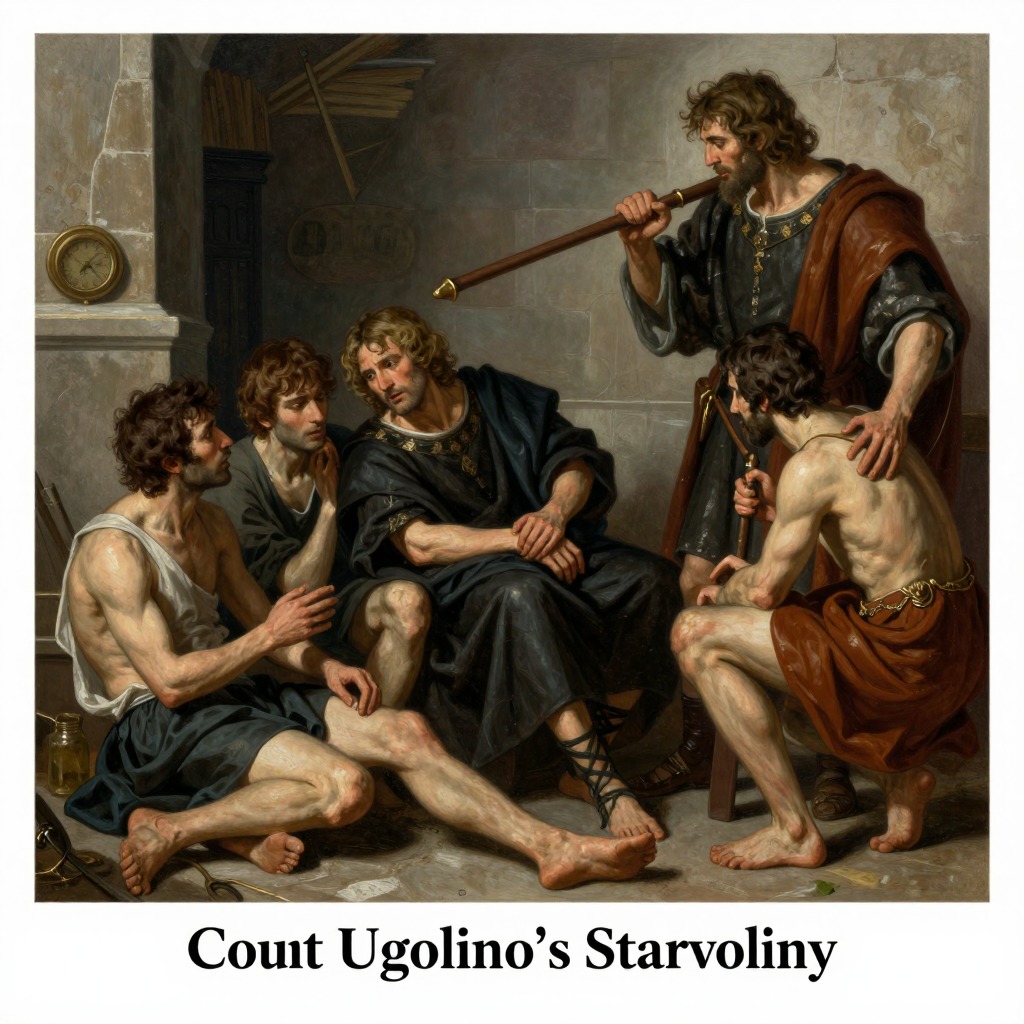
Ugolino's narrative, delivered while he pauses from his grisly meal, is the core of his character's significance. He describes being imprisoned with his sons and grandsons in a tower in Pisa, later known as the Tower of Famine. After many months, he had a prophetic dream in which Ruggieri, as a master hunter, pursued a wolf and its whelps (representing Ugolino and his children) with a pack of hounds, tearing their flanks. Upon waking, he heard his sons moaning in their sleep and asking for bread. When the hour for their usual food came, he heard the door of the tower being nailed shut. He gazed at his sons in silence, unable to weep, his heart turned to stone. His children, particularly his young son Anselm, asked him what was wrong, but he remained silent for the entire day and the following night. As a glimmer of light entered the prison, he saw his own anguish reflected in his sons' faces and, in agony, bit his own hands. His sons, believing he did it from hunger, offered their own flesh to him, saying, "Father, much less pain 'twill give us / If thou do eat of us; thyself didst clothe us / With this poor flesh, and do thou strip it off." Ugolino calmed himself to spare them further sadness. Over the next days, he watched his sons die one by one: Gaddo on the fourth day, and the other three between the fifth and sixth days. Already blind from hunger and grief, he groped over their dead bodies for three days, calling their names. The story concludes with the devastating line, "Then hunger did what sorrow could not do," implying that he finally succumbed to starvation, though the ambiguity of whether he also resorted to cannibalism has haunted the poem's readers for centuries.
Relationship with Archbishop Ruggieri
The relationship between Ugolino and Ruggieri is one of mutual betrayal and eternal, reciprocal torment. Ruggieri, whom Ugolino trusted, was the architect of his imprisonment and death. In Hell, their roles are reversed in a grotesque parody of their earthly conflict. Ugolino, the traitor, is now the eternal aggressor, his teeth fixed in Ruggieri's skull, "where the brain is to the nape united." This act is not merely one of punishment but of a willful, unending vengeance that Ugolino himself perpetuates. He tells Dante that his words are "seed that may bear fruit / Of infamy to the traitor whom I gnaw," indicating that his narrative is as much an act of posthumous revenge as his physical gnawing. The two are bound together in the ice, a single, inseparable unit of hatred and suffering, their relationship a stark emblem of the corrosive nature of treachery.
Thematic Significance
Ugolino's story serves as a profound exploration of the limits of pity and the nature of divine justice. Dante, the pilgrim, is so moved by the tale that he does not weep but instead feels a deep, overwhelming compassion, a reaction that the poem itself seems to endorse even as it condemns Ugolino to Hell. The pathos is amplified by the innocence of Ugolino's children, who are guilty of no crime yet share his fate. This raises a troubling question about the justice that punishes the innocent alongside the guilty. Furthermore, the story is a powerful indictment of Pisa, which Dante curses as an "opprobrium of the people," calling for the islands of Capraia and Gorgona to block the Arno and drown every inhabitant for their cruelty in killing Ugolino's young sons. Ugolino's narrative thus transcends his personal damnation to become a universal cry against political treachery and the suffering of the innocent, cementing his place as one of the most memorably tragic figures in all of literature.