Curio
Curio, a Roman tribune of the first century BCE, appears in Dante's Inferno as a figure whose historical role as a political incendiary is transformed into a permanent, grotesque emblem of schism. He is encountered in the Ninth Bolgia of the Eighth Circle, where those who sowed discord and division among people are punished. His presence, though fleeting, carries the weight of a decisive moment in Roman history: his advice to Julius Caesar to cross the Rubicon, an act that precipitated civil war and the end of the Republic. In Dante's moral geography, this counsel is not a mere political maneuver but a sin against the unity of the human community, and Curio's punishment is a precise, physical manifestation of that transgression.
Identity and Historical Background
Curio was a Roman senator and tribune who, after initially opposing Caesar, became one of his most ardent supporters. The historical record, particularly through Lucan's epic Pharsalia, which Dante knew well, emphasizes Curio's role in persuading Caesar to march on Rome. Dante draws directly on this tradition. In the Inferno, Curio is identified not by a lengthy self-introduction but by the testimony of another damned soul, Pier da Medicina, who points him out and describes his crime. Pier declares that Curio, "being banished, every doubt submerged / In Caesar by affirming the forearmed / Always with detriment allowed delay." This encapsulates the essence of Curio's guilt: he used his rhetorical skill to eliminate hesitation and push Caesar toward an irrevocable, destructive act. The phrase "the forearmed / Always with detriment allowed delay" is a compressed version of Curio's famous argument that inaction is more dangerous than action, a piece of advice that, in Dante's view, led directly to civil war.
Punishment and Contrapasso
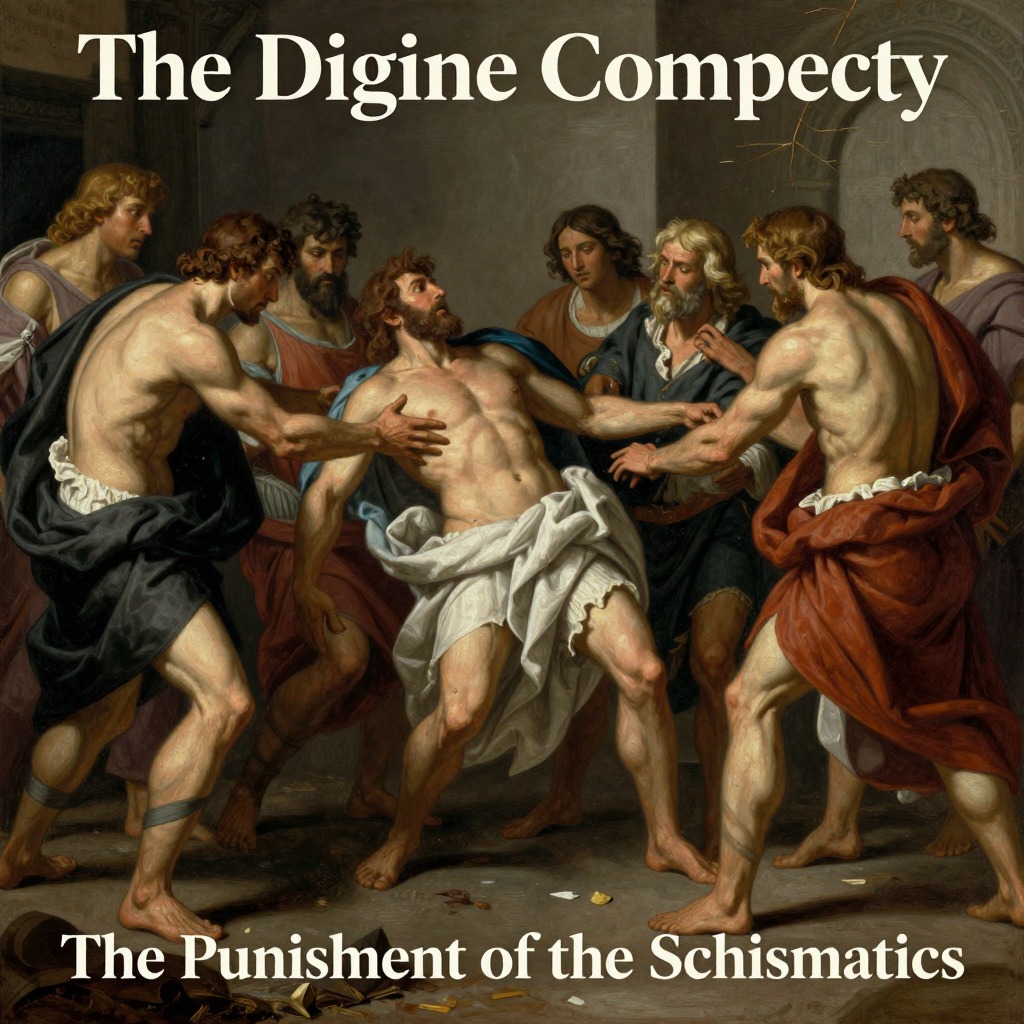
Curio's punishment is a stark example of Dante's principle of contrapasso, where the penalty mirrors the sin. He is found among the Schismatics, a group of souls who are horribly mutilated by a demon wielding a sword. Their bodies are slashed and split as a perpetual reenactment of the divisions they caused on earth. Curio's specific mutilation is described with brutal precision: he has "tongue asunder in his windpipe slit." The tongue, the instrument of his persuasive and divisive speech, is literally cut in two. This is not merely a symbolic wound; it is a permanent, physical condition that renders him unable to speak, the very act that defined his historical crime. The muteness is the ultimate negation of his power as an orator and counselor. Dante, observing him, notes that Curio, "who in speaking was so bold," is now reduced to a silent, gesticulating figure, his boldness forever silenced by the justice of Hell.
Narrative Role and Thematic Significance
Curio's appearance in the Inferno serves a specific narrative and thematic function. He is not a character with whom Dante converses; rather, he is pointed out by another sinner, Pier da Medicina, who acts as a guide through this particular section of the Malebolge. This indirect presentation emphasizes Curio's role as a historical example rather than a fully realized dramatic personality. His story is a cautionary tale about the power of words to cause irreparable harm. In the broader context of the Divine Comedy, Curio represents the corruption of political counsel, a theme that resonates with Dante's own experience of exile and his bitter critique of the factional strife that plagued Florence and Italy. The sin of schism, of which Curio is a part, is presented as one of the most serious, as it attacks the very fabric of social and political unity. Curio's silent, mutilated form stands as a permanent warning against the misuse of eloquence to serve ambition and division rather than truth and peace.