Forese Donati
Forese Donati, a Florentine glutton and intimate friend of Dante Alighieri, appears in the sixth terrace of Purgatory, where the sin of gluttony is purged through a paradoxical hunger and thirst. His encounter with Dante is one of the most personal and emotionally charged reunions in the entire Commedia, a meeting that not only rekindles old bonds but also illuminates the mechanics of purgatorial purification, the efficacy of prayers from the living, and the moral decay of contemporary Florence. Forese's presence is a testament to the power of repentance, even when delayed, and the profound love that can survive death and transform suffering into solace.
Identity and Background
Forese Donati was a Florentine, a member of the powerful Donati family, and a close companion of Dante Alighieri in their youth. The text implies a shared history of dissolute living, as Dante later alludes to a past they both regret, saying, "If thou bring back to mind / What thou with me hast been and I with thee, / The present memory will be grievous still" . This shared past, marked by gluttony and other excesses, forms the basis of their deep, fraternal bond. Forese's sister, Piccarda Donati, is already in Paradise, triumphing in her crown on high Olympus, a fact that Forese himself reveals to Dante with evident pride and joy . His wife, Nella, is a figure of devout piety, whose prayers and tears have been instrumental in shortening Forese's time in Purgatory.
Arc Through the Plot
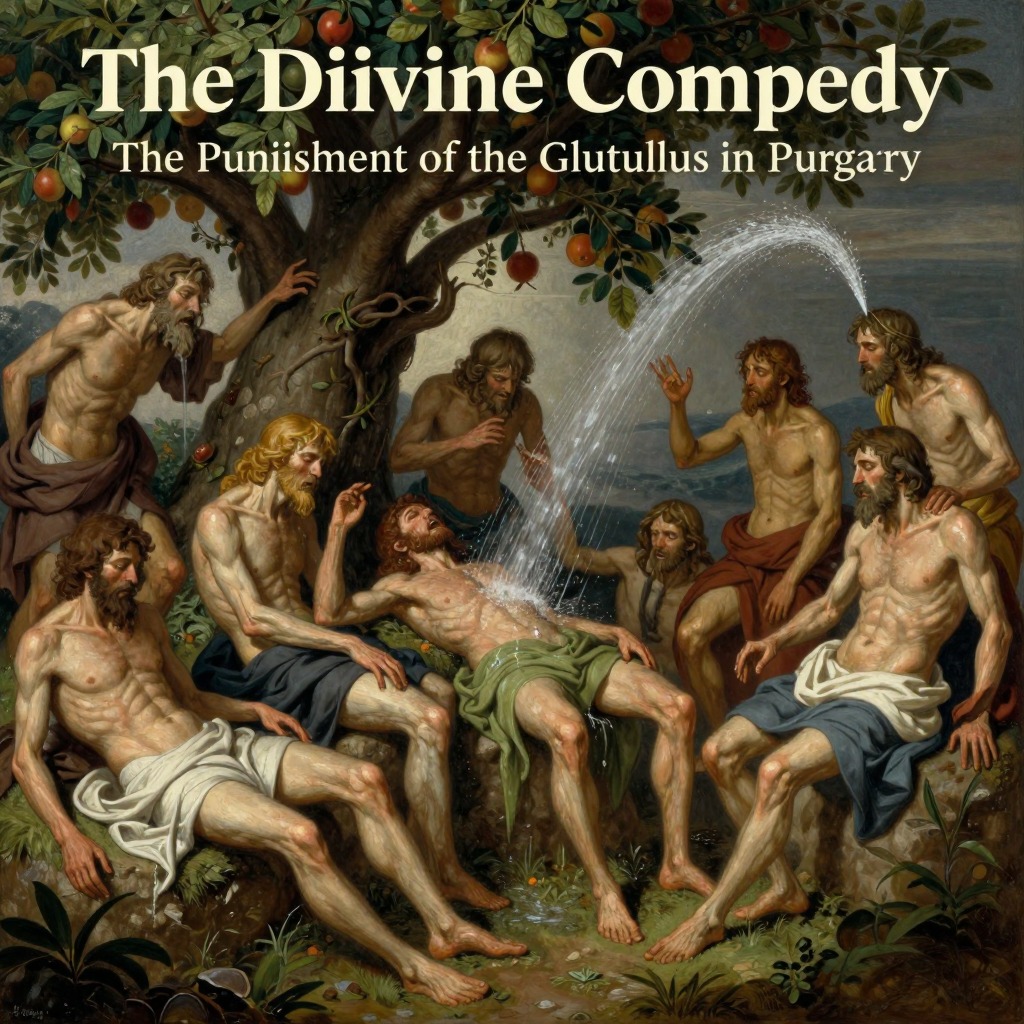
Dante encounters Forese on the sixth terrace of Mount Purgatory, where the gluttonous are purified. The meeting is marked by shock and recognition, as Forese's appearance is radically altered by the purgatorial process. He is so emaciated that Dante initially fails to recognize him, describing his face as "dark and cavernous," his skin stretched tight over his bones, and his eyes like "rings without the gems" . The sight moves Dante to profound grief, and he exclaims, "That face of thine, which dead I once bewept, / Gives me for weeping now no lesser grief" . Forese explains that the scent of the fruit from the tree and the water that sprays upon it, which they pass in their circuit, kindles an insatiable desire to eat and drink, a torment that is also their solace, for it mirrors the longing for God that ultimately leads to liberation . This process, he says, is like the Christ's own cry of thirst on the cross, "Eli," which liberated humanity .
Relationships and Conflict
The central relationship in this episode is the friendship between Dante and Forese. Their reunion is marked by a mixture of joy, sorrow, and mutual recognition of past failings. Forese's primary conflict is with his own past sin of gluttony, which he is now actively purging. However, the narrative also reveals a broader social conflict: Forese's fierce condemnation of the immodest women of Florence. He prophesies a time when they will be forbidden from going about "displaying breast and paps," a practice he compares unfavorably to the modesty of women in the "Barbagia of Sardinia" . This outburst reveals a deep concern for the moral state of his city, a theme that resonates with Dante's own political and moral critiques throughout the poem. Forese's relationship with his wife, Nella, is presented as a model of redemptive love. Her "overflowing tears" and "prayers devout" have drawn him from the Ante-Purgatory and set him free from the other circles, demonstrating the power of intercessory prayer .
Change and Ending
Forese's transformation is both physical and spiritual. He has moved from a life of gluttony to a state of purgatorial hunger that is itself a form of grace. His joy at seeing Dante alive is palpable, and he eagerly questions him about his journey and his companions. When Dante reveals that Virgil is his guide and that Statius has just been freed from Purgatory, Forese is filled with wonder. The encounter ends with Forese departing to rejoin the other penitents, but not before delivering a final, cryptic prophecy about the corruption in Florence. He tells Dante that the man most guilty of the city's ruin will be dragged "at a beast's tail" towards the valley where there is no repentance, a grim foreshadowing of divine justice . Forese then hurries away, driven by the urgency of his purgatorial work, leaving Dante with Virgil and Statius.
Thematic Significance
Forese Donati's episode is a powerful illustration of several key themes in the Commedia. First, it demonstrates the efficacy of prayer from the living for the dead, as Nella's intercessions have dramatically shortened Forese's purgatorial sentence. Second, it explores the nature of purgatorial suffering, which is not merely punitive but restorative, transforming the sinner's disordered desires into a longing for God. The hunger and thirst of the gluttons are a direct contrapasso for their former excess, yet they are also a source of solace, as they lead the soul toward its true end. Third, the episode reinforces the importance of friendship and memory, as Dante's grief and love for Forese are integral to the emotional power of the scene. Finally, Forese's prophecy against Florence serves as a reminder of the poem's ongoing political and moral critique, linking the personal purification of the individual soul to the broader need for societal reform.