Guido Guinicelli
Guido Guinicelli, the thirteenth-century Bolognese poet, occupies a singular place in Dante's Divine Comedy as the acknowledged father of the "sweet new style" (dolce stil novo) and as a soul undergoing purification in Purgatory's seventh terrace, where the lustful are cleansed by fire. His appearance in Canto XXVI of the Purgatorio is not merely another encounter among the penitent; it is a moment of profound literary and personal recognition, in which Dante, the pilgrim, meets the man whose verses first taught him how love could be the subject of exalted poetry. Guinicelli's role in the poem is thus double: he is both a historical figure suffering the consequences of his earthly appetites and a poetic ancestor whose influence Dante openly celebrates, even as he surpasses him.
Identity and Literary Legacy
Guido Guinicelli (circa 1230–1276) was a poet of the Bolognese school, active in the generation before Dante. He is credited with founding the dolce stil novo, a poetic movement that transformed the courtly love tradition by making love an instrument of moral and spiritual refinement. In the Purgatorio, Dante presents him as a figure of immense authority: when Guinicelli names himself, Dante's reaction is immediate and overwhelming. He describes himself as being like the sons of Lycurgus, who, upon seeing their mother again, were struck with a joy that lifted them—though Dante adds that he did not rise to such a height, only felt the force of the emotion. The pilgrim stands "without speech and hearing thoughtfully" for a long time, beholding the poet, unable to approach him because of the fire that separates them. When he finally speaks, Dante declares that Guinicelli's "dulcet lays" will make their very ink dear "as long as shall endure our modern fashion." This is not mere flattery; it is a formal acknowledgment of literary paternity.
The Encounter in the Seventh Terrace
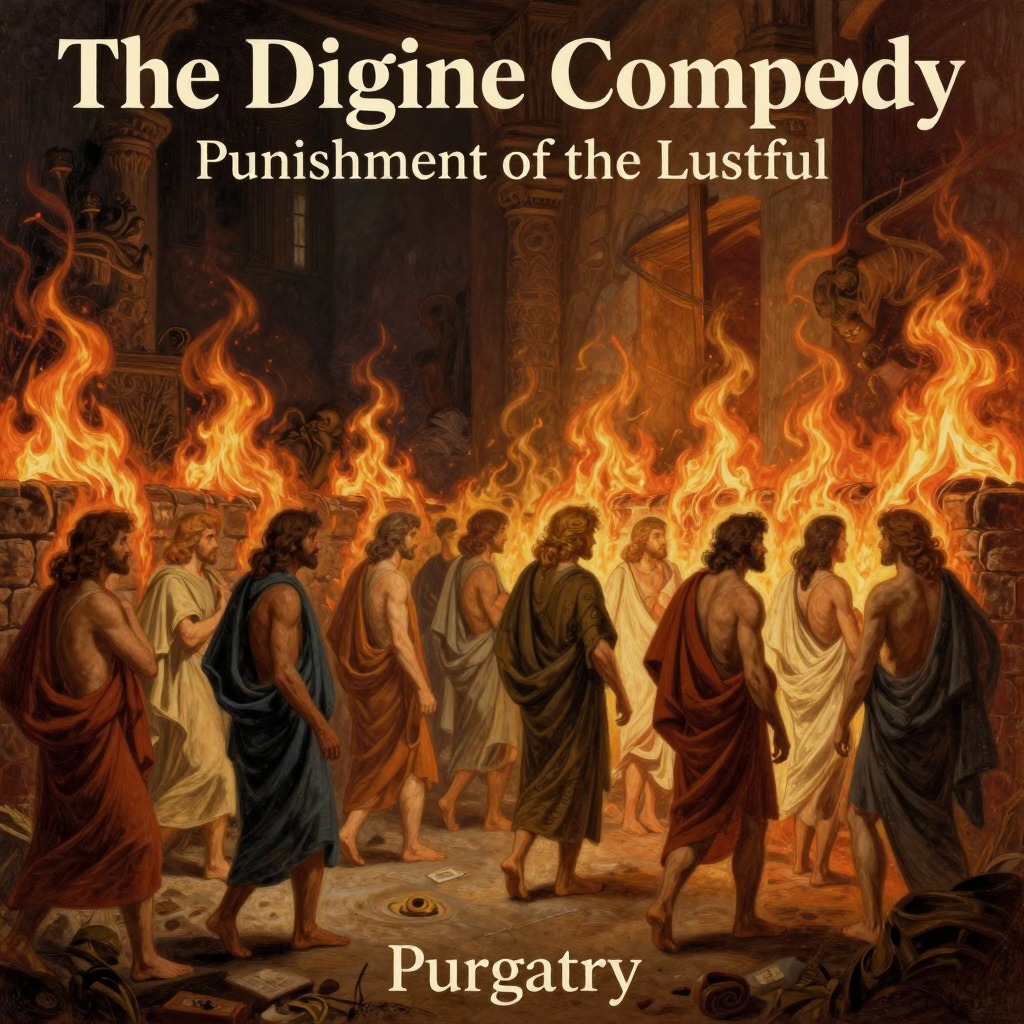
The meeting occurs on the seventh and final terrace of Mount Purgatory, where the sin of lust is purged. The penitent souls walk through a wall of flame, singing hymns and crying out examples of chastity and of lust punished. Guinicelli is among them, and when he first speaks to Dante, he does so from within the fire, his words emerging as if from a furnace. He identifies himself not by name but by his sin: he and his companions are those who "observed not human law, following like unto beasts our appetite." Yet his tone is not one of despair; he speaks of purging himself "having repented ere the hour extreme." When Dante, after learning his identity, expresses his reverence, Guinicelli responds with characteristic modesty and generosity. He points to another spirit ahead of him—Arnaldo Daniello—and declares that this Provençal poet was "of the mother tongue a better smith," mastering both "verses of love and proses of romance." He dismisses those who think the Lemosin surpasses Arnaldo, calling them "idiots" who form opinions "ere art or reason has by them been heard." This judgment is not petty; it is a measured literary critique, delivered from within the purifying fire.
Relationship with Dante and the Sweet New Style
The encounter is as much about poetic theory as about personal homage. Earlier in the canto, Buonagiunta da Lucca had asked Dante if he was the one who "evoked the new-invented rhymes, beginning, 'Ladies, that have intelligence of love?'" Dante's reply—that he writes as Love dictates—had already established the principle of the dolce stil novo: poetry as the direct transcription of love's inner voice. Now, with Guinicelli, the genealogy is made explicit. Guinicelli himself acknowledges that he and his contemporaries—including the Notary (Giacomo da Lentini) and Guittone d'Arezzo—were held "short of the sweet new style that now I hear." He sees clearly how Dante's pen "goes closely following after him who dictates," whereas their own did not. This is a remarkable moment of self-awareness and humility: the founder of the tradition admits that his successor has surpassed him. Dante, for his part, does not gloat. He simply listens, and when Guinicelli vanishes back into the fire "as fish in water going to the bottom," the pilgrim is left with the weight of the encounter.
Thematic Significance: Poetry, Purification, and Influence
Guinicelli's presence in Purgatory serves multiple thematic purposes. First, it dramatizes the idea that even the highest artistic achievement does not exempt a soul from the need for purification. Guinicelli was a great poet, but he was also a man who sinned; his lust must be burned away before he can ascend to Paradise. Second, the encounter establishes a literary lineage that culminates in Dante himself. By having Guinicelli—the acknowledged master—defer to Arnaldo Daniello and then to Dante, the poem constructs a history of vernacular poetry in which Dante stands as the heir and perfection of a tradition. Third, the scene underscores the Purgatorial principle that suffering is not incompatible with joy. Guinicelli speaks of his punishment without bitterness, and his final words are a request for Dante's prayers: "To him repeat for me a Paternoster, so far as needful to us of this world, where power of sinning is no longer ours." The request is humble, liturgical, and forward-looking—a fitting end for a poet who, even in fire, remains a teacher and a guide.