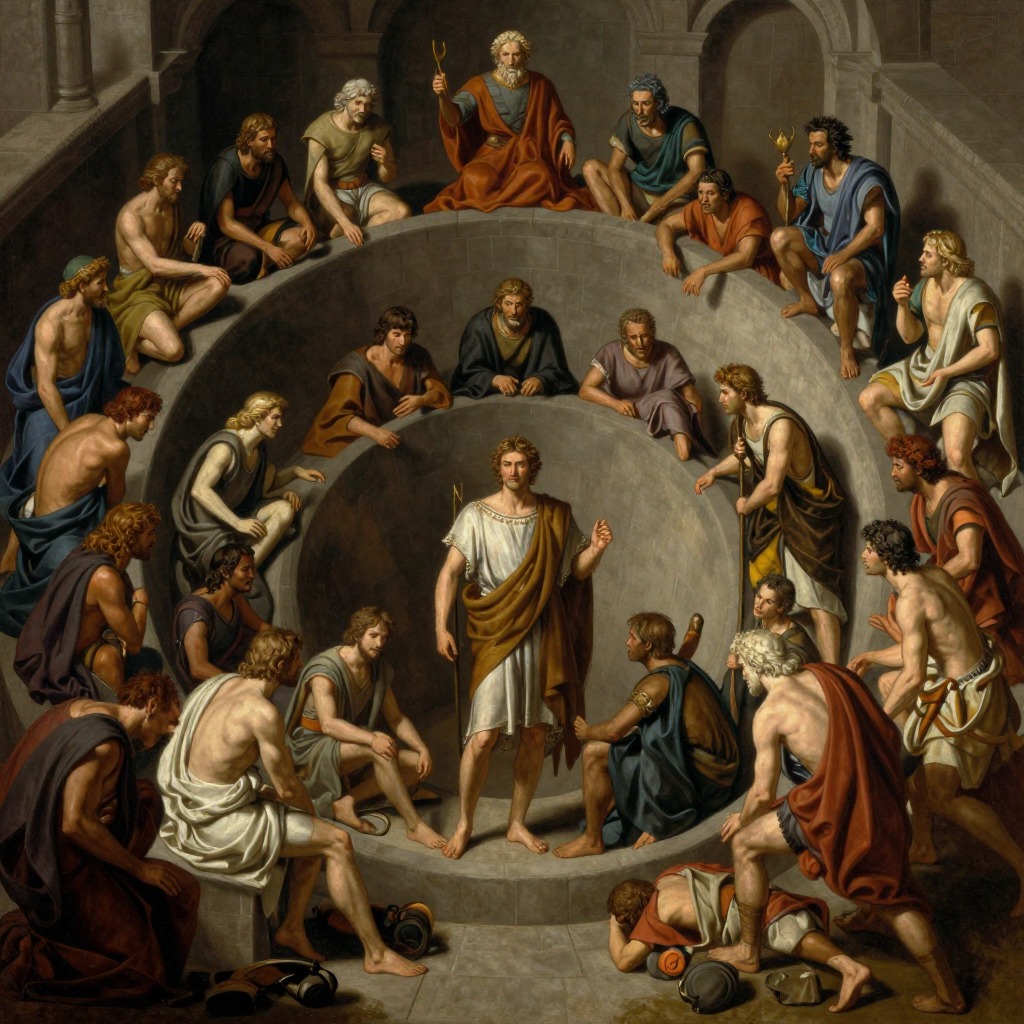
Homer
Homer, the sovereign poet of ancient Greece, occupies a position of supreme honor in the first circle of Hell, Limbo, where he presides over the four great classical poets as their acknowledged lord. His presence in the poem establishes a direct lineage of poetic authority that connects the classical world to Dante's own Christian epic, and his works serve as a catalyst for the spiritual transformation of the poet Statius.
Identity and Position in Limbo
Homer appears in the "Noble Castle of Philosophy" within Limbo, the first circle of Hell reserved for virtuous pagans and the unbaptized. He is described as "Poet sovereign" and carries a falchion, a symbol of his martial and poetic authority. When Virgil approaches with Dante, a voice proclaims, "All honour be to the pre-eminent Poet; His shade returns again, that was departed," and Homer, together with Horace, Ovid, and Lucan, approaches the pair. Virgil identifies Homer as the one "who comes before the three, even as their lord," and notes that "that solitary voice" — the one that hailed Virgil — "proclaimed" the name that applies to each of them, so "They do me honour, and in that do well." The four poets form "the fair school / Of that lord of the song pre-eminent, / Who o'er the others like an eagle soars." After they converse briefly, they turn to Dante with signs of salutation, and Virgil smiles. They then honor Dante by making him "one of their own band; / So that the sixth was I, 'mid so much wit." The group proceeds to the Noble Castle, a seven-walled fortress defended by a rivulet, and enters through seven portals into a luminous meadow where the great spirits of antiquity are gathered.
Influence on Statius and Christian Conversion
Homer's poetry exerts a profound influence beyond the grave, serving as the indirect instrument of the poet Statius's conversion to Christianity. In Purgatory, Statius explains to Virgil that his own poetic vocation and his faith both originated from Virgil's works, but he also acknowledges Homer's foundational role. Statius says, "Thou first directedst me / Towards Parnassus, in its grots to drink, / And first concerning God didst me enlighten." He then quotes a line from Virgil's Fourth Eclogue — "The age renews itself, / Justice returns, and man's primeval time, / And a new progeny descends from heaven" — and declares, "Through thee I Poet was, through thee a Christian." This chain of influence traces back to Homer, whose epics established the poetic tradition that Virgil inherited and that ultimately led Statius to the truth. Statius also mentions that among the poets in Limbo are "Euripides, Antiphon, Simonides, Agatho, and many other Greeks who of old their brows with laurel decked," as well as figures from his own Thebaid — "Antigone, Deiphile and Argia, / And there Ismene mournful as of old" — all of whom inhabit the same circle as Homer.
Narrative Role and Thematic Significance
Homer functions as the archetypal poet whose authority Dante invokes to legitimize his own poetic enterprise. By being admitted into the company of Homer, Horace, Ovid, and Lucan — becoming "the sixth" among them — Dante symbolically positions himself as the heir and continuator of the classical epic tradition. The encounter occurs in the context of Dante's journey through Hell, which begins when he finds himself "within a forest dark" at the midpoint of his life, having "lost" the "straightforward pathway." Virgil, who becomes his guide, leads him "through the eternal place" to show him "the desperate lamentations" of the damned and "those who contented are / Within the fire, because they hope to come" to the blessed. Homer's presence in Limbo, rather than in the deeper circles of punishment, reflects the medieval Christian view that virtuous pagans, though denied salvation through no fault of their own, are not subjected to active torment. His inclusion among the "honourable people" who "have such great honour" because "The honourable name, / That sounds of them above there in thy life, / Wins grace in Heaven" underscores the enduring power of poetic fame. Homer's epics, which recount the Trojan War and its aftermath, are the ultimate source of the classical narratives that permeate Dante's poem, and his figure embodies the ideal of poetic excellence that Dante aspires to surpass by writing a Christian epic that leads its readers to salvation.