Justinian
Justinian, the Byzantine emperor who reformed and codified Roman law, appears in the second heaven of Paradise, the Sphere of Mercury, as a spirit who achieved fame through just and active deeds. His discourse to Dante is a sweeping, providential history of the Roman Eagle—the imperial standard—and a fierce condemnation of both Guelphs and Ghibellines for corrupting its sacred purpose. He embodies the ideal of a ruler who subordinates personal ambition to the divine order, and his speech forms the political and historical heart of the Paradiso.
Identity and Historical Role
Justinian introduces himself as a Caesar who, "by the will of primal Love," took "from the laws the useless and redundant" . He describes his early adherence to the Monophysite heresy—believing Christ had only one nature—until Pope Agapetus corrected him, after which he aligned himself fully with orthodox faith. Inspired by this correction, he devoted himself entirely to the task of legal reform, and entrusted military affairs to his general Belisarius, whose victories were so divinely favored that they signaled Justinian could "repose." This portrait emphasizes the harmony of spiritual and temporal authority: the emperor receives doctrinal guidance from the Church but wields independent power over law and arms.
The History of the Roman Eagle
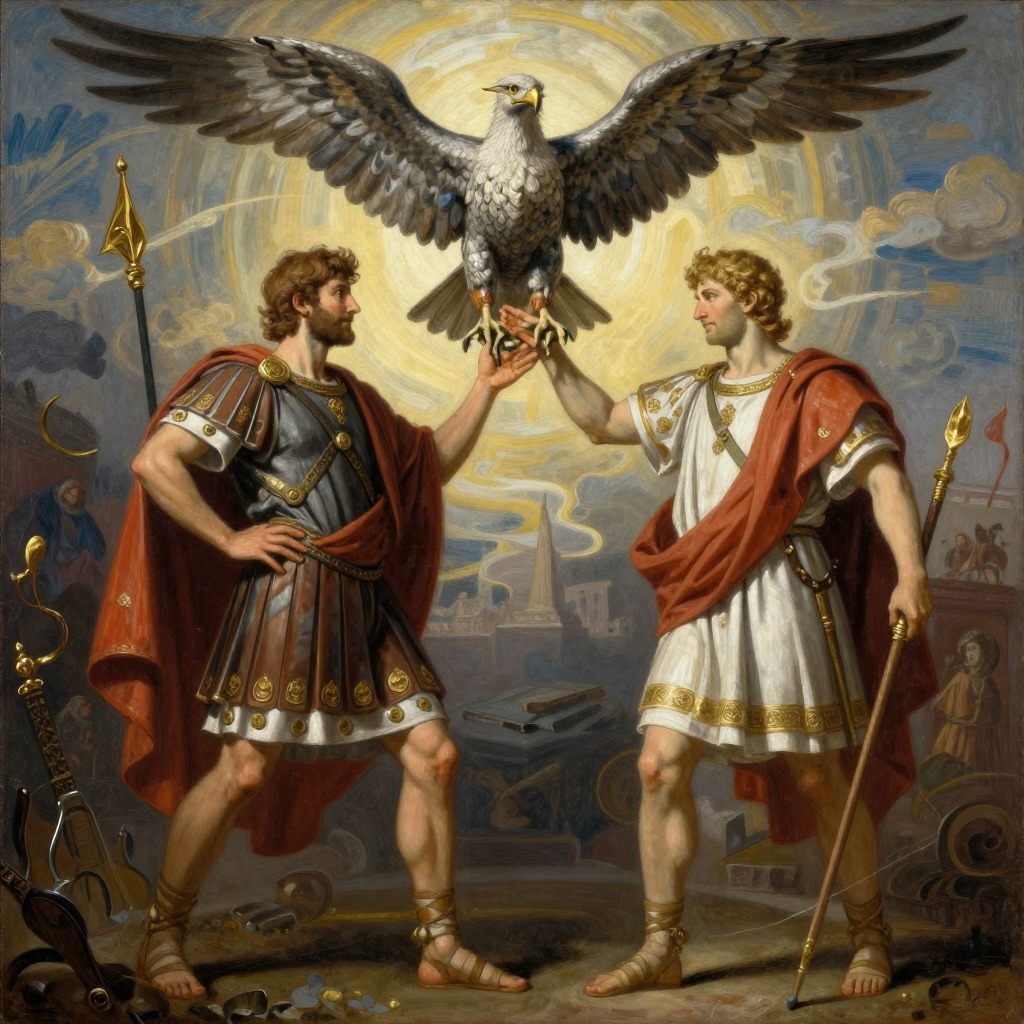
The bulk of Justinian's speech is a compressed epic of the Roman Eagle, from its origins in Troy through the founding of Alba Longa, the reign of the seven kings, the Republic, the Empire, and its Christian destiny. He traces the Eagle's journey from the time of Aeneas, through the wars against Brennus, Pyrrhus, and Hannibal, to the triumphs of Pompey and Scipio. He then recounts how Caesar assumed the standard, crossing the Rubicon and waging war from Spain to Egypt, and how Augustus brought universal peace, closing the Temple of Janus. The Eagle's role culminates in the vengeance of Titus against Jerusalem for the crucifixion, and in Charlemagne's defense of the Church against the Lombards. For Justinian, this history demonstrates that the Eagle is a divinely ordained instrument of justice, not a mere emblem of worldly power.
Condemnation of Factional Abuse
Justinian turns from history to a direct attack on contemporary political factions. He declares that both the Guelphs, who oppose the imperial standard with the yellow lilies of France, and the Ghibellines, who claim it for their own party, are equally guilty of sin. "Let the Ghibellines ply their handicraft beneath some other standard," he says, "for this ever ill follows he who it and justice parts." He warns the new Charles (Charles of Valois) not to strike down the Eagle, lest he fear its talons, which once stripped the hide from a nobler lion. The emperor's words are a plea for the restoration of the Empire's sacred, unifying role, free from partisan corruption.
The Nature of Beatitude in Mercury
Justinian explains that the souls in Mercury are those who "active have been, that fame and honour might come after them." Their joy is proportioned to their desert, and they feel no envy because divine justice sweetens their affection so that it "cannot warp to any iniquity." He compares the diverse seats in heaven to voices that make up a sweet melody. Within this sphere, he points out the light of Romeo, a minister of Raymond Berenger of Provence, whose faithful service was rewarded with ingratitude and poverty—a parallel to Justinian's own theme of righteous action ill-rewarded by the world.
Narrative Role and Significance
Justinian's canto is the Paradiso's most concentrated political statement. He provides the theological and historical justification for Dante's vision of a universal, divinely sanctioned Empire, independent of papal interference. His speech directly echoes the political theory of Dante's Monarchia, arguing that the Roman Empire was ordained by Providence to prepare the world for Christ's redemption. By placing this discourse in the mouth of the emperor who codified Roman law, Dante elevates the ideal of justice as the foundation of both earthly and heavenly order. Justinian's presence in Paradise, despite his early heresy, demonstrates the power of correct doctrine and righteous action to redeem even a ruler's errors.