King David
King David, the biblical psalmist and monarch, occupies a uniquely exalted position in Dante's Divine Comedy, where he is presented not merely as a historical figure but as the embodiment of righteous kingship and inspired song. His presence spans the poem's highest realms, from the Heaven of Jupiter to the Empyrean, and his legacy is invoked as a standard of justice against which corrupt rulers are measured. David's function in the poem is twofold: he is both the archetypal just king, whose reign prefigures divine order, and the singer whose psalms become the very language of celestial praise.
Identity and Biblical Legacy
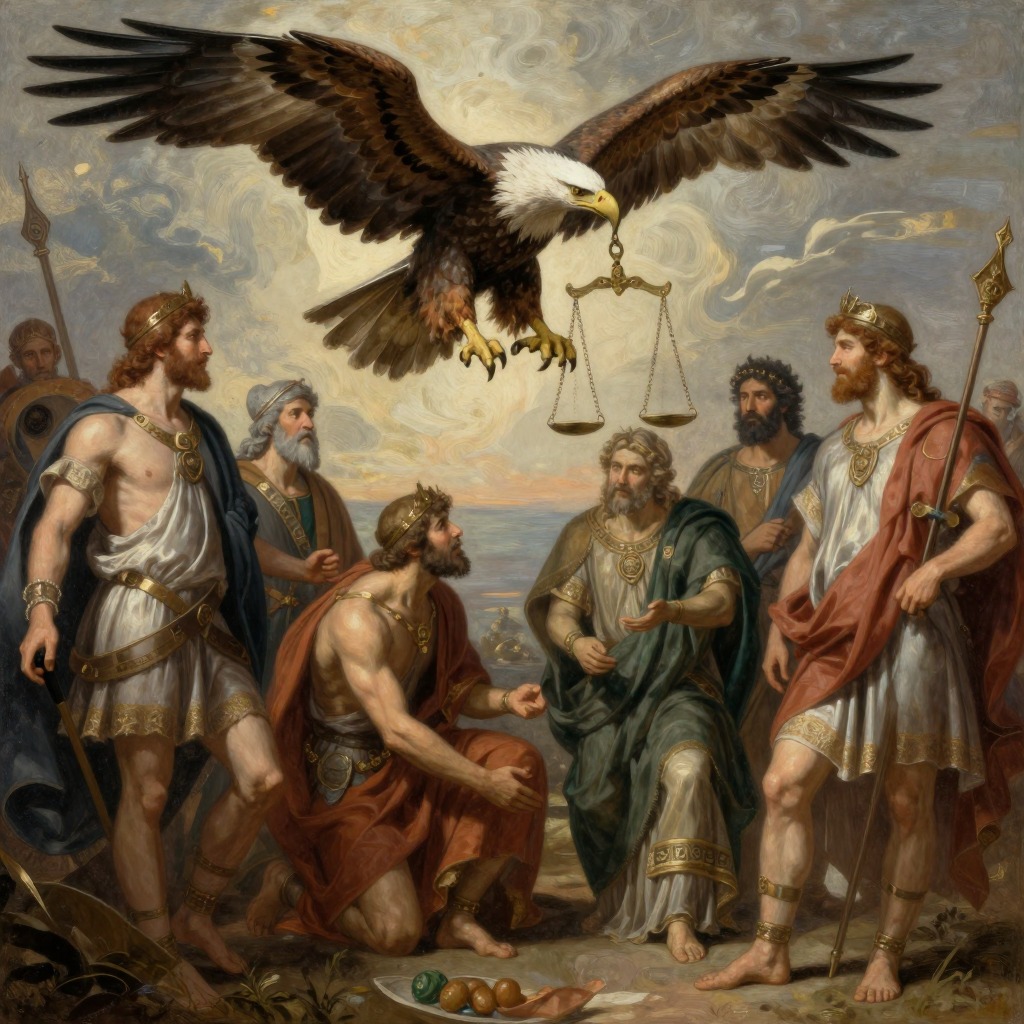
David is introduced in the Heaven of Jupiter as the central jewel in the Celestial Eagle, the constellation of righteous souls that forms the emblem of imperial justice. The Eagle itself speaks of David as "the singer of the Holy Spirit, / Who bore the ark from city unto city" (E12539-E12544). This description emphasizes David's dual identity as both a musician inspired by God and a king who brought the Ark of the Covenant to Jerusalem, an act that united religious and political authority. The Eagle notes that David "now knoweth he the merit of his song, / In so far as effect of his own counsel, / By the reward which is commensurate" (E12541-E12543), indicating that in Paradise David fully understands the value of his earthly works and receives a reward perfectly proportioned to his merits. His placement at the pupil of the Eagle's eye—the most luminous point—signals his preeminence among the just rulers.
Role in the Celestial Eagle
Within the Heaven of Jupiter, David is the first and most prominent of the five souls that form the Eagle's eyebrow, a circle of righteous kings and rulers. The Eagle declares: "He who is shining in the midst as pupil / Was once the singer of the Holy Spirit" (E12538-E12539). This positioning is not arbitrary; David's centrality reflects his role as the archetype of the just monarch, whose reign was characterized by both piety and justice. The Eagle's discourse on salvation and divine judgment repeatedly returns to David as a model, and his presence validates the Eagle's teaching that "Regnum coelorum suffereth violence / From fervent love, and from that living hope / That overcometh the Divine volition" (E12595-E12597). David's own salvation, achieved through faith and repentance, exemplifies the power of grace to transform even a flawed king into a saint.
Presence in the Empyrean and the White Rose
In the final vision of Paradise, David appears again in the White Rose of the Empyrean, the eternal assembly of the blessed. Saint Bernard, guiding Dante through the celestial hierarchy, points out David among the Hebrew patriarchs and kings: "Sarah, Rebecca, Judith, and her who was / Ancestress of the Singer, who for dole / Of the misdeed said, 'Miserere mei,' / Canst thou behold from seat to seat descending" (E14263-E14266). The reference to the penitential psalm "Miserere mei" (Psalm 51) directly links David to his most famous act of repentance after his sin with Bathsheba, showing that his salvation was achieved through contrition and divine mercy. Bernard explains that David sits among those "who believed in Christ who was to come" , placing him in the section of the Rose reserved for the righteous of the Old Testament. His position, lower than the Virgin Mary but among the most honored of the Hebrew saints, reflects his status as a forerunner of Christ and a model of repentant kingship.
Thematic Significance: Justice and Song
David's presence in the poem serves to unite two of Dante's central themes: justice and the power of song. As a king, David embodies the ideal of the just ruler, whose authority is derived from God and exercised for the common good. The Eagle of Jupiter, which speaks with David's voice, condemns corrupt Christian kings and praises those who ruled righteously, using David as the standard against which all rulers are measured. As a singer, David represents the divine origin of poetry itself; his psalms are the template for the celestial music that fills Paradise, and his role as "the singer of the Holy Spirit" anticipates Dante's own claim to poetic inspiration. In the Heaven of Jupiter, the Eagle's speech is accompanied by a melody that "as a lark that in the air expatiates, / First singing and then silent with content / Of the last sweetness that doth satisfy her" (E12574-E12576), echoing David's own psalmody. Through David, Dante asserts that true kingship and true poetry are both gifts of grace, and that their highest purpose is to reflect the justice and love of God.