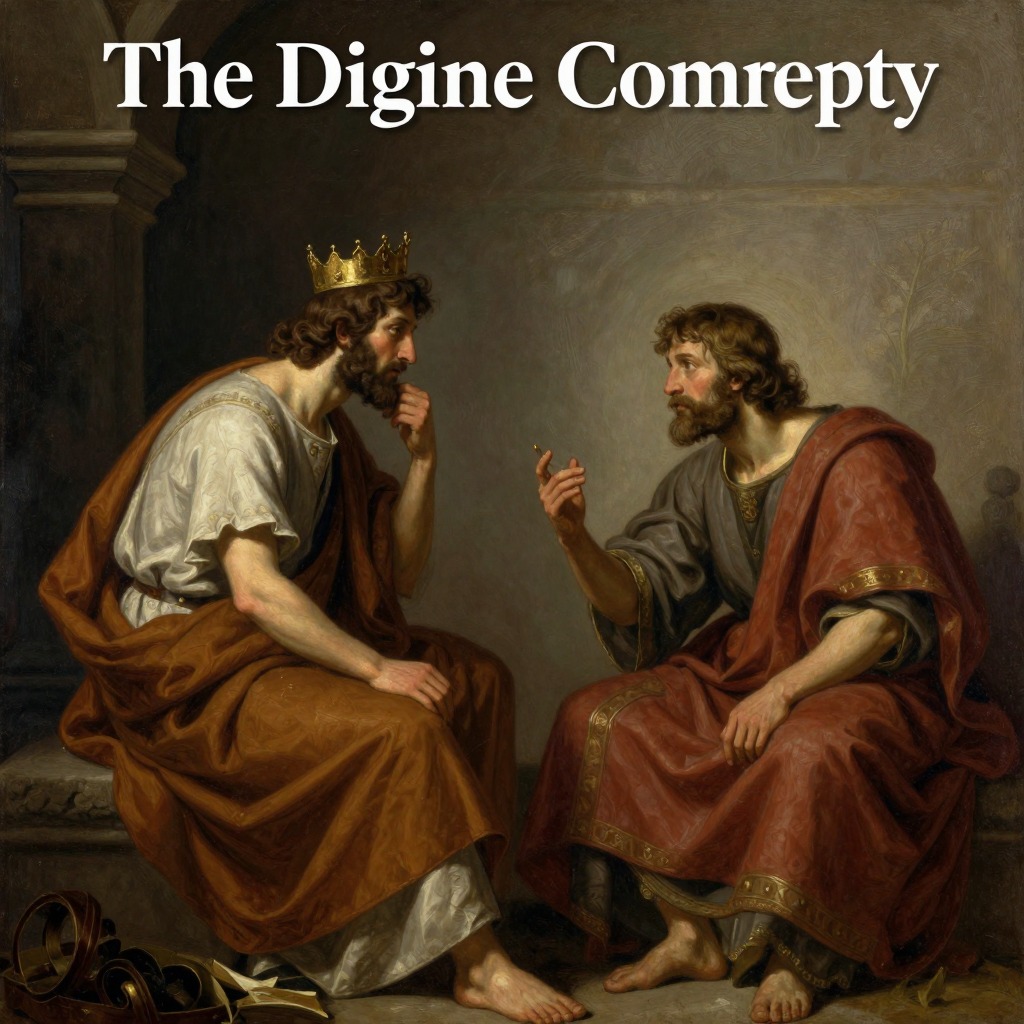
Manfredi
Manfredi, the grandson of the Empress Constance and the Hohenstaufen king of Sicily, appears among the souls who died in contumacy of Holy Church but repented at the very end of their lives. He is encountered by Dante and Virgil on the lower slopes of Mount Purgatory, in the region where those who postponed repentance until their final hour must wait before they can begin the purgatorial ascent. His presence in Purgatory rather than in Hell is itself a theological statement: Manfredi was excommunicated and died violently on the battlefield, yet because he turned to God in his last moments, weeping and penitent, he was saved. His story is one of the most powerful affirmations in the Commedia of the boundlessness of divine mercy, which overrides even the most severe ecclesiastical penalties.
Identity and Appearance
Manfredi is described as blond, beautiful, and of noble aspect, bearing a wound on his brow and another high upon his breast. When Dante first sees him, he does not recognize him, and Manfredi must point to his own wounds to identify himself. He speaks with a smile, a detail that underscores the joy of his salvation despite the violence of his death and the indignities his body suffered afterward. He identifies himself as the grandson of the Empress Constance, a lineage that ties him both to the imperial Hohenstaufen dynasty and to the blessed soul of Constance herself, whom Dante will later meet in Paradise. Manfredi's bearing is regal even in Purgatory, and his words are marked by a calm confidence in God's mercy.
The Circumstances of His Death and Burial
Manfredi recounts that after his body was lacerated by two mortal stabs, he gave himself weeping to God, who willingly pardons. He acknowledges that his iniquities had been horrible, but insists that Infinite Goodness has such ample arms that it receives whatever turns to it. The contrast between his sins and his salvation is stark: he was a king who fought against the Papacy, was excommunicated, and died in battle, yet a single moment of genuine contrition at the point of death was enough to secure his place among the saved. His body, however, was treated with contempt by his ecclesiastical enemies. The Bishop of Cosenza, sent by Pope Clement IV, had Manfredi's remains disinterred from beneath a cairn near Benevento and cast them out of the kingdom, beyond the river Verde, where they lie exposed to wind and rain. This posthumous punishment, carried out with tapers quenched as a sign of execration, was meant to deny him even the dignity of a Christian burial. Yet Manfredi's soul was already beyond the reach of such earthly vengeance.
The Doctrine of Delayed Purgatorial Entry
Manfredi explains the special condition that governs his presence on the lower slopes of Purgatory. Those who die in contumacy of Holy Church, even if penitent at the last, must wait outside the gate of Purgatory for a period thirty times as long as the time they spent in their presumption. This waiting is not a punishment in the sense of active suffering, but a deferral of the purgatorial process. Manfredi himself has been waiting for many years, and he will continue to wait until the full term is completed, unless the period is shortened by the righteous prayers of the living. This doctrine establishes a direct link between the souls in Purgatory and the faithful on earth: the prayers of those still living can hasten the soul's entry into the purifying fire. Manfredi's request to Dante is therefore not for himself alone but for all the souls in his condition: he asks Dante to tell his daughter, the beautiful Costanza, the truth of his state, so that she may pray for him and shorten his exile.
Manfredi's Message and Thematic Significance
Manfredi's encounter with Dante serves as a crucial theological lesson in the Purgatorio. It demonstrates that the Church's power to bind and loose on earth does not extend to the eternal destiny of a soul that has sincerely repented, even if that repentance comes at the very last moment. The excommunication that Manfredi suffered in life is rendered irrelevant by his final act of contrition. His story also introduces the theme of the efficacy of prayers for the dead, a practice that Dante will explore and defend throughout the second canticle. Manfredi's request that Dante inform his daughter of his state is a practical illustration of this doctrine: the living can actively assist the dead by their intercessions. Finally, Manfredi's fate is a rebuke to those who would limit God's mercy by human judgments. The Bishop of Cosenza and Pope Clement may have thought they had consigned Manfredi to damnation, but God's grace proved more powerful than their anathemas. Manfredi's smile, even as he speaks of his unburied bones, is the smile of one who knows that the ultimate victory belongs not to the powers of this world but to the infinite goodness of God.