Ripheus
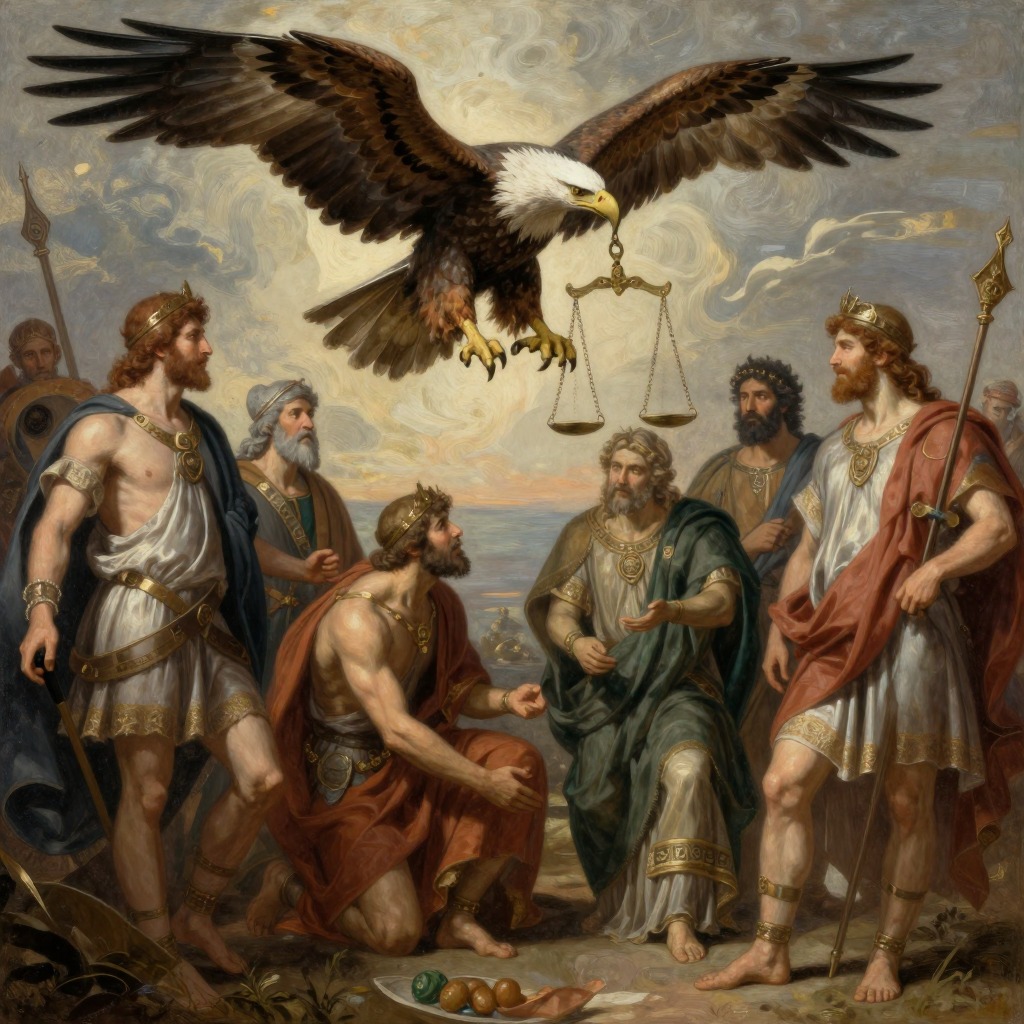
Ripheus is a figure from classical epic who appears in Dante's Paradiso as one of the six blessed souls forming the eye of the Celestial Eagle in the Heaven of Jupiter, the sphere of just rulers. His inclusion among the saved is one of the most startling demonstrations in the poem of the unfathomable reach of divine grace, for he was a Trojan, a pagan who lived centuries before Christ, yet he was admitted to Paradise. The Eagle itself, a composite voice of the righteous kings, presents Ripheus as the fifth light in its brow, and his story becomes a central illustration of the mystery of predestination and the power of hope and faith even outside the visible Church.
Identity and Background
Ripheus is a minor character in Virgil's Aeneid, where he is described as a Trojan warrior, "the most just of the Trojans" and "ever observant of the right." He dies in the fall of Troy. Dante, drawing on this classical reputation for justice, reimagines his fate entirely. In the Paradiso, the Eagle reveals that Ripheus, though a pagan, was saved through a special grace. He "set all his love below on righteousness" , and this love, combined with a divinely granted premonition of the coming Redeemer, led him to a living faith in Christ before the Incarnation. The Eagle explains that Ripheus "believed therein, and suffered not / From that day forth the stench of paganism" . His salvation was not through the Law or circumcision, but through an anticipation of Christian baptism: "Those Maidens three, whom at the right-hand wheel / Thou didst behold, were unto him for baptism / More than a thousand years before baptizing" . The three theological virtues—Faith, Hope, and Charity—served as his baptism.
The Revelation of Grace and Predestination
The Eagle's discourse on Ripheus is framed as a direct response to Dante's unspoken doubt about the justice of condemning the virtuous unbaptized. The Eagle had earlier addressed the problem of a righteous man born on the banks of the Indus who lives without sin but dies without faith or baptism, asking "Where is this justice that condemneth him?" . Ripheus is the counter-example, showing that God's grace can reach whom it wills, by means unknown to human reason. The Eagle declares: "The first life of the eyebrow and the fifth / Cause thee astonishment, because with them / Thou seest the region of the angels painted. / They passed not from their bodies, as thou thinkest, / Gentiles, but Christians in the steadfast faith / Of feet that were to suffer and had suffered" . Ripheus, like the Emperor Trajan who is the other "astonishing" soul in the Eagle's eye, was granted a temporary return to life after death—a resurrection of the flesh—so that he could explicitly embrace Christianity. The Eagle explains that Trajan "returned unto his bones" through the prayers of Pope Gregory, and that this was "of living hope the reward" . Ripheus, by contrast, was saved through a direct infusion of grace: "The other one, through grace, that from so deep / A fountain wells that never hath the eye / Of any creature reached its primal wave, / Set all his love below on righteousness" . This grace opened his eye to the future redemption, and he believed in it.
Thematic Significance: The Inscrutability of Divine Justice
Ripheus's presence in the Eagle's eye serves as the poem's most radical assertion of the limits of human judgment. The Eagle, after recounting his story, directly addresses the mystery of predestination: "O thou predestination, how remote / Thy root is from the aspect of all those / Who the First Cause do not behold entire!" . The blessed themselves do not know the full number of the elect, and they accept this ignorance as part of their joy: "And you, O mortals! hold yourselves restrained / In judging; for ourselves, who look on God, / We do not know as yet all the elect; / And sweet to us is such a deprivation, / Because our good in this good is made perfect, / That whatsoe'er God wills, we also will" . Ripheus, therefore, is not merely a saved pagan; he is a living emblem of the truth that God's justice is not bound by human categories of merit, and that the divine will is the ultimate measure of all righteousness. His story transforms the abstract theological problem of the virtuous pagan into a concrete, joyful revelation of grace that transcends the ordinary boundaries of salvation history.