Sinon of Troy
Sinon of Troy is a figure from classical mythology who appears in Dante's Inferno as a forger in the Tenth Bolgia of Malebolge, where he is punished for his role in the deception of the Trojan Horse. His presence in the poem serves as a testament to the enduring consequences of fraudulent speech and action, and his bitter quarrel with the counterfeiter Master Adam illustrates the corrosive nature of sin.
Identity and Background
Sinon of Troy is the Greek soldier who, according to the Aeneid, allowed himself to be captured by the Trojans and convinced them to bring the wooden horse inside their city walls, leading to the fall of Troy. In Dante's Inferno, he is condemned to the Tenth Bolgia of the Eighth Circle, where falsifiers and forgers are punished. He is described as "the false Sinon, Greek of Troy" , and his punishment involves suffering from a burning fever that causes him to emit smoke "like a wet hand in winter" .
Life and Plot Trajectory
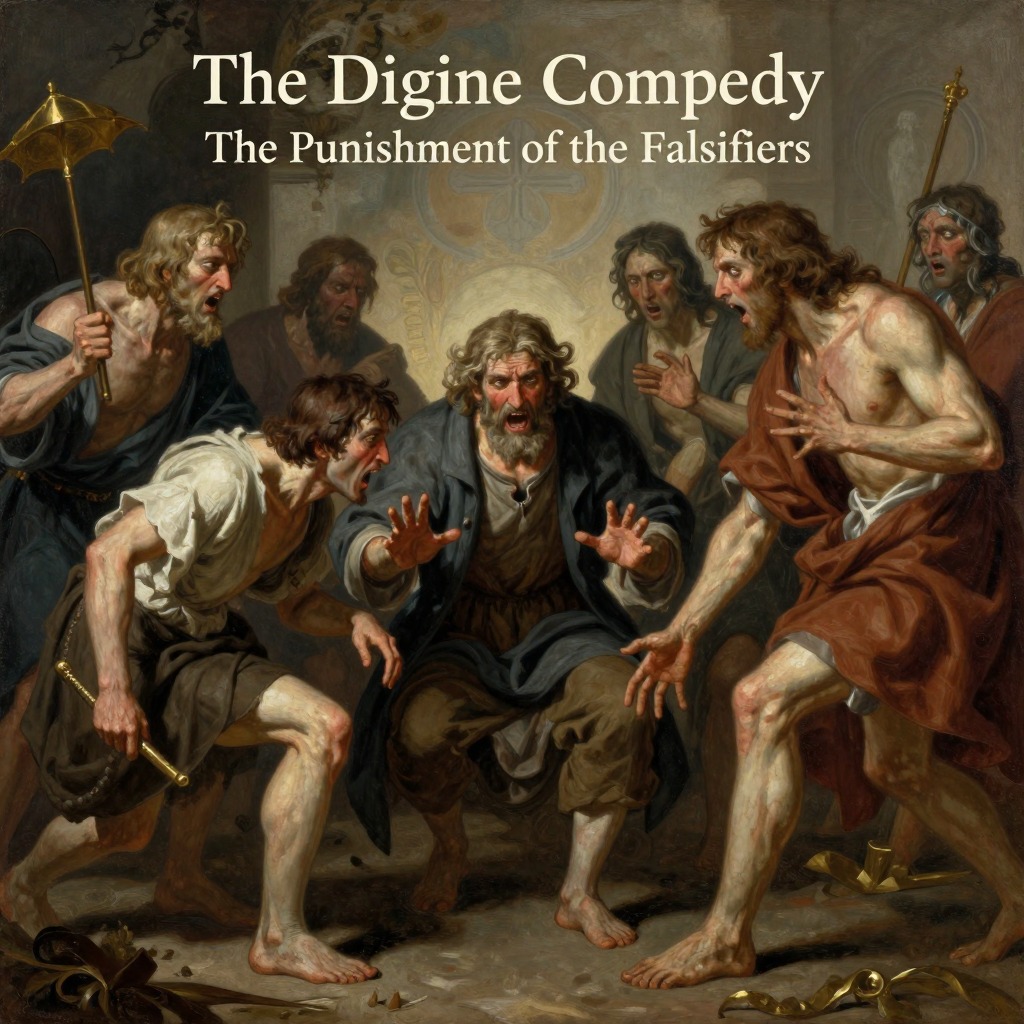
Sinon appears in Canto XXX of the Inferno, where Dante and Virgil encounter him among the other falsifiers. He is lying near Master Adam, a counterfeiter who is afflicted with dropsy. The two engage in a heated verbal exchange, each accusing the other of greater crimes. Sinon taunts Master Adam about his counterfeiting, while Master Adam retorts by reminding Sinon of his false testimony at Troy. Their quarrel escalates into physical violence, with Master Adam striking Sinon in the face .
Key Actions and Objectives
Sinon's primary action in the poem is his participation in the deception of the Trojan Horse, which he himself describes as his defining sin. In his exchange with Master Adam, he defends himself by pointing out that while he is punished for one falsehood, Master Adam is guilty of multiple crimes, including counterfeiting the Florentine florin with three carats of impurity . This argument reveals Sinon's attempt to justify his own sin by comparing it to another's, a common trait among the damned.
Relationships and Conflict
Sinon's relationship with Master Adam is one of mutual recrimination. The two figures represent different forms of fraud: Sinon's is verbal and historical, while Master Adam's is material and economic. Their quarrel is interrupted by Virgil, who rebukes Dante for being too absorbed in listening to their dispute, calling it a "base wish" to take pleasure in such arguments . This moment underscores the moral lesson that even in Hell, the damned continue to perpetuate their sins through conflict and deceit.
Change and Ending
Sinon does not undergo any change or redemption in the poem. He remains locked in his punishment and his quarrel with Master Adam, embodying the eternal nature of damnation. His final appearance is marked by Virgil's admonition to Dante, which serves as a reminder that the poet must not be distracted by the petty disputes of the damned but must focus on his journey toward salvation.
Narrative Role and Evaluation
Sinon of Troy functions as a representative of fraudulent speech and historical deception. His inclusion in the Inferno reinforces Dante's theme that all forms of fraud, whether in word or deed, are subject to divine justice. The quarrel between Sinon and Master Adam also serves as a dramatic illustration of the contrapasso principle, where the damned are forced to relive the consequences of their sins in an endless cycle of accusation and conflict. Sinon's role, though brief, is significant in demonstrating the moral and theological framework of Dante's Hell.