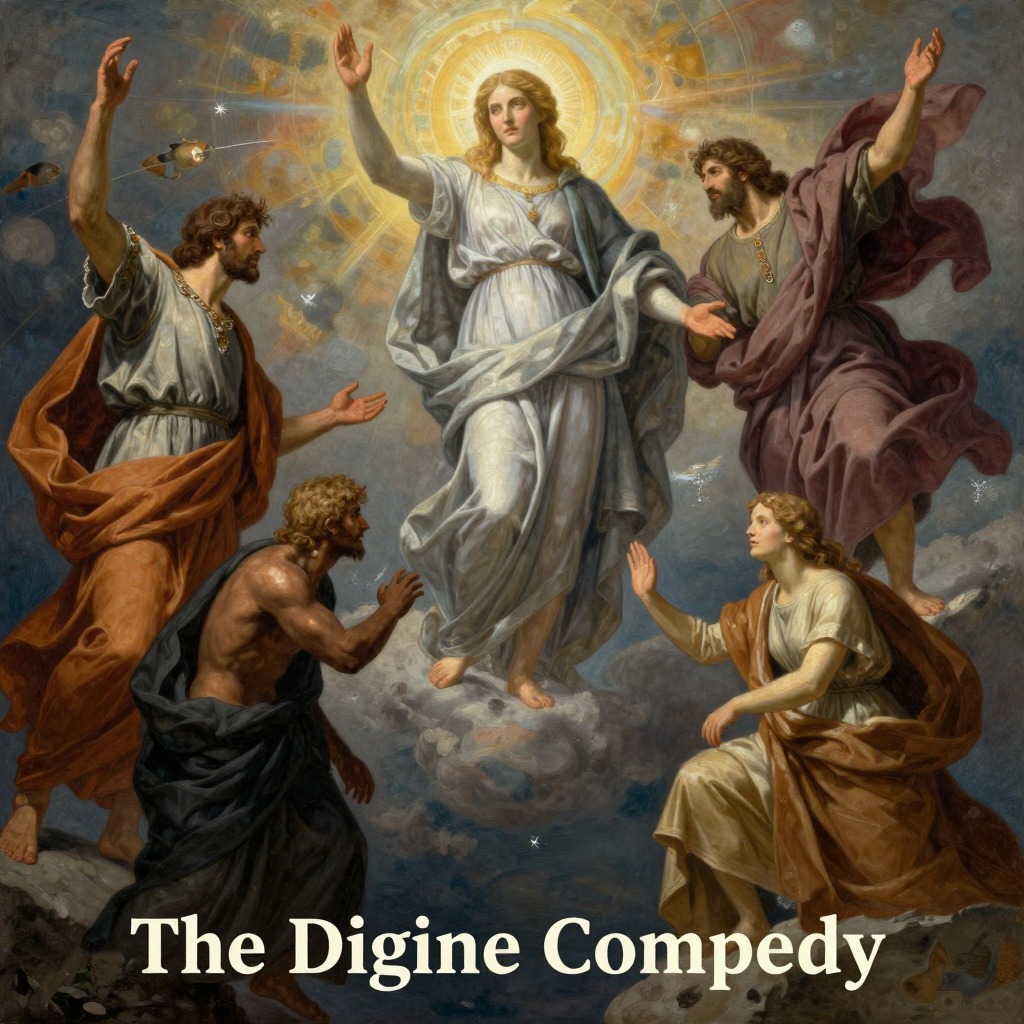
Solomon
Solomon, the biblical king of Israel, occupies a singular place among the wise spirits in the Heaven of the Sun, where he is celebrated not for the breadth of his learning but for the unique quality of his royal discernment. St. Thomas Aquinas, speaking from within the circle of theologians, points to Solomon as the fifth and most beautiful light in their garland, a soul whose love for truth was so profound that the whole world below remains eager for tidings of it. Yet the praise Aquinas offers is carefully delimited: Solomon's greatness lies not in metaphysical speculation but in the practical wisdom proper to a king, a distinction that Dante's poem uses to explore the nature of human excellence and the limits of intellectual ambition.
Identity and Place in the Heaven of the Sun
Solomon is introduced among the twelve luminous spirits of the first circle of the Sun, a company that includes St. Thomas Aquinas, Albertus Magnus, Gratian, Peter Lombard, Dionysius the Areopagite, Paulus Orosius, Boethius, Isidore of Seville, the Venerable Bede, Richard of Saint Victor, and Siger of Brabant. Aquinas identifies Solomon as the fifth light, calling it "the fairest" among them and declaring that it "breathes forth from such a love, that all the world / Below is greedy to learn tidings of it." The spirit contains "the lofty mind, where knowledge / So deep was put, that, if the true be true, / To see so much there never rose a second." This superlative claim immediately raises a theological question, for it seems to place Solomon above Adam and Christ himself in wisdom, a paradox that Aquinas later resolves by specifying the kind of knowledge Solomon possessed.
The Nature of Solomon's Wisdom
Aquinas clarifies that Solomon's peerless wisdom was not speculative or universal but regal and practical. When God told Solomon to ask for what he wished, the king did not request knowledge of the number of celestial movers, the logical relationship between necessity and contingency, the proof of a first motion, or the possibility of inscribing a triangle without a right angle in a semicircle. Instead, he asked for the wisdom to govern justly, "that he might be sufficiently a king." This distinction is crucial: Solomon's excellence lies in "a regal prudence," the capacity to rule with justice and discernment, not in the mastery of all possible knowledge. Aquinas's words "there never rose a second" refer specifically to this kingly wisdom, not to wisdom in general, and the qualification is reinforced by the reminder that Adam and Christ, in their respective perfections, possessed a fullness of knowledge that Solomon did not.
Thematic Significance: The Limits of Human Ambition
Solomon's presence in the Heaven of the Sun serves as a corrective to the intellectual pride that Dante critiques throughout the poem. The king who asked for understanding rather than riches or long life becomes a model of properly directed desire, one that subordinates curiosity to the demands of righteous governance. Aquinas's discourse on Solomon is embedded in a larger warning against hasty judgment and the arrogance of those who "affirm without distinction, or deny." The example of Solomon, who knew what to ask for and what not to ask for, stands in contrast to the philosophers who "went on and knew not whither" and the heretics who "have been even as swords unto the Scriptures." In the economy of Dante's Paradise, Solomon represents the ideal of wisdom in service to justice, a figure whose light shines brightest not because he knew everything but because he knew the one thing needful for a king.