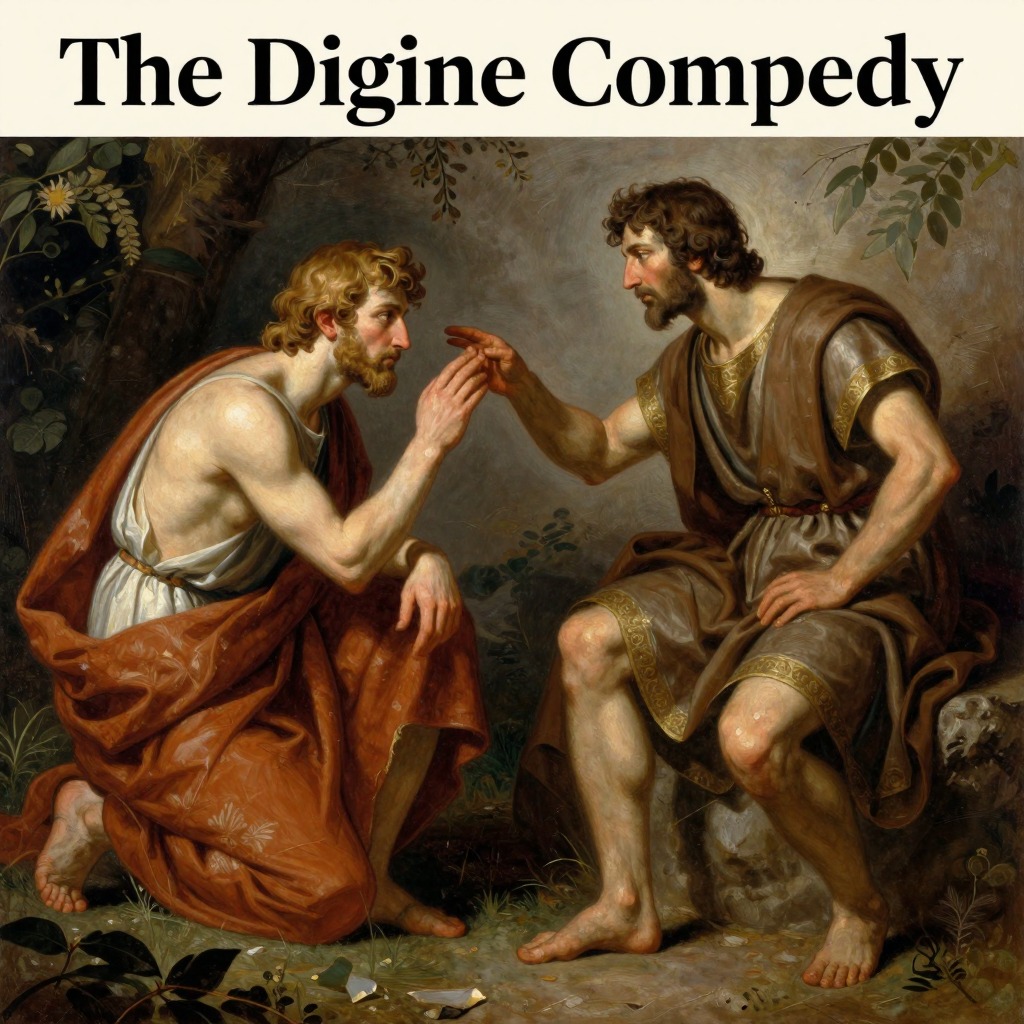
Sordello
Sordello is a 13th-century Lombard poet and nobleman whom Dante and Virgil encounter in the Valley of the Princes in Ante-Purgatory. His fierce love for his native Mantua triggers an immediate embrace with Virgil and a passionate denunciation of Italy's political corruption, making him a figure of patriotic fervor and a guide through the twilight realm of the negligent rulers.
Identity and Introduction
Sordello appears in the sixth canto of the Purgatorio as a solitary soul stationed apart from the crowd, gazing intently at the approaching travelers. Virgil describes him as a "Lombard soul" who bears himself "lofty and disdainful," with a "grand and slow" movement of his eyes. He does not speak at first but lets the pair pass, eying them "after the manner of a couchant lion." When Virgil draws near and entreats him to point out the best ascent, Sordello does not answer the request but instead questions them about their native land and their life. The moment Virgil says "Mantua," the shade, who had been "all in itself recluse," rises from his place and cries out, "O Mantuan, I am Sordello of thine own land!" and the two poets embrace. This spontaneous recognition, triggered solely by the sound of their shared birthplace, establishes Sordello as a figure whose identity is bound to his city and whose emotional life is governed by a fierce, almost territorial, patriotism.
Role in Ante-Purgatory and the Valley of the Princes
Sordello explains that no fixed place has been assigned to the souls in Ante-Purgatory; it is lawful for him to go up and round as far as he can. Because the day is declining and nocturnal ascent is forbidden—"not that aught else would hindrance give, however, to going up, save the nocturnal darkness; this with the want of power the will perplexes"—he offers to lead Dante and Virgil to a fair sojourn among the souls withdrawn on the right hand. He draws his finger on the ground to show a line that cannot be crossed after sunset. He guides them to a hollow in the mountainside, a valley "where of itself the hill-side makes a lap," filled with grass and flowers of such vivid color that gold, silver, scarlet, pearl-white, Indian wood, and fresh emerald would all be vanquished, and with a mingled fragrance of a thousand odours. There, seated on the green and singing "Salve Regina," are the spirits of negligent princes—rulers who neglected their duties in life. Sordello points them out one by one from the ledge above, identifying Rudolph of Habsburg, Ottocar of Bohemia, Philip III of France, Henry I of Navarre, Peter III of Aragon, Charles I of Anjou, Henry III of England, and William VII of Montferrat, among others. He serves as a knowledgeable guide to this twilight court, interpreting the postures and sighs of the kings who failed to act.
The Encounter with Virgil and the Lament for Italy
Sordello's recognition of Virgil as a fellow Mantuan leads to a profound moment of homage. When Virgil reveals his identity—"I am Virgilius; and for no crime else did I lose heaven, than for not having faith"—Sordello reacts with wonder, bowing his brow and embracing him "where inferiors embrace." He addresses Virgil as "glory of the Latians" and "pride eternal of the place I came from." Virgil explains that he comes from Limbo, the place of darkness without torments, where he dwells with the unbaptized innocents and those who knew the cardinal virtues but not the three theological ones. This exchange establishes Sordello as a soul who, though still in Ante-Purgatory, recognizes and reveres the supreme poet of the Latin language. Immediately after the embrace, Dante breaks into a passionate apostrophe to Italy, lamenting that a noble soul like Sordello could be moved to joy by the mere sound of his native land while Italy itself is a "ship without a pilot in great tempest," a "brothel" of provinces, torn by war and tyranny. The invective, which names the German Albert of Habsburg and the feuding factions of Montecchi and Cappelletti, is directly inspired by Sordello's example of patriotic love.
The Guardian Angels and the Serpent
In the eighth canto, Sordello remains with Dante and Virgil in the Valley of the Princes through the evening. He identifies the two angels who descend with flaming swords, truncated of their points, as guardians sent "from Mary's bosom" to protect the valley against the serpent that will come. When the serpent appears—"the same which gave to Eve the bitter food"—slithering through the grass and flowers, Sordello points it out, and the angels drive it away. He also introduces Dante to Nino di Gallura, a noble judge, and to Currado Malaspina, with whom Dante exchanges prophecies. Sordello thus acts as a mediator between the living poet and the shades of the great, facilitating the encounters that reveal the political and personal fates of the souls in this region.
The Dream of Lucia and the Ascent to the Gate
Sordello's final role occurs during the night in the valley. While Dante sleeps, Saint Lucia descends and carries him upward to the Gate of Purgatory. Virgil explains to the awakened Dante that "Sordello and the other noble shapes remained; she took thee, and, as day grew bright, upward she came, and I upon her footsteps." Sordello does not accompany them beyond the valley; his function is confined to Ante-Purgatory, where he serves as a guide and a symbol of the love of country that can stir even the most disdainful soul. His departure from the narrative is unremarked, but his presence has already accomplished its purpose: to demonstrate that the bonds of native land and poetic tradition can transcend the barriers of death and damnation.