Virgil
Virgil, the Roman poet of the Aeneid, appears to Dante in the Dark Forest and serves as his guide through Hell and Purgatory, embodying human reason and classical wisdom while remaining barred from Paradise. He is the first character Dante encounters after losing his way, and his intervention sets the entire journey in motion. As a figure of authority, compassion, and intellectual clarity, Virgil leads Dante through the eternal place of desperate lamentations and the mountain where souls purge themselves, but he cannot enter the Earthly Paradise himself, for he lived before Christ and lacked faith. His role is that of a mentor who represents the highest reach of human understanding unaided by divine revelation.
Identity and Background
Virgil introduces himself to Dante in the Dark Forest as a shade who was once a man. He was born in Lombardy, both his parents were Mantuans, and he lived at Rome under the good Augustus during the time of false and lying gods. He was a poet who sang of the just son of Anchises, Aeneas, who came forth from Troy after its burning. Dante immediately recognizes him as Virgilius, the fountain that spreads abroad so wide a river of speech, and declares him his master and author, the one from whom he took the beautiful style that has done honour to him. Virgil explains that he cannot ascend to the blessed people because he was rebellious to God's law, and that a soul more worthy than himself will guide Dante thereafter.
Role as Guide and Mentor
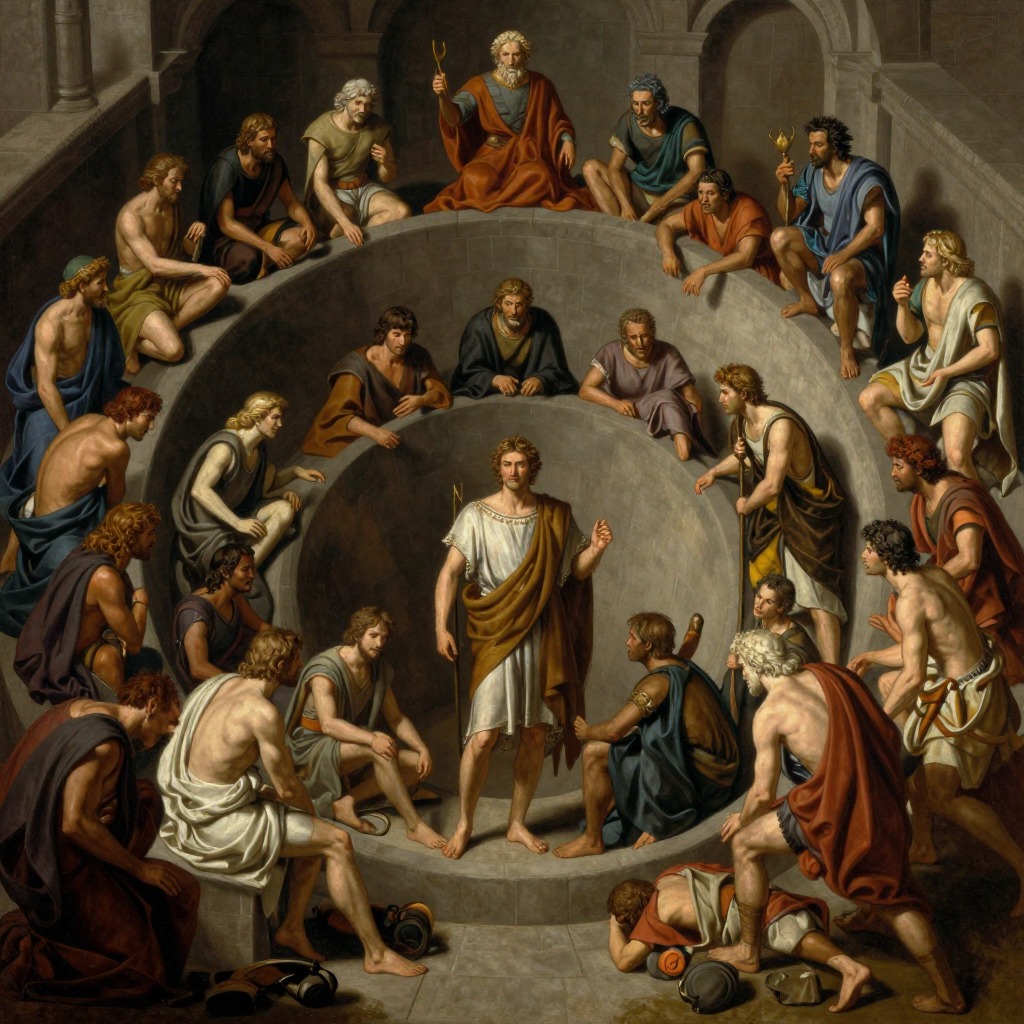
Virgil's primary function is to lead Dante through the three realms of the afterlife. He guides him through the eternal place where he shall hear the desperate lamentations and see the ancient spirits disconsolate, and then through those who are contented within the fire because they hope to come to the blessed people. He explains the structure of Hell, the nature of its punishments, and the moral order that underlies them. When Dante falters, Virgil rebukes his cowardice and reminds him of the three Ladies benedight who care for him in the court of Heaven. He carries Dante on his back when necessary, as when they descend on Geryon, and he protects him from the Malebranche devils by confronting them with the authority of divine will. He also instructs Dante in the nature of love, free will, and the order of the universe, preparing him for the higher truths he will learn from Beatrice.
Relationships and Interactions
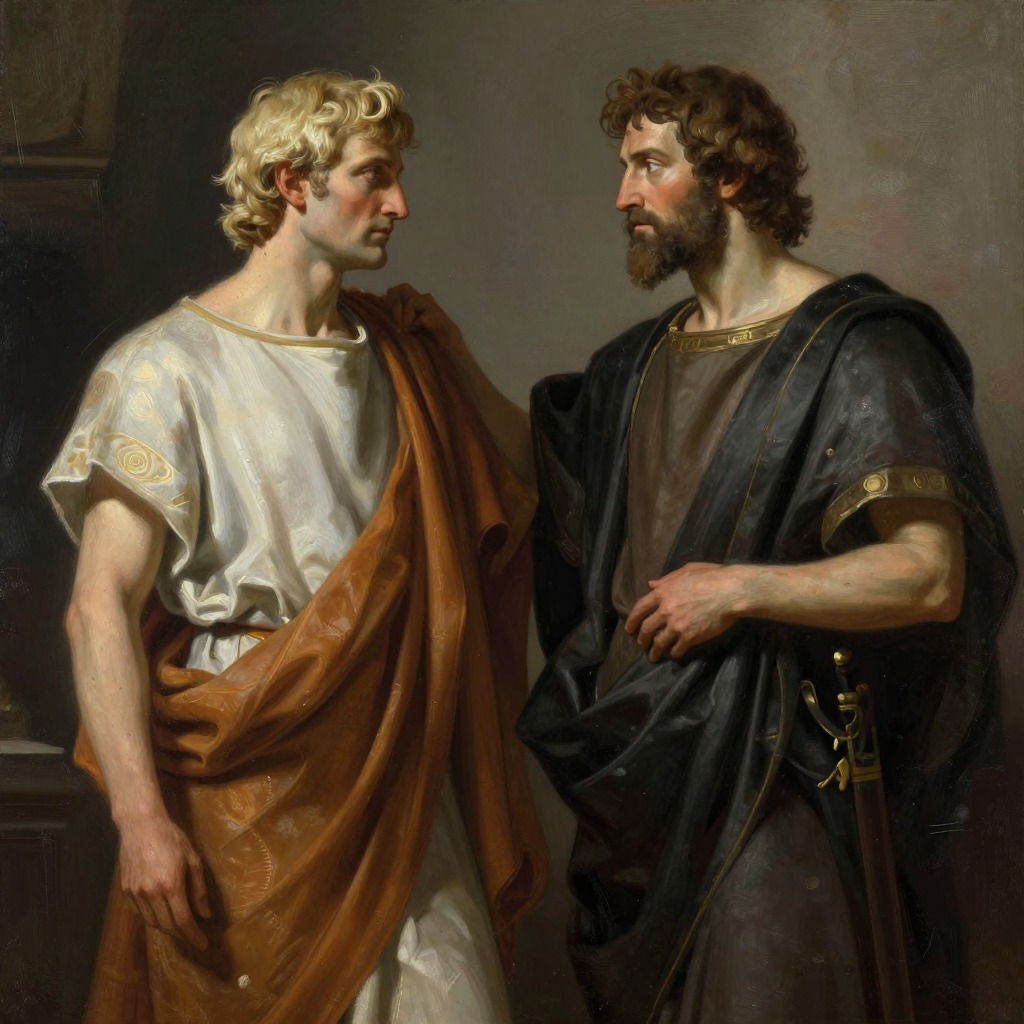
Virgil's relationships with other characters reveal his authority and his limitations. He commands respect from the infernal guardians, such as Charon, Minos, and the Malebranche, by invoking the will of Heaven. He is greeted with honour by the four great poets in Limbo—Homer, Horace, Ovid, and Lucan—who make him one of their band. He is deeply moved by the encounter with his fellow Mantuan, Sordello, who embraces him with humility. He also serves as a mentor to the poet Statius, who credits Virgil's poetry with leading him to Christianity. With Dante, Virgil is both a stern teacher and a tender father, often taking him by the hand, embracing him, and carrying him through danger. He is also the one who must ultimately leave Dante, for he cannot enter the Earthly Paradise, and his departure is one of the most poignant moments in the poem.
Change and Ending
Virgil's journey with Dante ends at the summit of Mount Purgatory, in the Earthly Paradise. He has led Dante through the temporal fire and the eternal, and he declares that by intellect and art he has brought him there, but that now Dante must take his own pleasure for his guide. He crowns and mitres Dante over himself, signifying that the pilgrim's free will is now sound and that he no longer needs Virgil's guidance. Virgil then vanishes, and Dante weeps at his departure. Beatrice, who appears immediately after, rebukes Dante for weeping, telling him that he must weep for another sword. Virgil's exit marks the transition from the realm of human reason to the realm of divine revelation, and his absence is felt throughout the rest of the poem.
Thematic Significance
Virgil represents the pinnacle of human reason, classical wisdom, and poetic achievement, yet he is also a figure of tragic limitation. He is damned not for any sin but for his lack of faith, living as he did before Christ. His knowledge and virtue are insufficient to save him, and he must remain in Limbo, the first circle of Hell, where the only punishment is to live in desire without hope. His role as Dante's guide underscores the poem's central theme that human reason, while noble and necessary, is ultimately incomplete without divine grace. Virgil's poetry, especially the Aeneid, is presented as a source of inspiration and moral instruction, but it cannot lead to salvation. His departure marks the boundary between the natural and the supernatural orders, and his character embodies the dignity and the sorrow of the virtuous pagan.