Augustus Waters
Augustus Waters is the charismatic, philosophically inclined seventeen-year-old love interest of Hazel Grace Lancaster in John Green's The Fault in Our Stars. A former basketball player and osteosarcoma survivor who lost a leg to the disease, Augustus is defined by his fear of oblivion, his belief in metaphor, and his desire to live a life—and die a death—of significance. His relationship with Hazel transforms both of them, and his eventual death from a cancer recurrence forms the novel's central tragedy.
Identity and Background
Augustus Waters is introduced at a Support Group meeting in the basement of an Episcopal church, where he is a guest of his friend Isaac. He is described as long and leanly muscular, with mahogany hair and blue eyes, and he carries himself with an aggressively poor posture that somehow conveys confidence. He wears a prosthetic leg, the result of osteosarcoma that took his limb a year and a half before the story begins. When asked to share his fears with the group, he responds without hesitation: "I fear oblivion," he says. "I fear it like the proverbial blind man who's afraid of the dark." This declaration establishes his central preoccupation: the terror of being forgotten, of leaving no mark on the world. He is a self-described "big believer in metaphor," a trait he demonstrates by carrying an unlit cigarette that he never lights, explaining, "You put the killing thing right between your teeth, but you don't give it the power to do its killing." He lives with his parents, Mark and Cindy Waters, in a house festooned with sentimental sayings called "Encouragements," which he both mocks and secretly appreciates. He attends North Central High School, a year behind his age, and he saved his Wish from The Genie Foundation—granted in exchange for his leg—rather than spending it hastily.
Arc Through the Plot
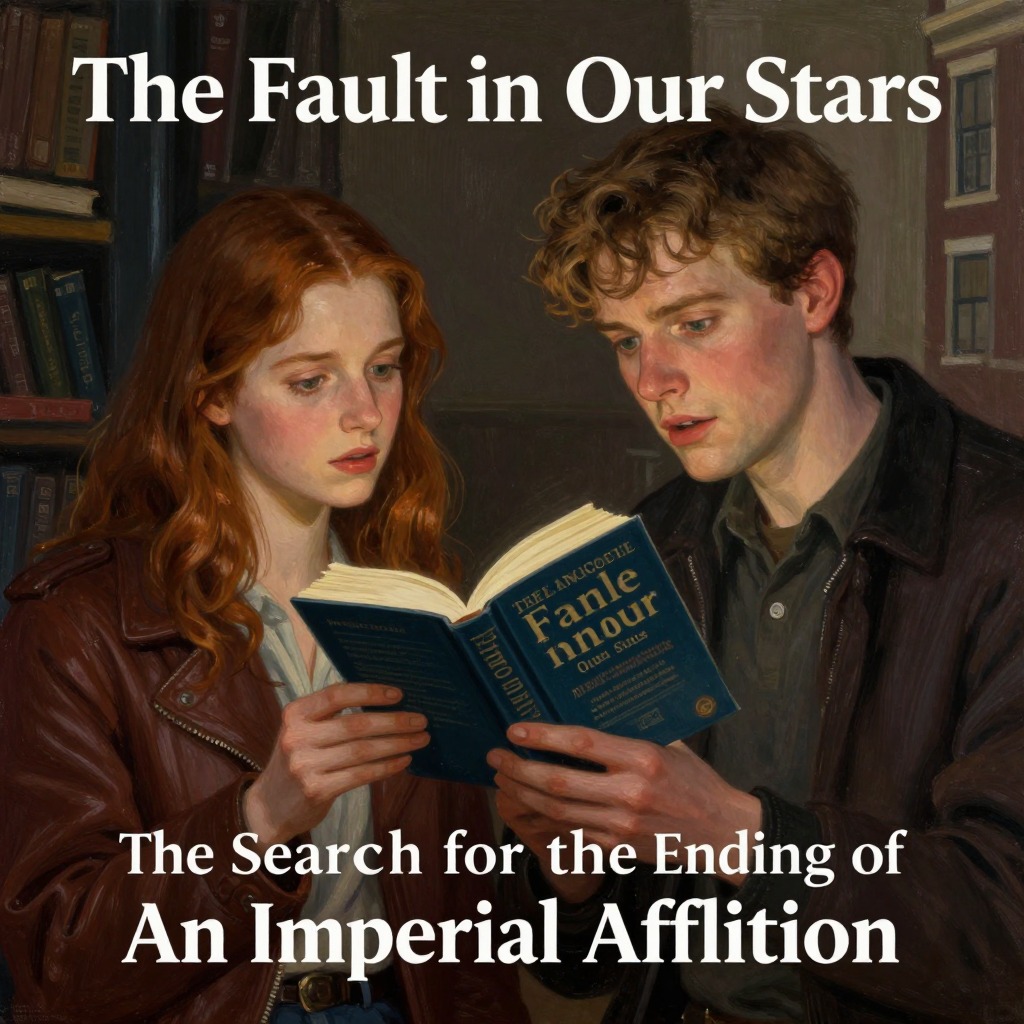
Augustus's arc begins with his immediate, intense attraction to Hazel at Support Group. He stares at her throughout the meeting, and afterward he invites her to his house to watch V for Vendetta, comparing her to Natalie Portman. He gives her a copy of The Price of Dawn, a video-game novelization, and she gives him her favorite book, An Imperial Affliction by Peter Van Houten. He reads it obsessively, finishing it in a single day, and is devastated by its abrupt, mid-sentence ending. Determined to get answers for Hazel, he tracks down Van Houten's assistant, Lidewij Vliegenthart, and begins an email correspondence with the reclusive author. He then orchestrates a Dutch-themed picnic at the Funky Bones sculpture park, where he reveals that he has saved his Wish and intends to use it to take Hazel to Amsterdam to meet Van Houten. The trip proceeds despite Hazel's hospitalization for fluid in her lungs, and in Amsterdam, they have a romantic dinner at Oranjee, visit the Anne Frank House (where they share their first kiss), and finally meet Van Houten, who turns out to be a cruel, drunken disappointment. It is only after the disastrous meeting that Augustus reveals the truth: he has had a recurrence of his cancer. "I lit up like a Christmas tree, Hazel Grace," he tells her. "The lining of my chest, my left hip, my liver, everywhere." The remainder of the novel follows his decline, his prefuneral at the Support Group, and his death eight days later.
Key Actions and Objectives
Augustus's primary objective is to live a life that matters, to be remembered, to leave a mark. This drive manifests in his grand gestures: using his Wish to take Hazel to Amsterdam, writing a letter to Van Houten demanding answers, and even planning his own prefuneral so he can hear his eulogies. He is also fiercely protective of those he loves. He helps Isaac through his breakup with Monica and his blindness, and he orchestrates the egging of Monica's car as an act of solidarity. He is a compulsive hero in video games, always sacrificing his character to save civilians, and he frames his own death in similar terms: "All salvation is temporary," he says. "I bought them a minute. Maybe that's the minute that buys them an hour, which is the hour that buys them a year." He is also deeply self-aware, acknowledging his own vanity and his tendency toward grandiosity. He tells Hazel that he bought a "death suit" before his amputation, and he wears it to their romantic dinner at Oranjee. His final act is to write a letter to Van Houten, asking him to write a eulogy for Hazel, in which he articulates his understanding of her: "She walks lightly, old man. She walks lightly upon the earth."
Relationships and Conflict
The central relationship of Augustus's life is with Hazel. Their connection is immediate and intellectual, forged through shared reading and philosophical conversation. He tells her on the plane to Amsterdam, "I'm in love with you, and I know that love is just a shout into the void, and that oblivion is inevitable, and that we're all doomed and that there will come a day when all our labor has been returned to dust, and I know the sun will swallow the only earth we'll ever have, and I am in love with you." Hazel, however, resists the relationship, seeing herself as a "grenade" that will inevitably hurt him. Augustus refuses to accept this, telling her, "It would be a privilege to have my heart broken by you." His past relationship with Caroline Mathers, a girl who died of brain cancer, haunts him. He describes her as having been made cruel by her tumor, and he admits that he stayed with her out of obligation, unable to "dump a girl with a brain tumor." This experience informs his determination to be with Hazel on her own terms. His friendship with Isaac is a constant source of support; they play video games together, and Augustus is present for Isaac's surgery and his emotional breakdown after Monica leaves him. His relationship with his parents is loving but strained, particularly after his recurrence, when he screams at his mother, "BECAUSE IT IS MY LIFE, MOM. IT BELONGS TO ME."
Change and Ending
Augustus's arc is a trajectory from confident, metaphor-wielding hero to a vulnerable, humiliated, and ultimately dying boy. His physical decline is stark: he goes from the muscular athlete who stares at Hazel at Support Group to a wheelchair-bound figure who cannot control his own body. He experiences the indignity of soiling himself, and he is found by Hazel in his car, covered in vomit, after a failed attempt to buy a pack of cigarettes. He confesses, "I hate myself I hate myself I hate this I hate this I disgust myself I hate it I hate it I hate it just let me fucking die." The novel explicitly contrasts this reality with the conventions of the genre: "According to the conventions of the genre, Augustus Waters kept his sense of humor till the end, did not for a moment waiver in his courage, and his spirit soared like an indomitable eagle until the world itself could not contain his joyous soul. But this was the truth, a pitiful boy who desperately wanted not to be pitiful, screaming and crying." He dies in the ICU at Memorial Hospital, with his family present. His funeral is held at the same church where he met Hazel, and she delivers a eulogy in which she speaks of "our little infinity." After his death, Hazel discovers that he wrote a letter to Van Houten, in which he articulates his final understanding of heroism: "The real heroes anyway aren't the people doing things; the real heroes are the people NOTICING things, paying attention."
Thematic Significance
Augustus Waters embodies the novel's central tension between the desire for significance and the reality of oblivion. His fear of being forgotten drives his actions, but his love for Hazel teaches him a different kind of value: the value of paying attention, of walking lightly, of leaving a smaller scar. His character arc challenges the conventional narrative of the heroic cancer patient, insisting instead on the messy, undignified, and painful reality of dying. He is a character who wants to be a hero but learns that the truest heroism is in noticing the world and loving another person. His final gift to Hazel is not a grand gesture but a letter that reframes her own life as a triumph of attention over ambition. In this, he becomes the novel's most powerful voice for its central idea: that the meaning of a life is not measured by its duration or its fame, but by the depth of its attention to the world and to the people it loves.