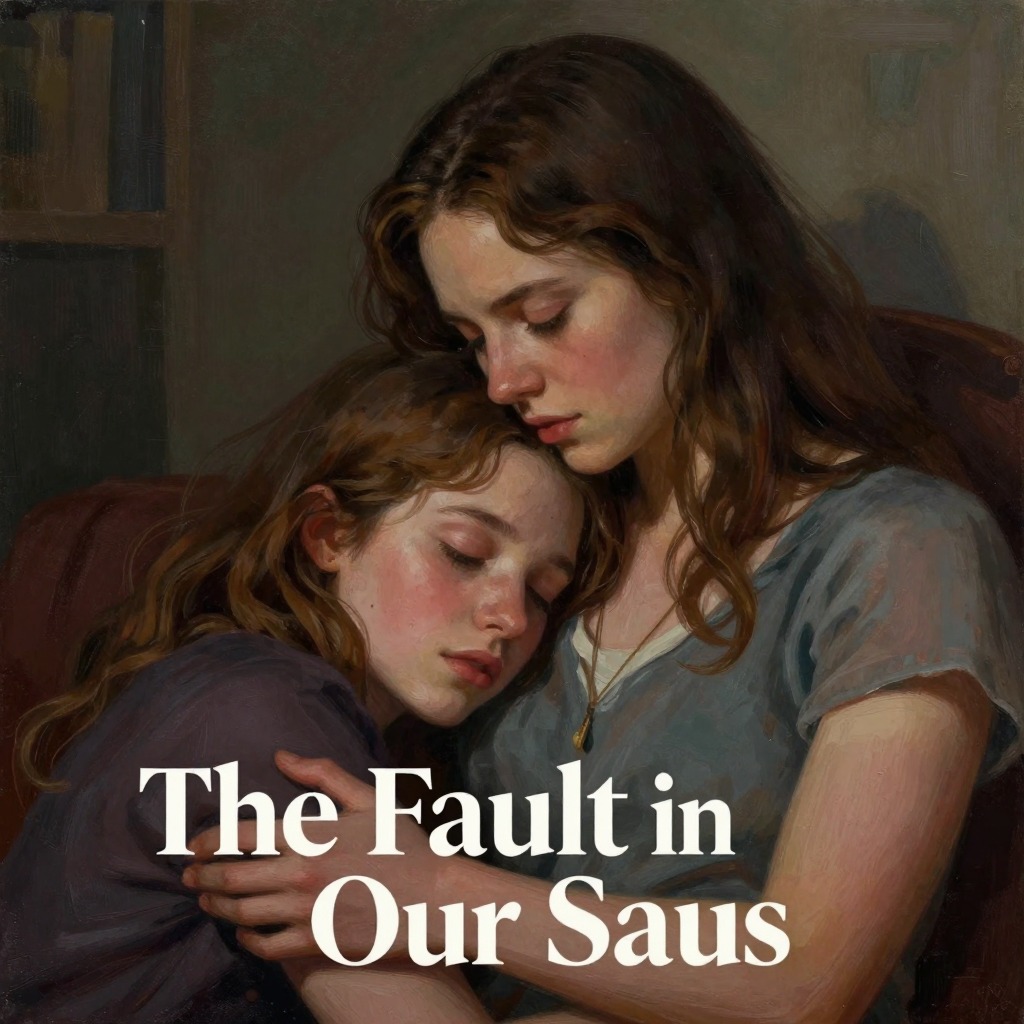
Hazel Grace Lancaster
Hazel Grace Lancaster is the sixteen-year-old narrator and protagonist of John Green's The Fault in Our Stars. Diagnosed with Stage IV thyroid cancer that has metastasized to her lungs, she lives a life circumscribed by illness, oxygen tanks, and the constant awareness of her own mortality. Her encounter with the charismatic Augustus Waters at a cancer support group initiates a love story that forces her to confront her deepest fears about the pain she will cause others, ultimately leading her to redefine heroism, love, and the meaning of a finite life.
Identity and Background
Hazel Grace Lancaster was diagnosed with Stage IV thyroid cancer at the age of thirteen, three months after she got her first period. The cancer spread to her lungs, and after a radical neck dissection, radiation, and chemotherapy that failed to stop the tumors, she was placed in the ICU with pneumonia, where her family prepared for her death. A last-ditch experimental drug called Phalanxifor, which slows the growth of cancer cells, proved effective in her case, shrinking her tumors and granting her a reprieve. She now lives with lungs that "suck at being lungs," requiring a portable oxygen tank that delivers two liters of oxygen per minute through a cannula. Her parents withdrew her from school three years prior, and she has earned her GED, taking classes at a community college. Her life is largely confined to her home, where she reads obsessively, particularly her favorite book, An Imperial Affliction by Peter Van Houten, a novel about a girl with cancer that ends mid-sentence. She has written a dozen letters to the reclusive author asking what happens after the novel's end, but has never received a reply.
Life and Plot Trajectory
Hazel's life is transformed when her mother forces her to attend a weekly cancer Support Group at a stone-walled Episcopal church. There, she meets Augustus Waters, a seventeen-year-old osteosarcoma survivor who has lost a leg. Augustus is immediately drawn to her, and after a staring contest and a pointed exchange about his unlit cigarette—which he keeps as a metaphor for holding the power of death without giving it the power to kill—he invites her to his house to watch V for Vendetta. Their relationship deepens as they exchange books: he gives her The Price of Dawn, a video-game novelization, and she gives him An Imperial Affliction. Augustus, captivated by the book, contacts the reclusive author Peter Van Houten through his assistant, Lidewij Vliegenthart, and receives a reply. Hazel then writes to Van Houten herself, and he invites her to visit him in Amsterdam to discuss the book's ending. Augustus uses his one Wish from the Genie Foundation—granted in exchange for his leg—to take Hazel to Amsterdam. Despite a severe medical crisis that lands her in the ICU, her doctors eventually approve the trip. In Amsterdam, they have a romantic dinner at Oranjee, but their meeting with Van Houten is a disaster: he is a drunk, cruel man who refuses to answer her questions, telling her that the characters are fictions and that her desire for answers is childish. Devastated, Hazel and Augustus visit the Anne Frank House, where they share their first kiss, and later that night, they have sex in his hotel room. The next morning, Augustus reveals that his cancer has returned aggressively, with tumors in his chest, hip, and liver. He had known before the trip but kept it from her. Hazel, who had been trying to keep him at arm's length to avoid hurting him, realizes she cannot protect him from the pain of her own eventual death. She accompanies him through his decline, participating in a prefuneral he organizes for himself at the Support Group, where she delivers a eulogy about infinite numbers and the "little infinity" he gave her. Augustus dies eight days later. At his funeral, Hazel delivers another eulogy, and afterward, she discovers that he had written a letter to Peter Van Houten, asking him to write a eulogy for her. In the letter, Augustus describes Hazel as someone who "walks lightly upon the earth" and argues that the real heroes are not those who do things, but those who notice things. Hazel reads the letter and, in the final pages of the novel, affirms her love for him in the present tense.
Key Actions and Objectives
Hazel's primary objective throughout the novel is to minimize the pain she causes others. She describes herself as a "grenade," destined to explode and wound everyone who loves her. This belief drives her to resist intimacy with Augustus, even as she falls in love with him. She tells him she cannot kiss him because all she sees is what she will put him through. She also worries about her parents, particularly her mother, whom she overheard saying she "won't be a mom anymore" if Hazel dies. Hazel's actions are often motivated by a desire to protect others from her own impending death. She attends Support Group to make her parents happy, she agrees to go to Amsterdam despite her health risks, and she eventually allows herself to love Augustus, even though she knows it will cause him pain. Her other key objective is to learn what happens after the end of An Imperial Affliction. This quest drives the central plot of the novel, leading her to Amsterdam and to a confrontation with Peter Van Houten. When Van Houten refuses to answer her questions, she is devastated, but she ultimately finds a different kind of answer in Augustus's letter, which reframes her understanding of her own life and death.
Relationships and Conflict
Hazel's central relationship is with Augustus Waters. Their connection is immediate and intense, built on a shared experience of cancer, a love of literature, and a mutual understanding of mortality. However, their relationship is also defined by conflict. Hazel's "grenade" philosophy creates a barrier between them, as she tries to keep him at a distance to protect him. Augustus, in turn, struggles with his own desire for a heroic, meaningful death, which Hazel finds frustrating and misguided. She tells him that his obsession with dying for something is "really mean" to say to someone who is terminal. Their conflict is resolved when Augustus reveals his recurrence, and Hazel realizes that she cannot unlove him, even knowing the pain it will cause. She tells him, "It would be a privilege to have my heart broken by you." Hazel's relationship with her parents is also a source of conflict and growth. She is fiercely protective of them, but she also feels trapped by their constant hovering. She lashes out at them, telling her mother that she is dying and that her mother will "not be a mother anymore." This confrontation leads to a deeper understanding, as her mother reveals she is pursuing a master's degree in social work, and her father tells her that the universe wants to be noticed. Hazel also has a friendship with Isaac, another cancer patient who goes blind. They bond over their shared experiences and their mutual love of Augustus. Her relationship with her former friend Kaitlyn is more distant, as Hazel feels an "unbridgeable distance" between herself and healthy peers.
Change and Ending
Hazel undergoes a profound transformation over the course of the novel. She begins as a withdrawn, depressed teenager who believes she is a "grenade" whose only purpose is to minimize the damage she causes. She is obsessed with the idea that her life is meaningless and that she will be forgotten. Through her relationship with Augustus, she learns to accept love and to allow herself to be loved, even knowing that it will end in pain. She also learns to see her own life differently. Augustus's letter to Van Houten reframes her existence: he describes her as someone who "walks lightly upon the earth" and argues that the real heroism is not in leaving a mark, but in noticing the world. This idea resonates with Hazel, who, in the novel's final chapter, sits in a park and tries to notice everything: the light on the ruins, a child discovering a stick, her mother making a sandwich. She concludes that she is not sure that these things are temporary, and that the universe is "teeming with ruined ruins and screaming children." She does not find a cure or a miracle, but she finds a way to live with her pain and to find meaning in the finite. The novel ends with her reading Augustus's letter and affirming, "I do, Augustus. I do."
Narrative Role and Evaluation
Hazel Grace Lancaster is one of the most memorable and critically acclaimed narrators in contemporary young adult literature. Her voice is sharp, witty, and self-aware, blending intellectual sophistication with the raw emotional honesty of a teenager facing her own mortality. She is a deeply unreliable narrator in the sense that she consistently underestimates her own worth and the impact she has on others. The novel's power derives from the tension between her own self-perception as a "grenade" and the reader's growing understanding that she is, in fact, a source of love, meaning, and joy for those around her. Hazel's narrative arc subverts the traditional cancer-kid story: she does not die at the end, nor does she find a cure. Instead, she learns to live with the knowledge of her own death and to find value in the "little infinity" she shared with Augustus. Her story is a meditation on the nature of heroism, the meaning of love, and the importance of paying attention to the world. She is a testament to the idea that a life can be meaningful not because of its length or its accomplishments, but because of the depth of its connections and the quality of its attention.