Gavrila Ardalionovitch Ivolgin
Gavrila Ardalionovitch Ivolgin, known to all as Gania, is a young man of about twenty-eight, handsome, intelligent, and ambitious, yet trapped by poverty and a corrosive self-awareness of his own mediocrity. He works as a clerk in a public company under General Ivan Fedorovitch Epanchin, but his real project is to climb out of the shabby gentility into which his family has fallen. His father, General Ardalion Alexandrovitch Ivolgin, is a disgraced drunkard; his mother, Nina Alexandrovna, and his sister, Varvara Ardalionovna, endure the humiliation of taking in lodgers. Gania despises this life and is determined to escape it by any means necessary, a resolve that leads him into the most degrading entanglement of the novel.
Identity and Background
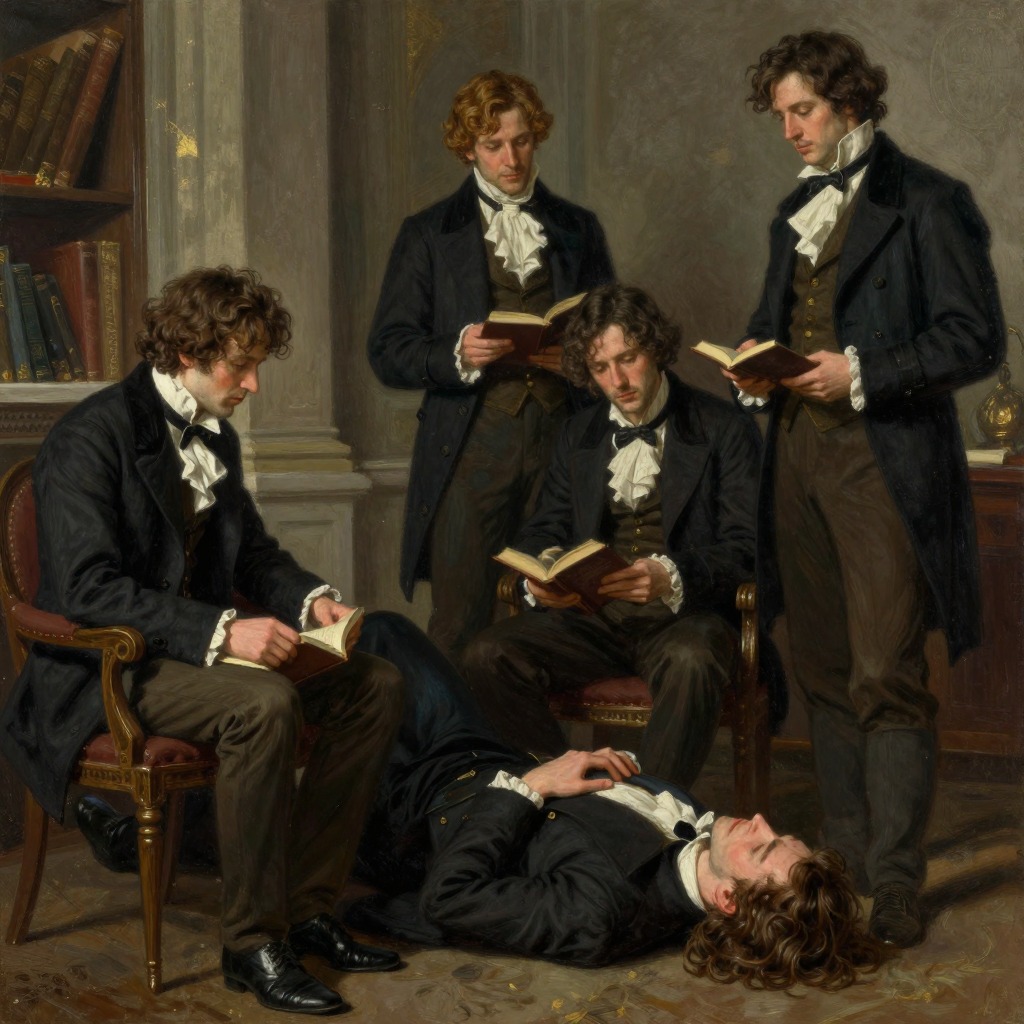
Gania is introduced as a remarkably handsome young fellow of some twenty-eight summers, fair and of middle height, with a small beard and a most intelligent face. Yet his smile, though sweet, is "a little thin" and shows his teeth too evenly; his gaze, though good-humored, is "a trifle too inquisitive and intent to be altogether agreeable" [E00190]. The prince immediately senses that "probably when he is alone he looks quite different, and hardly smiles at all" [E00191]. This duality—the polished surface and the bitter interior—defines Gania throughout the novel. He is the eldest son of a ruined general and a long-suffering mother, and he supports the family on his clerk's salary of two thousand roubles a year, a sum that forces them to let rooms in their cramped flat on the third floor [E00778]. The flat is divided by a passage; the three rooms for lodgers include one for Ferdishenko, one for the prince, and one empty. Gania's own room doubles as a study by evening and a bedroom at night [E00782]. He grinds his teeth with rage over this state of affairs, though he is anxious to be dutiful and polite to his mother; yet "it was very soon apparent to anyone coming into the house, that Gania was the tyrant of the family" [E00783].
The Marriage Scheme and Moral Collapse
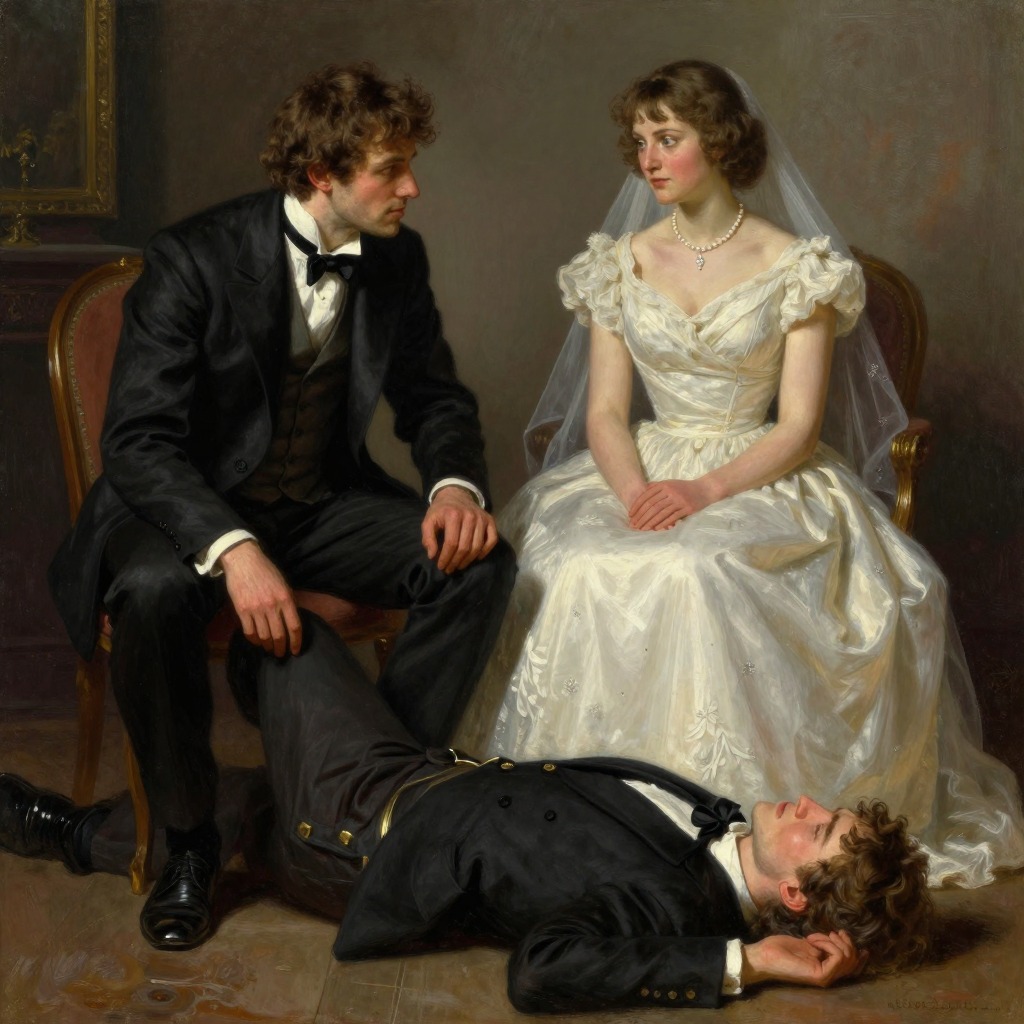
Gania's central plot is his proposed marriage to Nastasia Philipovna Barashkoff, a woman of extraordinary beauty and scandalous reputation, who has been the kept mistress of Afanasy Ivanovitch Totski. Totski, wishing to marry one of General Epanchin's daughters, offers Nastasia seventy-five thousand roubles as a dowry if she will marry Gania, thereby freeing Totski from his obligation to her [E00377]. Gania knows that Nastasia does not love him and that he does not love her; he is marrying her for the money. He confesses to the prince: "If I reckoned on that I should certainly be deceived, for I am still too weak in mind and character. I am obeying a passion, an impulse perhaps, because I have but one aim, one that overmasters all else" [E01162]. He imagines that with the seventy-five thousand roubles he will not buy a carriage but will continue wearing his old overcoat, follow the example of men who have made their fortunes, and in fifteen years become "the king of the Jews" [E01163]. Yet he is tormented by the knowledge that his family—especially his mother and sister—consider the match a disgrace. Nina Alexandrovna cries out, "Oh, it's such a DISHONOUR to us!" [E00267]. Varvara declares that the moment Nastasia enters the house, she will leave [E00919]. Gania's response is to assert his mastery: "I intend to be master of my own destiny, and that I expect to be obeyed at home" [E00266].
The Scene at Gania's House
The crisis comes when Nastasia arrives uninvited at Gania's flat, on the very day she is to give her final answer. She enters with theatrical bravado, mocking Gania's family and his pretensions [E00944]. Gania is paralyzed with rage and shame. When his sister Varvara spits in his face after he tries to drag her away, Gania loses all control and aims a blow at her, but the prince catches his arm [E01080]. In his fury, Gania slaps the prince across the face [E01082]. The prince, pale and trembling, says only: "Very well—never mind about me; but I shall not allow you to strike her!" and then, covering his face, murmurs: "Oh! how ashamed you will be of this afterwards!" [E01084-E01085]. Gania is immediately abashed; he later comes to the prince's room and apologizes, even offering to kiss his hand [E01125]. The prince embraces him, and Gania admits: "I never, never thought you were like that" [E01127]. Yet this moment of repentance does not change his course. He tells the prince that he will certainly marry Nastasia, that he is not going to look a fool, and that if she gives him any nonsense he will leave her but keep the money [E01150].
The Burning of the Money
The climax of Gania's moral ordeal occurs at Nastasia's birthday party. After Rogojin arrives with a packet of one hundred thousand roubles, Nastasia throws the money into the fire and tells Gania that if he pulls it out with his bare hands, it is his [E01568]. Gania stands motionless, a "silly, meaningless smile" on his white, death-like lips, and does not move [E01588]. He restrains himself, and the crowd watches in amazement. Nastasia then fishes the packet out with the tongs and declares that the money is Gania's after all, as a reward for his self-restraint [E01607]. Gania faints from the strain. Later that night, he brings the singed packet to the prince and insists that it be returned to Nastasia; he stays with the prince for two hours, sobbing bitterly, and they part on terms of cordial friendship [E01636].
Aftermath and Decline
After these events, Gania falls seriously ill and is unable to appear in society for over a month [E01633]. He throws up his situation in the public company and never goes near the Epanchins' house again. He is irritable and depressed, and his sister Varvara marries Ivan Petrovitch Ptitsin, partly because Gania can no longer support the family [E01634]. He moves in with the Ptitsins, living on their charity, and becomes increasingly bitter and cynical. He is tormented by the knowledge that Aglaya Ivanovna Epanchin, whom he had secretly hoped to win, has rejected him. When Varvara brings news of the prince's engagement to Aglaya, Gania reacts with a mixture of contempt and resignation, but his sister sees that "he's got some new idea in his head" [E04186]. He later receives a note from Aglaya asking for a meeting at the green bench, which fills him with a brief, triumphant hope [E04311]. But the meeting ends in humiliation: Aglaya dismisses him coldly, and Gania is left standing like a fool [E05057].
Character and Thematic Significance
Gania embodies the corrosive effects of ambition without talent, pride without honor. He is acutely aware of his own mediocrity and longs to be original, but he lacks the courage or the moral substance to achieve anything genuine. The narrator describes him as belonging to the class of "clever commonplace" people who are "far less happy" than the merely stupid, because they are tormented by the "deathless worm of suspicion and doubt" [E04150]. Gania is capable of conceiving base actions but too honest to carry them out; he despises his family yet depends on them; he dreams of wealth yet cannot bring himself to seize it when it is offered. His final fate is to be left with nothing—neither the money, nor the woman, nor the respect of anyone he values. He is a study in the tragedy of the ordinary man who cannot transcend his own limitations.