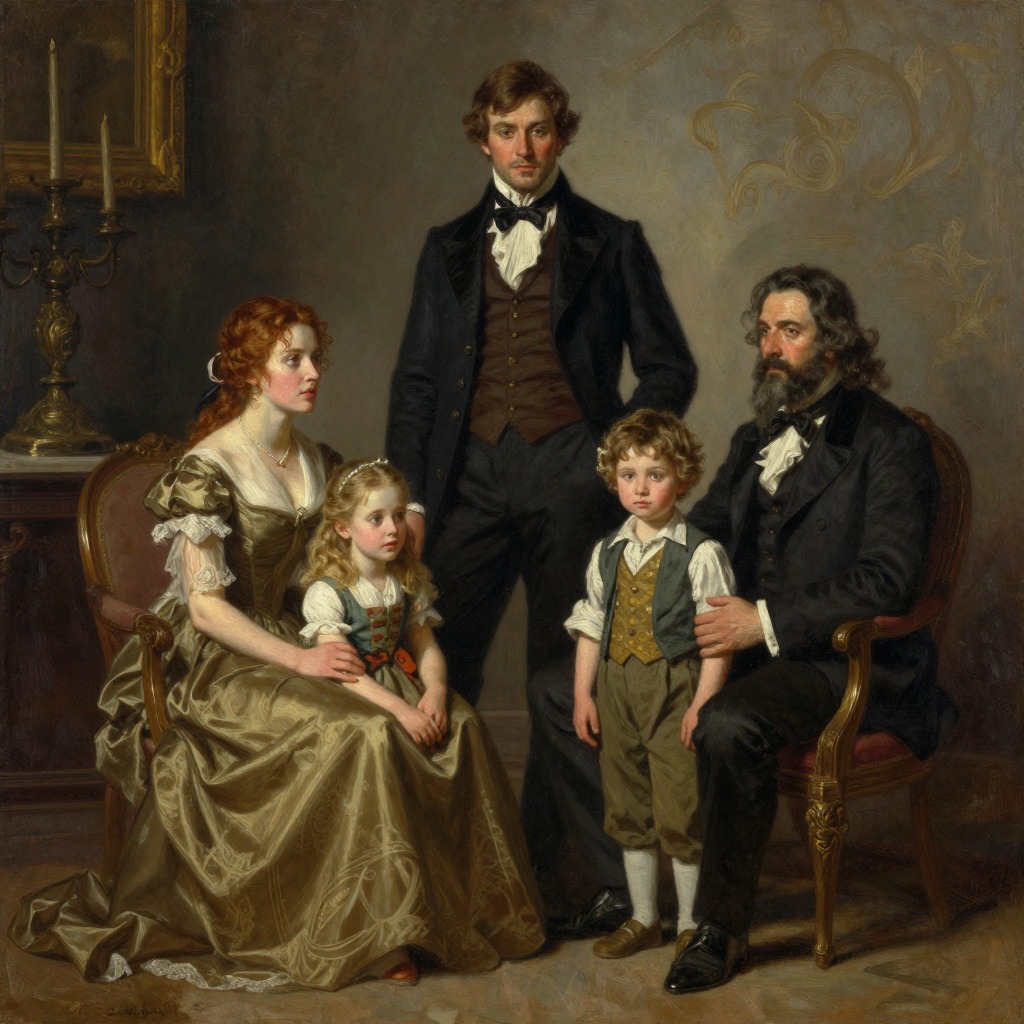
Kostia Lebedeff
Kostia Lebedeff, the young son of the clerk Lukian Timofeyovitch Lebedeff and a schoolfellow of Colia Ivolgin, appears only fleetingly in The Idiot, yet his few appearances carry a disproportionate narrative weight. He is a boy on the cusp of adolescence, old enough to be drawn into the ideological battles of the older youths but young enough to remain a vehicle for the novel's most whimsical and tender moments. His most significant act—the purchase and sale of a hedgehog—becomes the unlikely instrument through which Aglaya Epanchin signals her forgiveness to Prince Muishkin after a bitter quarrel, while his silent presence during Hippolyte Terentieff's apocalyptic speeches places him as a witness to the radical ideas that convulse the younger generation.
The Hedgehog and the Hatchet
Kostia's defining scene occurs on the morning after the prince's disastrous evening at the Epanchins', when Aglaya had stormed out after humiliating Muishkin. Colia Ivolgin arrives at the Epanchin villa carrying a hedgehog, explaining that he and Kostia had bought it from a peasant they met on the road for fifty copecks, along with a hatchet that had taken their fancy. The money, however, was not theirs: it belonged to a schoolmate named Petroff, who had given them the sum to purchase Schlosser's History from another schoolfellow who was selling his books. Colia and Kostia had succumbed to the temptation of the hedgehog instead. When Aglaya, still agitated from the morning's events, begs Colia to sell her the hedgehog—even calling him "dear Colia" in her coaxing—he refuses for a long time but eventually yields, fetching the shy Kostia, who appears "covered with confusion" and carrying the hatchet. Aglaya then places the hedgehog in a wicker basket and instructs Colia to deliver it to the prince as "a token of my profound respect." The hedgehog thus becomes a coded message of reconciliation, and Kostia, though he speaks not a word in the scene, is the co-owner of the object that makes this communication possible.
Witness to Radicalism
Kostia's other appearances place him in the orbit of the novel's most intellectually turbulent characters. He is present during Hippolyte Terentieff's feverish monologues at Lebedeff's villa, where the dying youth holds forth on the Apocalypse, the nature of faith, and the meaning of death. When Lebedeff, in his drunken enthusiasm, begins to expound on the "star called Wormwood" from the Book of Revelation—interpreting it as the network of railroads spreading across Europe—Kostia is among the listeners, part of the audience that includes the prince, Colia, and the other young men. He is also present during the chaotic scene when Hippolyte's companions—Burdovsky, Doktorenko, and Keller—confront the prince over the alleged inheritance from Pavlicheff, a confrontation that exposes the nihilistic and utilitarian currents among the younger generation. In these scenes, Kostia functions as a silent observer, a boy absorbing the ideological ferment around him without yet having the words or the will to participate.
Narrative Function and Thematic Significance
Kostia Lebedeff's role in the novel is that of a minor character whose actions, however small, set in motion significant emotional and relational developments. The hedgehog episode, in which he is an unwitting collaborator, provides the prince with the first sign that Aglaya's anger has softened, allowing him to return to the Epanchin house that evening in a state of joy and hope. Kostia's presence also reinforces the novel's interest in the younger generation—the schoolboys and students who are caught between the old world of their parents and the new world of nihilism, radicalism, and ideological confusion. Unlike Hippolyte, who articulates his despair and defiance, or Burdovsky, who pursues his claim with a mixture of principle and self-interest, Kostia remains largely inarticulate, a figure of youthful mischief and unformed potential. His brief appearances serve as a reminder that the novel's drama unfolds not only among its central characters but also in the margins, where children and adolescents observe, absorb, and occasionally act in ways that reshape the story's emotional landscape.