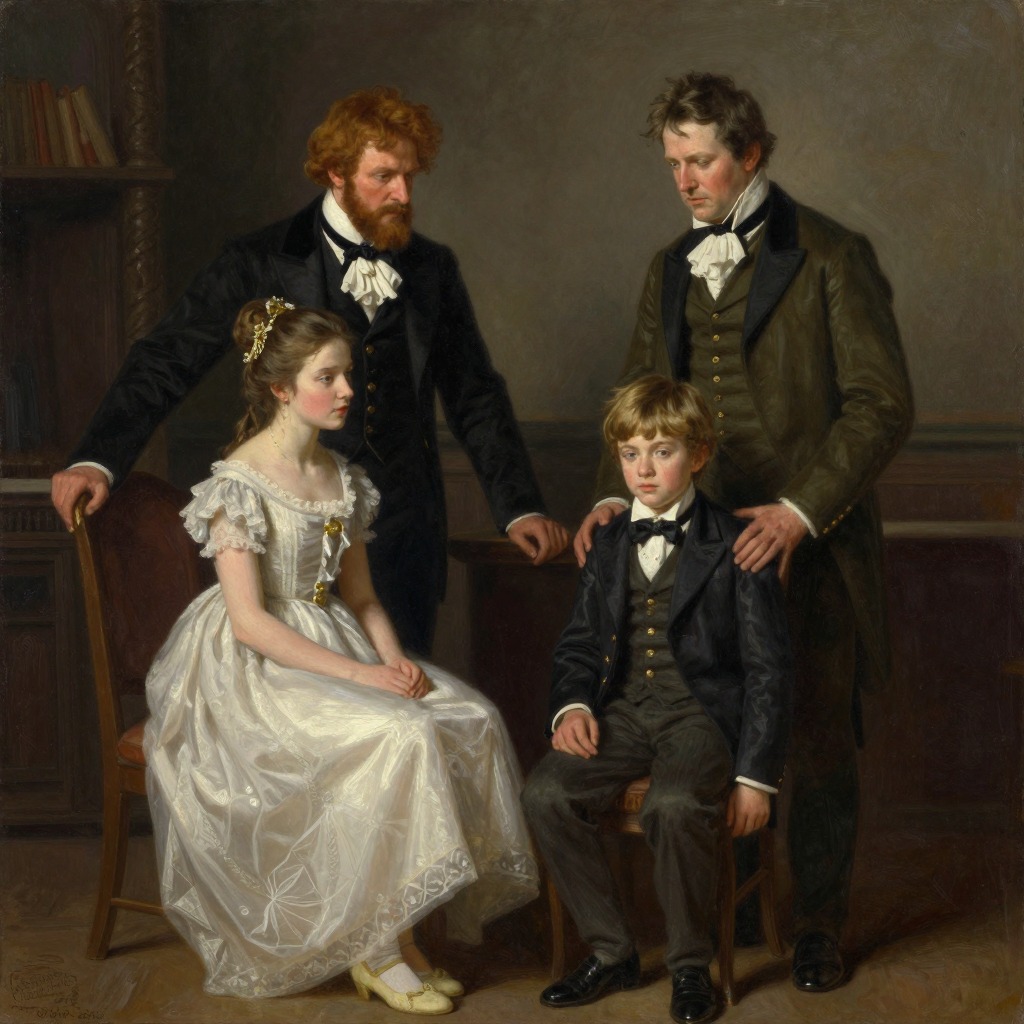
Prince S.
Prince S. is a man of excellent family, solid means, and about thirty-five years of age, who enters the Epanchin circle in the spring and quickly becomes a stabilizing presence. He had served in a civil department, attended to local government matters in provincial towns, and acted as a corresponding member of several important scientific societies, establishing himself as an active, modest, and unobtrusive person who always finds good work to employ himself. His arrival in St. Petersburg from Moscow marks a turning point for the family, as he makes a deep impression on Adelaida Ivanovna, the second daughter, and by spring he proposes to her, an offer she accepts to the delight of both General Epanchin and Lizabetha Prokofievna.
Role in the Epanchin Household and Relationship with Adelaida
Prince S. is quickly integrated into the family's inner circle, where he is treated with the familiarity and respect due to a future son-in-law. His engagement to Adelaida is considered both happy and suitable, approved in society, and it provides a measure of relief to Lizabetha Prokofievna, who had long fretted over her daughters' matrimonial prospects. Adelaida is devoted to him, and the match is seen as a wise one. He is present at many of the family's key gatherings, including the tense evening at the prince's villa where Hippolyte reads his "Necessary Explanation," and the formal party where Prince Muishkin suffers his epileptic fit. In these settings, he often acts as a voice of reason, attempting to steer conversations away from dangerous or embarrassing topics. When Evgenie Pavlovitch makes provocative statements about Russian liberalism, Prince S. challenges him seriously, refusing to let the remarks pass as mere jokes. He also tries to calm Lizabetha Prokofievna during her outbursts, suggesting they take the prince with them when she threatens to break off relations.
Witness to the Prince's Ordeal and the Party's Collapse
At the Epanchins' evening party, Prince S. is among the guests who witness Prince Muishkin's catastrophic epileptic fit. After the fit, he joins Prince N. and Evgenie Pavlovitch in a futile attempt to restore the harmony of the evening, but the party dissolves soon after. His presence at this event underscores his position as a trusted family intimate, one who shares in both the family's joys and its most shaming public disasters. Later, when the Epanchins travel abroad and visit Dr. Schneider's establishment in Switzerland, Prince S. accompanies them. There, he makes a few just and sensible remarks about the invalid prince's condition, though Evgenie Pavlovitch observes that there is not yet perfect harmony between Adelaida and her fiance, suggesting that the recent family tragedies—especially Aglaya's disastrous marriage—have given Adelaida much to think about and may have strained the relationship.
Thematic Significance
Prince S. represents the ideal of the responsible, enlightened Russian aristocrat—a man of action, intellect, and moral seriousness who is neither a reactionary nor a nihilist. He is the embodiment of the stable, productive nobility that Prince Muishkin, in his impassioned speech at the party, hopes will lead Russia forward rather than disappear into darkness. Unlike the feverish passions of Rogojin, the cynical calculations of Gania, or the mystical simplicity of the prince himself, Prince S. offers a model of measured, constructive engagement with the world. His marriage to Adelaida, an artist with a restless spirit, suggests a union of practical sense with creative energy, a balance the novel holds up as one of its few hopeful possibilities. Yet even this relationship is shadowed by the novel's tragic conclusion, as the family's grief over Aglaya and the prince leaves its mark on all of them.