Aslan
Aslan is the great lion, the true King of Narnia and the son of the Emperor-Beyond-the-Sea, whose return breaks the White Witch's eternal winter and fulfills the prophecy of the four thrones. He is the central figure of redemption, sacrifice, and resurrection in the story, embodying a power that is both terrible and good, and his actions—from his willing death on the Stone Table to his final victory—determine the fate of Narnia and its human visitors.
Identity and Nature
Aslan is not a man but a lion—"the Lion, the great Lion"—as Mr. Beaver explains to the children. He is the King of the whole wood and the son of the great Emperor-Beyond-the-Sea, a being whose authority predates the creation of Narnia itself. When the Beaver first speaks Aslan's name, each of the four children feels an immediate, inexplicable response: Peter feels suddenly brave and adventurous, Susan senses a delicious smell or strain of music, Lucy feels the joy of a holiday morning, and Edmund experiences a sensation of mysterious horror. This visceral reaction establishes Aslan as a figure of immense, numinous power that transcends ordinary understanding. Mr. Beaver warns that Aslan is not safe—"'Course he isn't safe. But he's good. He's the King, I tell you"—a formulation that captures the Lion's essential nature: he is not a tame or domesticated force, but one that commands awe and demands courage.
Arrival and Meeting at the Stone Table
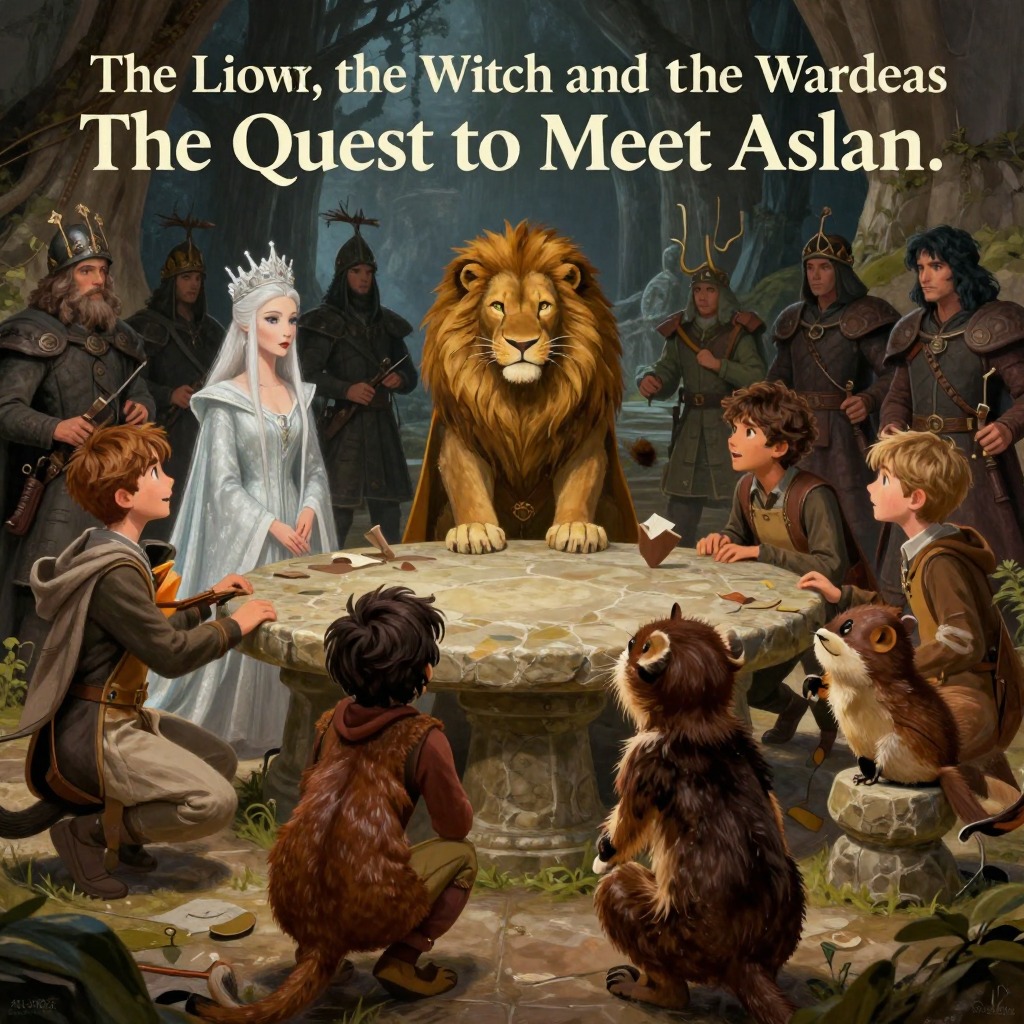
Aslan arrives in Narnia at a time when the White Witch's winter has held the land in an unbroken grip of cold and despair. The Beavers lead Peter, Susan, and Lucy to the Hill of the Stone Table, where they find Aslan standing in the center of a half-moon of creatures: Tree-Women and Well-Women (Dryads and Naiads) playing stringed instruments, four great centaurs, a unicorn, a bull with the head of a man, a pelican, an eagle, a great dog, and two leopards—one carrying his crown, the other his standard. When the children first see him, they cannot look directly at his face; they catch only a glimpse of the golden mane and the great, royal, solemn, overwhelming eyes, and then find themselves trembling. Aslan welcomes each of them by name—"Welcome, Peter, Son of Adam. Welcome, Susan and Lucy, Daughters of Eve. Welcome He-Beaver and She-Beaver"—and his deep, rich voice takes the fidgets out of them, leaving them glad and quiet. He shows Peter a far-off sight of Cair Paravel, the castle of the four thrones, and tells him, "You are the first-born and you will be High King over all the rest." When Susan blows her horn in distress, Aslan sends Peter to win his spurs, and after Peter kills the wolf Fenris Ulf, Aslan knights him with the flat of the blade, saying, "Rise up, Sir Peter Fenris-Bane. And, whatever happens, never forget to wipe your sword."
The Deep Magic and the Sacrifice
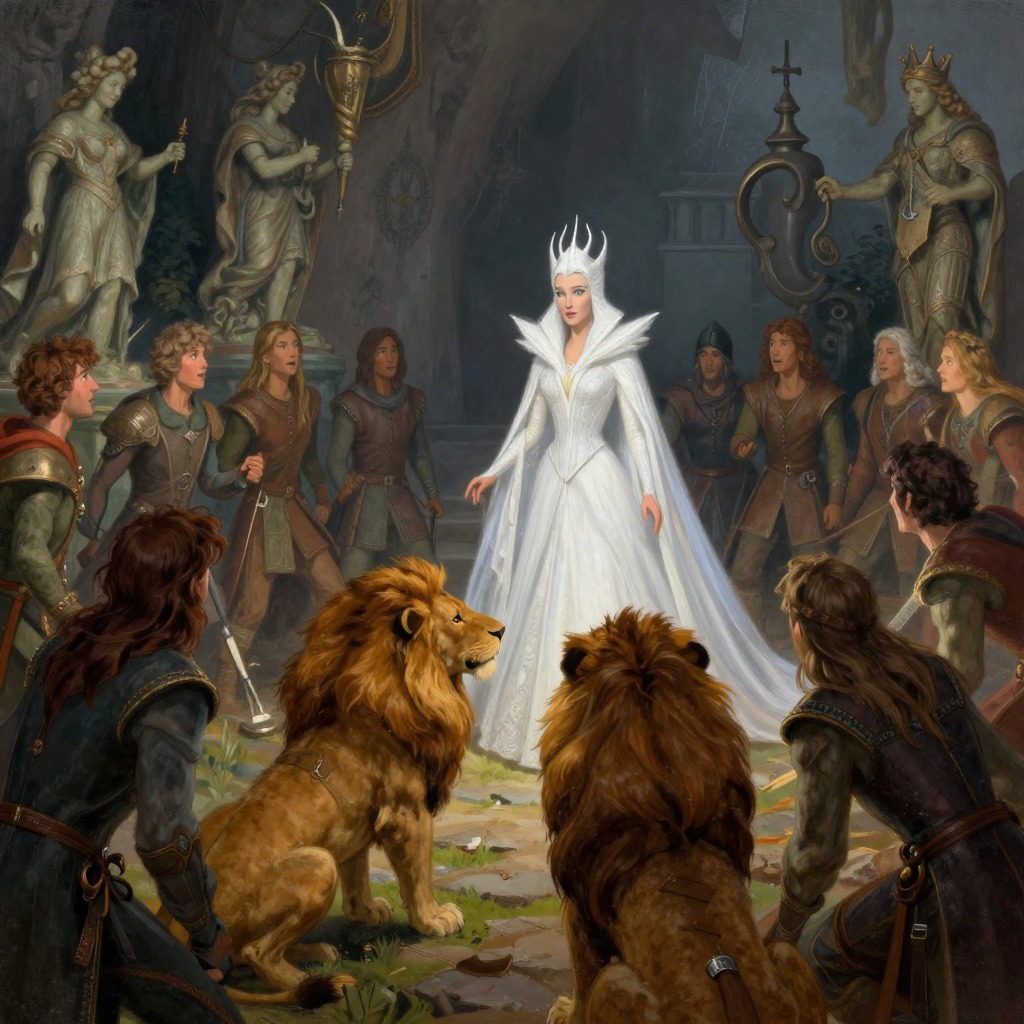
The White Witch confronts Aslan at the Stone Table, claiming Edmund as her lawful prey under the Deep Magic written on the Table of Stone, on the trunk of the World Ash Tree, and on the sceptre of the Emperor-Beyond-the-Sea: every traitor belongs to her, and for every treachery she has a right to a kill. Aslan does not deny the law. He speaks with the Witch alone, and afterward announces that she has renounced her claim on Edmund's blood. But the Witch, with a look of fierce joy, demands a guarantee; Aslan's roar—so vast that his great mouth opens wider and wider and the roar grows louder and louder—sends her fleeing for her life. That night, Aslan walks slowly and sadly away from the camp, his head and tail hanging low, and Susan and Lucy follow him. He allows them to accompany him to the foot of the hill where the Stone Table stands, then tells them to stop and not let themselves be seen. On the hilltop, the Witch's rabble—ogres, wolves, bull-headed men, spirits of evil trees, Cruels, Hags, Incubuses, Wraiths, Horrors, Efreets, Sprites, Orknies, Wooses, and Ettins—bind the unresisting Lion, shave his golden mane with shears, muzzle him, and jeer at him as "Puss, Puss! Poor Pussy." They drag him onto the Stone Table and tie him with cords. The Witch bares her arms, whets her stone knife, and taunts him: "Now I will kill you instead of him as our pact was and so the Deep Magic will be appeased. But when you are dead what will prevent me from killing him as well?" She kills him, and the children, hiding in the bushes, cover their eyes.
Resurrection and Deeper Magic
After the Witch and her followers leave, Susan and Lucy spend the night beside Aslan's dead body. They remove the muzzle, wipe away the blood and foam, and try in vain to untie the knots. At dawn, hundreds of field mice creep onto the Table and gnaw through the ropes. As the sun rises, the girls hear a great cracking noise: the Stone Table has broken into two pieces, and Aslan's body is gone. He appears behind them, larger than before, his mane grown again, shining in the sunrise. He explains that though the Witch knew the Deep Magic, there is a magic deeper still that she did not know: "when a willing victim who had committed no treachery was killed in a traitor's stead, the Table would crack and Death itself would start working backwards." He then romps with the girls in a joyful chase around the hilltop, tossing them in the air with his velveted paws and catching them, until all three lie together panting in the sun, no longer tired or hungry or thirsty.
Liberation and Final Battle
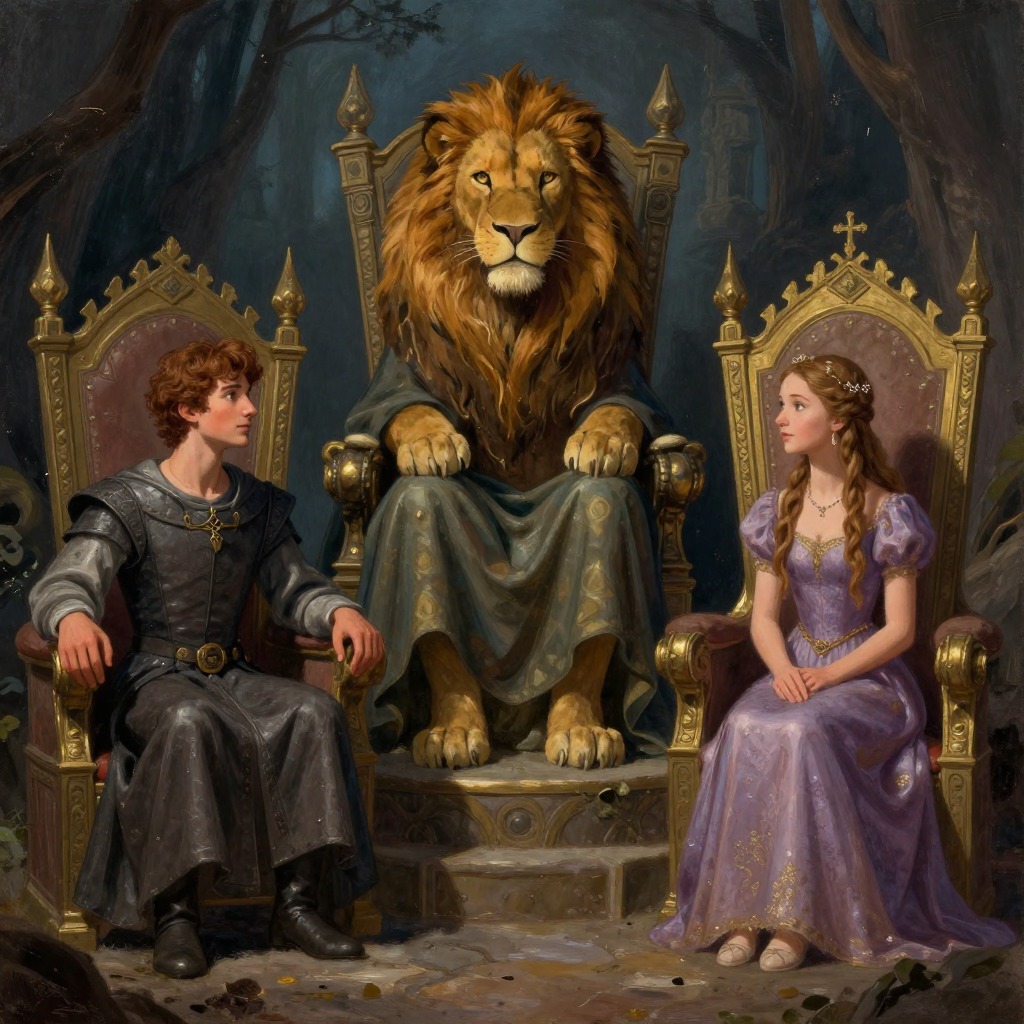
Aslan carries Susan and Lucy on his back in a breathtaking ride across Narnia, faster than any horse, leaping over the wall of the White Witch's castle. Inside the courtyard, he breathes on the stone statues—lions, dwarfs, Dryads, centaurs, a giant—and they return to life, the color spreading like flame over paper. The liberated creatures join him, and he leads them to the battlefield where Peter and Edmund are fighting the Witch's army. With a roar that shakes all Narnia from the Western lamp-post to the shores of the Eastern sea, Aslan flings himself upon the White Witch, and they roll over together with the Witch underneath. Her death ends the battle. Afterward, Aslan heals Edmund with Lucy's cordial and makes him a knight. At Cair Paravel, in the Great Hall with the ivory roof and the east door opening onto the sea, Aslan solemnly crowns the four children and leads them to the four thrones, declaring, "Once a king or queen in Narnia, always a king or queen. Bear it well, Sons of Adam! Bear it well, Daughters of Eve!"
Departure and Enduring Presence
After the coronation feast, Aslan quietly slips away. Mr. Beaver had warned the children that he would come and go: "He doesn't like being tied down—and of course he has other countries to attend to. It's quite all right. He'll often drop in. Only you mustn't press him. He's wild, you know. Not like a tame lion." This final characterization—wild, untamable, yet good—encapsulates Aslan's role in the story. He is not a figure who remains permanently present or subject to human control; his power and authority operate on a scale that extends beyond Narnia, and his appearances are gifts rather than guarantees. The children's entire adventure is framed by his return, his sacrifice, and his victory, and the land itself—from the melting of the eternal winter to the breaking of the Stone Table—bears witness to his transformative presence.