Father Christmas
Father Christmas is a pivotal figure in C. S. Lewis's The Lion, the Witch and the Wardrobe, whose arrival marks the first tangible sign that the White Witch's enchantment of eternal winter is breaking. He appears to the children and the Beavers in the forest, bringing gifts that are tools for the coming struggle, and his presence signals that Aslan is on the move and the Witch's magic is weakening.
Arrival and Significance
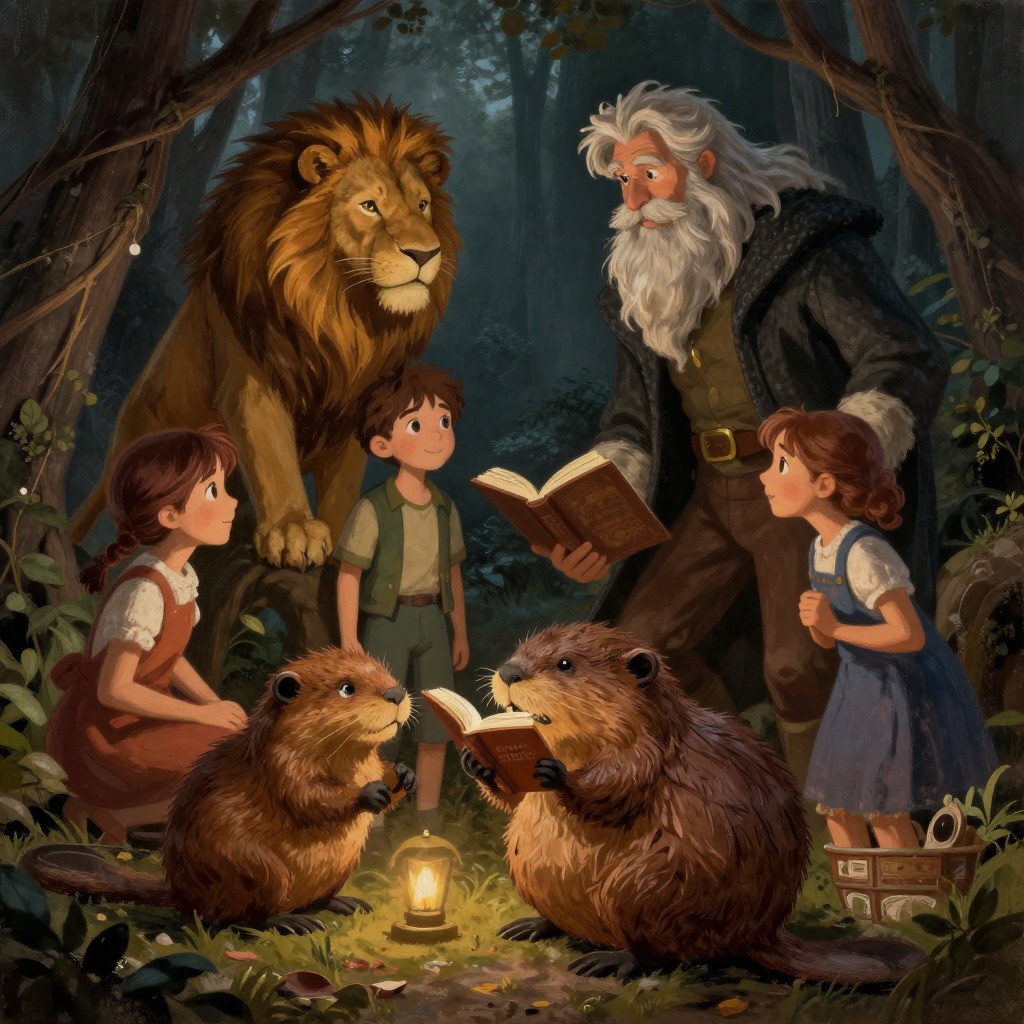
Father Christmas first appears to the children and the Beavers after they have fled the Beavers' house and taken refuge in a secret cave. The group emerges to find a sledge drawn by brown reindeer, far larger than the Witch's white ones, and on it sits a huge man in a bright red robe with a hood lined with fur and a great white beard that falls like a foamy waterfall over his chest. The children instantly recognize him from pictures and stories in their own world, but seeing him in Narnia is different: he is so big, so glad, and so real that they all become quite still, feeling both very glad and solemn. He announces, "I've come at last. She has kept me out for a long time, but I have got in at last. Aslan is on the move. The Witch's magic is weakening." Lucy feels a deep shiver of gladness that only comes when one is being solemn and still.
The Gifts
Father Christmas distributes gifts that are explicitly "tools not toys." To Mrs. Beaver he gives a new and better sewing machine, promising to drop it in her house as he passes; to Mr. Beaver he promises that when he gets home he will find his dam finished and mended, all leaks stopped, and a new sluice gate fitted. To Peter he gives a silver-colored shield with a red lion rampant across it, and a sword with a gold hilt, sheath, and belt, just the right size and weight for Peter to use. Peter is silent and solemn as he receives these gifts, feeling they are a very serious kind of present. To Susan he gives a bow and a quiver full of arrows and a little ivory horn, instructing her to use the bow only in great need, for it does not easily miss, and telling her that when she blows the horn, wherever she is, help of some kind will come to her. To Lucy he gives a little bottle of what looks like glass (but people later say it is made of diamond) containing a cordial made from the juice of one of the fire-flowers that grow in the mountains of the sun, which will restore anyone who is hurt with just a few drops, and a small dagger for her to defend herself at great need. When Lucy protests that she thinks she could be brave enough to fight, he replies, "That is not the point. But battles are ugly when women fight." Then, suddenly looking less grave, he brings out a large tray with five cups and saucers, a bowl of lump sugar, a jug of cream, and a great big teapot all sizzling and piping hot, crying "A Merry Christmas! Long live the true King!" before cracking his whip and vanishing with his sledge and reindeer.
Thematic Significance
Father Christmas's arrival is a direct challenge to the White Witch's reign. The Witch herself has made it "always winter and never Christmas," so his presence is a sign that her power is crumbling. The gifts he gives are not mere presents but instruments of the coming battle: Peter's sword and shield, Susan's bow and horn, and Lucy's cordial and dagger are all used in the final conflict. His appearance also reinforces the Christian allegory of the story, as Christmas celebrates the birth of Christ, and his gifts prefigure the roles the children will play in the war against the Witch. The fact that he can enter Narnia only when Aslan is on the move underscores the connection between the Lion's return and the breaking of the Witch's spell. Father Christmas himself is a figure of joy and solemnity, embodying the hope that the long winter is ending and that the true King is coming.