Arkady Apollonovich Sempleyarov
Arkady Apollonovich Sempleyarov, chairman of the Acoustics Commission of the Moscow theatres, is a minor but emblematic figure in Mikhail Bulgakov's The Master and Margarita. He appears during the climactic black magic seance at the Variety Theatre, where his insistence on a rational "exposure" of the magician's tricks leads to his own public humiliation. Sempleyarov embodies the hypocrisy and moral decay of the Soviet cultural elite, and his exposure is a key moment in the novel's satirical attack on officialdom.
Identity and Official Position
Sempleyarov is introduced as the evening's guest of honour at the Variety Theatre, seated in box no. 2 with two ladies: his expensively dressed wife and a young, pretty distant relation, a promising debutante from Saratov living in his apartment. His official title is chairman of the Acoustics Commission of the Moscow theatres, a position that grants him authority and respect within the cultural bureaucracy. He is a well-fed, self-important figure, accustomed to deference and control.
Role in the Seance and Demand for Exposure
During the seance, after the magician Woland and his assistant Koroviev (also called Fagott) have showered the audience with magic money and opened a ladies' shop, Sempleyarov intervenes. In a pleasant, sonorous, and very insistent baritone, he demands that the artiste expose the technique of his tricks, especially the trick with the paper money, and that the master of ceremonies, Georges Bengalsky, be returned to the stage. He claims the spectators are concerned about Bengalsky's fate. This demand is a performance of his official role: he presents himself as the voice of reason and public order, seeking to demystify the supernatural and restore normalcy.
Public Exposure and Humiliation
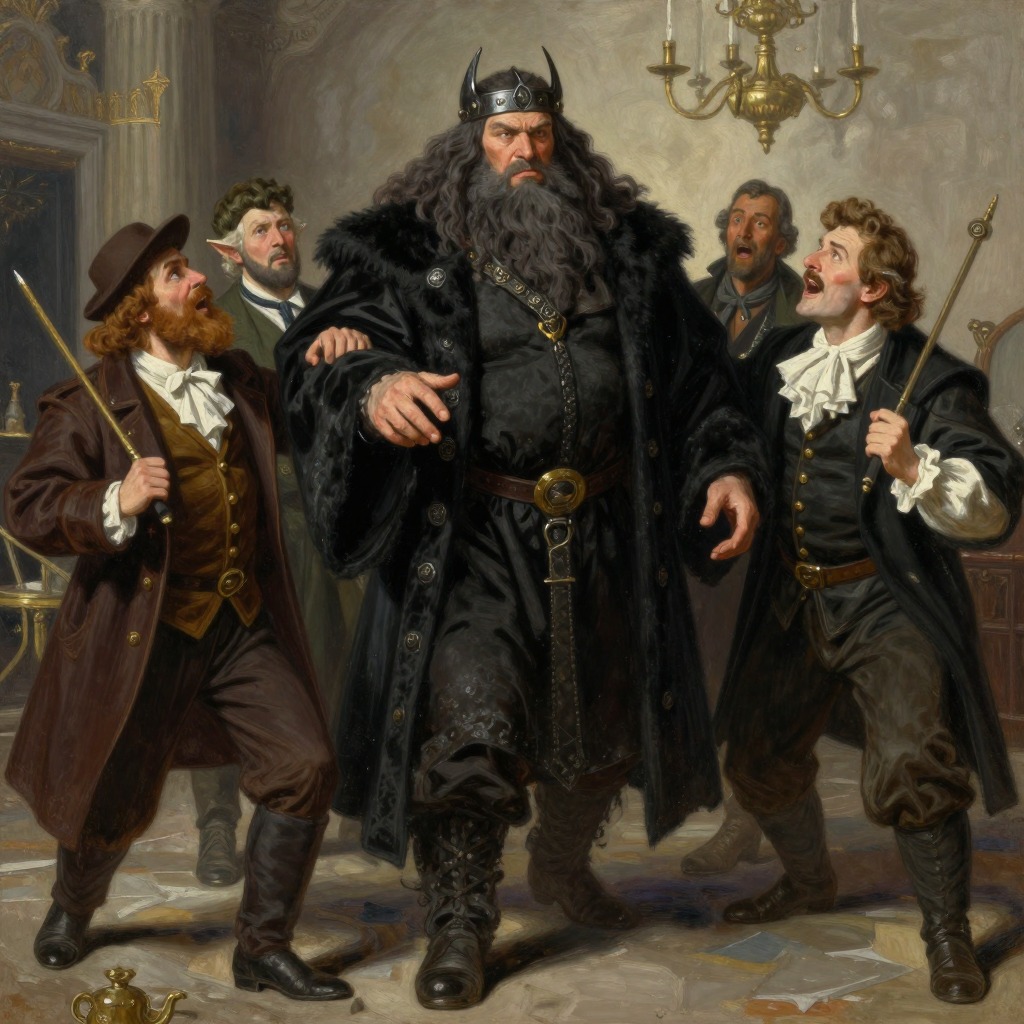
Koroviev, instead of complying, turns the tables on Sempleyarov. He asks where Sempleyarov was the previous evening. Sempleyarov's wife declares he was at a meeting of the Acoustics Commission, but Koroviev reveals the truth: after dismissing his chauffeur at the Commission building on Clean Ponds, Sempleyarov went by bus to Yelokhovskaya Street to visit an actress from the regional itinerant theatre, Militsa Andreevna Pokobatko, with whom he spent some four hours. This revelation is met with a cry of "Aie!" from the audience. Sempleyarov's young relation, the debutante, immediately understands the implication, exclaiming that she has long suspected it and now sees why the "giftless thing" got the role of Louisa. She strikes Sempleyarov on the head with her short, fat violet umbrella. Sempleyarov's wife then rises to her full height, demanding to know who dares touch him, and the young relation responds with a second blow. The scene descends into chaos, with the police running to Sempleyarov's box, people climbing over barriers, and bursts of infernal guffawing.
Thematic Significance: Hypocrisy and the Satire of Officialdom
Sempleyarov's exposure is a perfect example of the novel's satirical method. He is a man who publicly upholds the values of order, reason, and morality, but privately indulges in deceit and hypocrisy. His demand for an "exposure" of magic is ironically turned into an exposure of his own lies. The scene reveals the gap between the public performance of Soviet officialdom and the private reality of corruption and moral failure. Sempleyarov's fate is a warning to all who wield authority without integrity: the truth, in the form of Woland's demonic justice, will eventually be revealed. His humiliation also serves as a cathartic moment for the audience, both within the novel and for the reader, as the pompous and self-righteous are brought low. The episode underscores the novel's broader critique of a society where the "housing problem has corrupted them" and where official positions are used to conceal personal vice.