Bar-Rabban
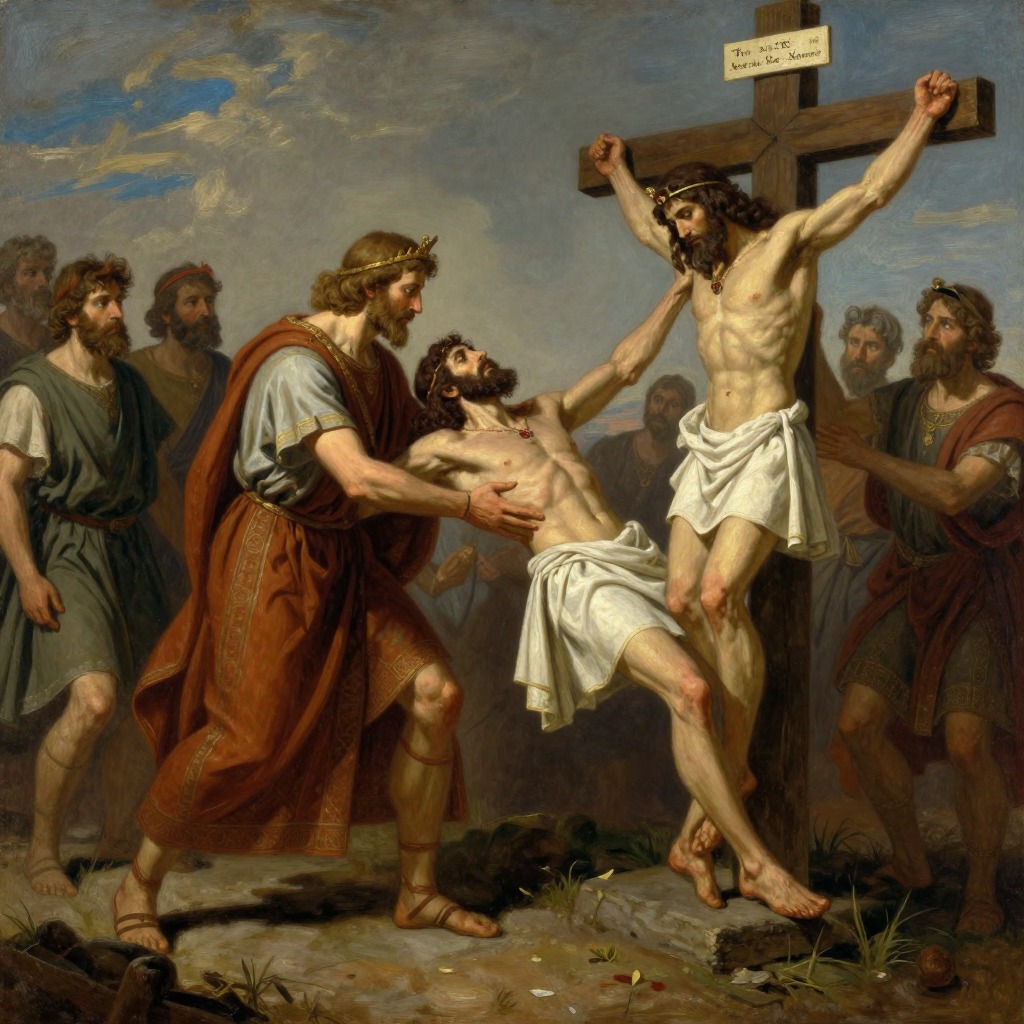
Bar-Rabban is one of the four criminals condemned to execution on the eve of Passover in Yershalaim, but his role in the novel is defined not by any action he performs—he never appears as a speaking or acting character—but by the choice that the Sanhedrin makes in his favor. He is named alongside Dysmas and Gestas as a robber and rebel, and the procurator Pontius Pilate, in his public announcement from the platform, lists him among the condemned: "Four criminals, arrested in Yershalaim for murder, incitement to rebellion, and outrages against the laws and the faith, have been sentenced to a shameful execution—by hanging on posts!" Yet Bar-Rabban is the one whom the law and custom of Passover will set free, and it is this release that constitutes the central moral and political drama of the trial scene.
The Choice Between Bar-Rabban and Yeshua
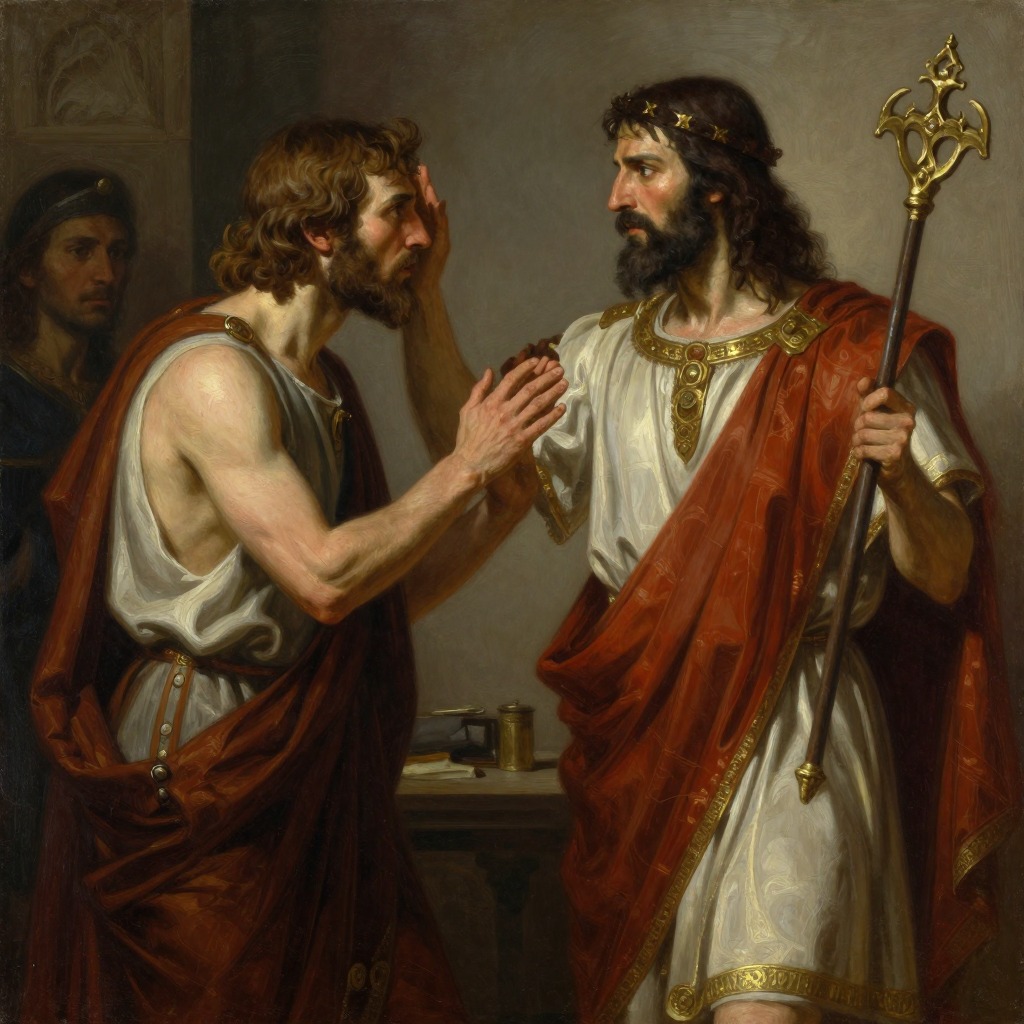
Pilate, having already confirmed the death sentence on Yeshua Ha-Nozri, attempts to use the Passover privilege of releasing one prisoner as a means to save the wandering philosopher. He summons the high priest Joseph Kaifa to the upper terrace of the palace garden and, speaking in Greek, explains that the Sanhedrin must choose between Bar-Rabban and Ha-Nozri. Pilate argues that the crimes of the two men are "quite incomparable in their gravity": Yeshua is merely an insane person who uttered preposterous things, while Bar-Rabban called directly for rebellion and killed a guard during his arrest. The procurator asks the high priest to reconsider and release "the less harmful of the two condemned men, and that is without doubt Ha-Nozri." Kaifa, however, replies firmly that the Sanhedrin intends to free Bar-Rabban. Pilate presses him twice more, and each time Kaifa repeats the same answer. The choice is made: Bar-Rabban will live, and Yeshua will die.
Pilate's Anguish and the Crowd's Response
The decision triggers in Pilate a profound and inexplicable anguish. As he stands on the platform before the crowd, he knows that the name he is about to cry out will resurrect the dead city and that no further words will be heard. He holds the silence, then rolls the letter 'r' over the silent city and shouts: "Bar-Rabban!" The crowd erupts in roars, shrieks, wails, guffaws, and whistles; coins and dates are showered onto the platform as people climb on shoulders to see the miracle of a man escaping death. Pilate turns and walks back across the platform, looking at nothing except the multicolored squares of flooring under his feet, knowing that behind him the convoy is already leading the three remaining men to the side stairs and toward Bald Mountain. The release of Bar-Rabban is thus not a moment of mercy but a spectacle of manipulated popular will, and Pilate's own complicity in it leaves him with the sense that he has not finished saying something to the condemned man, and that immortality—whose immortality he does not understand—has come.
Bar-Rabban as a Narrative Instrument
Bar-Rabban never speaks, never acts, and never appears in any scene except as a name on a list or a name shouted from a platform. His entire existence in the novel is instrumental: he is the counterweight that makes Yeshua's death a matter of choice rather than necessity, and his freedom is the price of Pilate's cowardice. The narrative uses him to expose the political calculation of the Sanhedrin, the impotence of Roman authority when faced with local religious power, and the fickleness of a crowd that can be swayed by the mere announcement of a name. In the dream of Nikanor Ivanovich Bosoy, the currency-theatre's master of ceremonies invokes Bar-Rabban's name as a rhetorical weapon, asking the high priest whether he will remember Bar-Rabban when the Roman legions come: "You will remember Bar-Rabban then, whom you saved, and you will regret having sent to his death a philosopher with his peaceful preaching!" The name thus echoes beyond the historical frame into the contemporary satire, linking the ancient choice to the modern mechanisms of power and manipulation.
Thematic Significance: The Unseen Criminal
Bar-Rabban's invisibility as a character—his lack of any personal history, motive, or presence—is itself the point. He is the placeholder for the crowd's desire, the Sanhedrin's political expediency, and Pilate's failure of nerve. The novel does not ask whether Bar-Rabban deserves to live; it asks why the system chooses him over Yeshua, and the answer lies not in Bar-Rabban's merits but in the structure of power that makes the choice possible. His release is the event that confirms Yeshua's sentence, and it is the event that Pilate cannot undo for two thousand years. Bar-Rabban, the man who never appears, is thus the hinge on which the entire Pilate story turns.