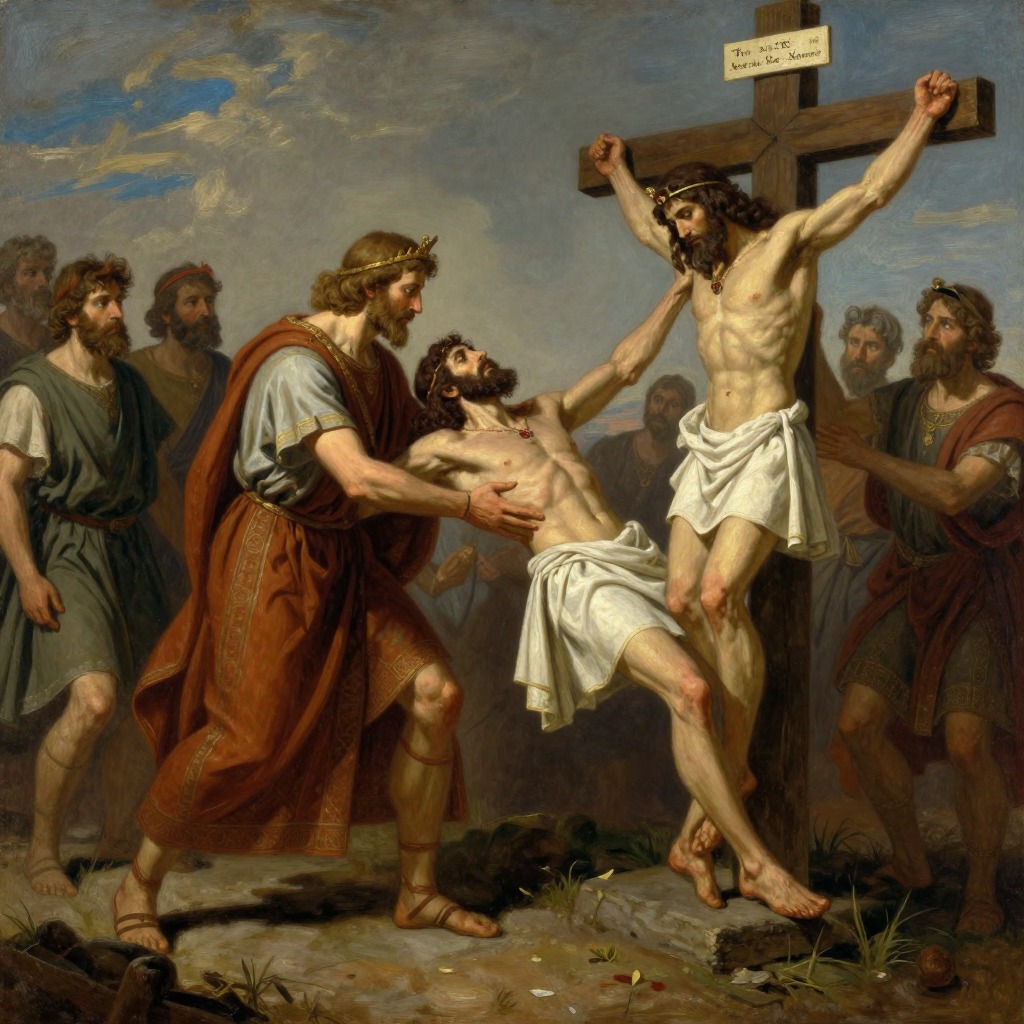
Dysmas
Dysmas is one of the three condemned men executed on Bald Mountain alongside Yeshua Ha-Nozri, a figure whose role in the novel is defined by his physical suffering, his futile protest against injustice, and his place in the political calculus of Pontius Pilate's decision. He is named among the four criminals whose sentences are announced to the crowd in Yershalaim: Dysmas, Gestas, Bar-Rabban, and Ha-Nozri. Unlike Bar-Rabban, who is released by Pilate in a concession to the Sanhedrin, Dysmas is led to the execution site with his arms bound, his fate sealed by the same authority that spares a more dangerous rebel.
Identity and Criminal Record
Dysmas is identified as a robber and rebel, his crime inscribed on a white board hung around his neck in two languages, Aramaic and Greek. Pilate, in his public proclamation, lists the four condemned men as having been arrested for murder, incitement to rebellion, and outrages against the laws and the faith. Dysmas and Gestas, Pilate explains to the high priest Joseph Kaifa, had ventured to incite the people to rebel against Caesar and had been taken in armed struggle by the Roman authorities. This distinguishes them from Bar-Rabban and Ha-Nozri, who had been seized by the local authorities and condemned by the Sanhedrin. Dysmas's crime is thus a direct challenge to imperial power, making him a figure of political rebellion rather than religious dissent.
Suffering on the Cross
Dysmas endures a prolonged and agonizing execution. Unlike Yeshua, who falls into unconsciousness early, Dysmas does not lose his mind. He swings his head constantly and rhythmically, right and left, so that his ears strike his shoulders, a repetitive motion that underscores his conscious torment. When the executioner offers a water-soaked sponge to Yeshua, Dysmas cries out in protest: "Injustice! I'm a robber just like him!" He strains against his bonds, his arms bound to the crossbar in three places with loops of rope, drawing in his belly and clawing at the ends of the crossbar with his nails. Malice blazes in his eyes as he turns his head towards Yeshua's post. The centurion Mark Ratslayer silences him with a shout: "Silence on the second post!" Dysmas's final moments come when the executioner, following the same ritual, gives him a drink and kills him with a spear thrust to the heart, pronouncing the same words: "Praise the hegemon!"
The Execution and Its Aftermath
The execution is carried out under the supervision of the man in the hood, who examines each body after death. Dysmas's body, like the others, is left hanging until the storm breaks. After the soldiers and the hooded man depart, Matthew Levi, the former tax collector, cuts the ropes on all three posts, and the two bodies of Dysmas and Gestas collapse on the ground beside the empty posts. The novel does not record any further fate for Dysmas's remains; his body is abandoned on the hilltop as the rain pours down.
Narrative and Thematic Significance
Dysmas serves as a counterpoint to Yeshua in the execution scene. His conscious, angry suffering contrasts with Yeshua's merciful oblivion, and his protest against the injustice of his fate highlights the arbitrary cruelty of the Roman and Sanhedrin authorities. He is a figure of pure physical rebellion, without the philosophical dimension of Yeshua's preaching or the political calculation of Bar-Rabban's release. His death is a routine act of imperial punishment, stripped of any redemptive or symbolic meaning, and his body is left to the storm and the scavengers. In the broader structure of the novel, Dysmas belongs to the world of "reality" as defined by Woland—a world of imposed terror and meaningless suffering—rather than to the parable of truth and mercy that Yeshua represents.