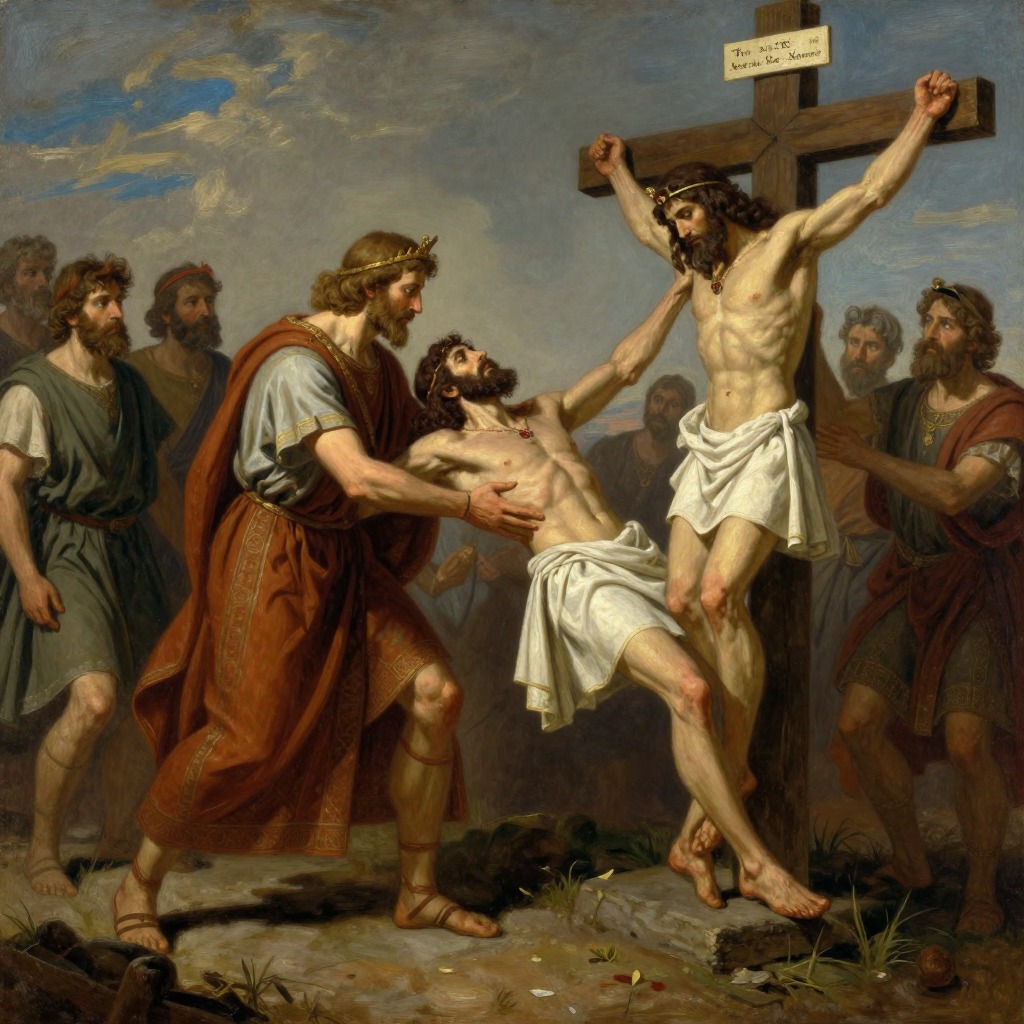
Gestas
Gestas is one of the three condemned criminals executed alongside Yeshua Ha-Nozri on Bald Mountain, a figure who appears only in the Yershalaim chapters of the novel and whose brief, agonizing presence serves as a stark counterpoint to the philosophical drama unfolding around him. Named by Pontius Pilate during the public sentencing at the hippodrome square, Gestas is identified as a robber and rebel, condemned for inciting rebellion against Caesar and for killing a guard during his arrest. His fate is sealed alongside that of Dysmas, Bar-Rabban, and Yeshua, though Bar-Rabban is ultimately released by the crowd at the insistence of the Sanhedrin.
Identity and Crime
Gestas is one of the four criminals whose names Pilate cries out to the crowd from the stone platform: Dysmas, Gestas, Bar-Rabban, and Ha-Nozri. Unlike Bar-Rabban, who is described as having directly called for rebellion and killed a guard, Gestas is grouped with the others as having been seized by local authorities and condemned by the Sanhedrin. Pilate, in his conversation with the high priest Joseph Kaifa, distinguishes between the two sets of criminals: Dysmas and Gestas, who ventured to incite the people to rebel against Caesar, were taken in armed struggle by the Roman authorities and accounted to the procurator, while Bar-Rabban and Ha-Nozri had been seized by the local authorities. This distinction places Gestas among those whose rebellion was serious enough to warrant Roman military intervention.
The Crucifixion
Gestas is crucified on the middle of the three posts on Bald Mountain. During the execution, he suffers more than the other two because he does not lose consciousness. He swings his head constantly and rhythmically, right and left, so that his ears strike his shoulders. When the executioner offers Yeshua a drink from a sponge on a spear, Dysmas cries out in protest, calling it an injustice, and Gestas falls silent only when the centurion Mark Ratslayer commands silence on the second post. As the storm approaches and the executioner moves to dispatch the condemned, Gestas, deprived of reason, cries out fearfully as the executioner comes near him, but when the sponge touches his lips, he growls something and seizes it with his teeth. A few seconds later, his body slumps as much as the ropes will allow. The man in the hood, accompanied by the head of the temple guard, examines each body in turn, confirming Gestas's death.
Aftermath
After the execution, Matthew Levi, the former tax collector and disciple of Yeshua, cuts down the bodies. He frees Yeshua's body first, then runs to the other posts, cuts the ropes on them as well, and the two bodies collapse on the ground. Only the three empty posts remain on the hilltop as the storm rages. Gestas's body is left behind when Levi carries Yeshua's body away, a final abandonment that underscores the anonymity and disposability of the condemned.
Narrative Significance
Gestas functions as a narrative marker of the brutality and indiscriminateness of Roman justice. His presence alongside Yeshua and Dysmas creates a triad of suffering that the novel uses to contrast Yeshua's philosophical composure with the animalistic desperation of ordinary criminals. Gestas's loss of reason and his final, wordless cry for water humanize him briefly, but the novel grants him no interiority, no backstory, and no redemption. He is a body to be punished, a name to be announced, and a corpse to be abandoned — a figure whose only significance is that he was there, that he suffered, and that he died.